 Society

Market expected to recover this week: experts
1.
 |
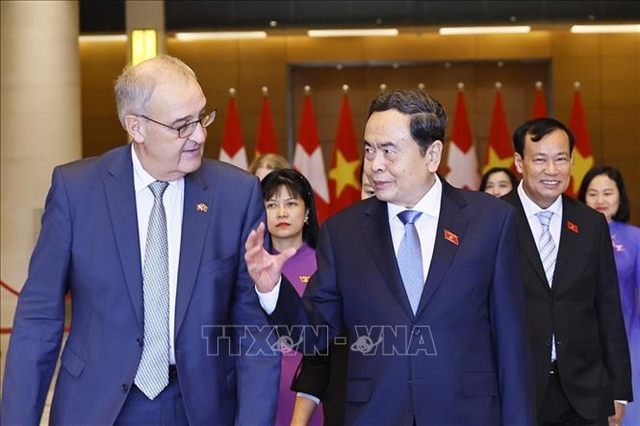
| Delegates at the conference. — VNS Photo Tố Như |
HÀ NỘI — The Government is preparing to revise a decree designed to encourage cooperative production and value-chain links in agriculture, with the aim of creating a modern, digital and low-emissions farming sector.
Over the past six years, Decree 98 has helped establish large agricultural chains, improve market transparency and strengthen the role of cooperatives as intermediaries between farmers and enterprises.
According to the Ministry of Agriculture and Environment, the decree has supported nearly 3,000 projects nationwide. Cooperatives have led over 2,300 of these projects, acting as reliable intermediaries between enterprises and farmers.
Farmers participating in organised chains report incomes 10–20 per cent higher than those working independently, while businesses benefit from a stable supply and improved brand reputation.
The policy has also facilitated exports to Japan, the EU and the US.
"Agricultural links are not just a method of production, but help build a culture of trust, cooperation and resilience among farmers, cooperatives and enterprises," Deputy Minister of Agriculture and Environment Võ Văn Hưng said yesterday at a conference reviewing six years of implementing the decree.
"Revising Decree 98 would modernise agricultural links, integrate digital management and ensure sustainability, in line with Việt Nam’s socio-economic development and international integration.”
The deputy minister said the revised decree will simplify procedures, create transparent support mechanisms and prioritise tangible value in agricultural chains.
Hưng noted that developing digital and green value chains is key, integrating electronic governance, traceability and carbon reduction, while organising production around standardised raw material zones with coded planting areas, transparent public services and digital training to ensure consistency and quality.
He also called for a full advisory ecosystem, where technical guidance, contract management and market support foster genuine cooperation beyond administrative assistance.
According to the ministry, total investment in approved projects has exceeded VNĐ15.2 trillion (US$578 million), including VNĐ3.2 trillion from the State. The remaining funds come from enterprises, cooperatives and farmers.
While infrastructure and governance support have enabled cooperatives to invest in storage, drying and traceability systems, the sustainability of links remains limited.
Many projects rely on short-term contracts, with minimal long-term investment in technology, quality or management, according to Lê Đức Thịnh, Director of the Department of Cooperative Economics and Rural Development.
“When markets fluctuate, these links can easily break down,” Thịnh said.
Deputy Director of the Institute of Strategy and Policy for Agriculture and Environment Hoàng Vũ Quang said that new policies should help enterprises and cooperatives develop large, integrated raw material zones.
“The State must support land access, land-use conversion and infrastructure for processing and storage. Large-scale organisation boosts productivity, quality and traceability,” he said.
The revised Decree 98 will use an Output-Based Aid model, reimbursing part of investment costs only when value chains achieve results, such as 70 per cent guaranteed output, traceability, technical compliance and reduced emissions, ensuring effective links and transparent use of public funds.
A national digital platform will consolidate contracts, raw material zones, planting codes, traceability, emissions and value chain efficiency, allowing farmers, cooperatives, enterprises and authorities to verify data and support international trade and carbon credit markets, he said.
The revision also expands links beyond supply, production and consumption to cover digital traceability, technical standards, straw management and emissions measurement.
Sustainable, low-emissions or export-oriented chains will receive greater incentives, while financial tools like value-chain loans, credit guarantees and PPP mechanisms will support infrastructure investment. — VNS
Society
 Society
 Society
 Society
 Society
 Society
 Society
 Society
 Society
 Society
 Society
 Society
 Society
 Society
 Society