 Society
Green transformation boosts sustainable growth
1.
|
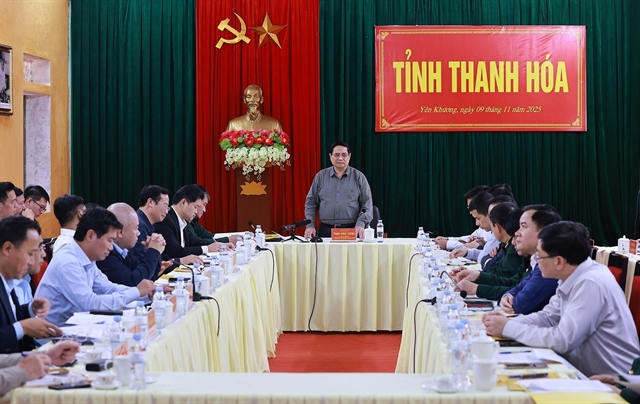
| Prime Minister Phạm Minh Chính the Standing Committee of Thanh Hóa Provincial Party Committee on local socio-economic development on Sunday. — VNA/VNS Photo Dương Giang |
THANH HÓA — Prime Minister Phạm Minh Chính has directed the central province of Thanh Hóa to optimise the potential of its four promising growth pillars – Lam Sơn, Sầm Sơn, Nghi Sơn and Bỉm Sơn, highlighting Lam Sơn’s potential for airport-linked urban development.
Speaking at a working session with local leaders on Sunday, the PM emphasised that Thanh Hóa possesses substantial potential, unique advantages, outstanding opportunities and, especially, strong human capital which is both a driver and a resource for development.
With favourable natural conditions and strategic transport connectivity, the province should capitalise on its geo-strategic position and fully tap into the potential of its forests, sea, rivers and mountains for economic development, he noted.
The PM hailed province’s socio-economic achievements and the effective rollout of the two-tier local administration model.
In the first nine months of 2025, Thanh Hóa recorded an economic growth rate of 8.19 per cent, ranking among the localities with the highest GRDP (gross regional domestic product) expansion nationwide.
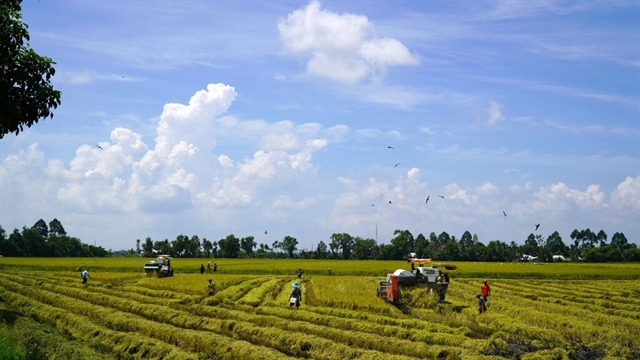
The province’s economic structure continued to shift positively, with notable increases in industry and services. Industrial output rose 15.55 per cent over the past ten months, while agricultural production remains stable, generating VNĐ127 million (over US$4,800) per hectare annually, up VNĐ2 million from 2024. Retail sales and consumer service revenue increased by 15.1 per cent, exports by 18.3 per cent, and tourism earnings by 33.7 per cent, all above national averages.
Its state budget revenue ranked among the country’s top ten. Public investment disbursement reached 66.7 per cent of this year's plan, higher than the national rate of 54.4 per cent. The province also saw a 27.5 per cent rise in direct investment and a 12.9 per cent increase in newly established enterprises.
Thanh Hóa has been promoting science, technology, digital transformation and AI application, while effectively implementing social policies, poverty reduction, and disaster recovery.
The implementation of the two-tier local administration model has been conducted in line with regulations and directions from central authorities, with high consensus and unity in both awareness and action. After four months of operation, administrations at the commune level have maintained smooth and uninterrupted operations with a 91.67 per cent rate of administrative requests processed, local officials reported.
However, PM Chính pointed out existing challenges, including the need to ensure more sustainable economic growth, streamline administrative reform, improve the investment environment, and enhance human resources quality.
The Government leader urged Thanh Hóa to uphold the spirit of self-reliance, unity and solidarity, while preserving and promoting its rich cultural heritage and proud revolutionary traditions as a source of internal strength.
He called for renewed thinking and visionary leadership, stressing that the local leadership must remain clean, innovative and proactive in science – technology development and digital transformation, with continued support from corporations such as Viettel and VNPT.
He requested the locality to improve transport, telecommunications and education connectivity, and to create favourable conditions for enterprises to grow.
Thanh Hóa, he said, must push ahead with administrative reforms, eliminate unnecessary procedures, and strengthen decentralisation and delegation of authority in tandem with resource allocation. Particularly, it must empower commune-level administrations to better serve the people. The two-tier local administration system should operate more efficiently through clearer functions, defined job positions, and sound personnel policies.
Given its vast area and large population, the province must also focus on improving living standards for residents in remote, border, and insular areas.
In addition, the PM directed Thanh Hóa to accelerate the construction of inter-level boarding schools in border communes, with armed forces and public engagement mobilised to assist with construction.
Responding to the province's proposals, the PM requested the Ministry of Construction to hand over the dredging project of Nghi Sơn Port to Thanh Hóa. He assigned Petrovietnam to coordinate with the province and foreign partners in the second phase of the Nghi Sơn Refinery and the development of petroleum storage facilities. — VNA/VNS
Society
Society
 Society
 Society
 Society
 Society
 Society
 Society
 Society
 Society
 Society
 Society
 Society
 Society
 Society