 Society

Capital market development critical to unlock investment resources
1.
.jpg) |
| Children of Vietnamese origin in Fukuoka, Japan are learning the mother tongue. Photo Hùng Nguyễn, Vietnamese Association in Fukuoka |
Nguyễn Khánh Chi
Driven by a deep love for their mother tongue, national pride and a yearning to connect with their roots, Vietnamese expatriates have committed themselves to ensuring that every generation of Vietnamese abroad feels close to the homeland’s culture and origins through the spread of the Vietnamese language.
Trần Hồng Vân, PhD, principal of Vietnamese Community Language School (VietSchool) in Australia, recognised the imperative of preserving Vietnamese among her three Australian-born children, even as she deeply understood their need to master English for full integration into their host country.
“No matter where we go, we must always remember our roots as Vietnamese. Teaching our children Vietnamese is a way to help them understand their origins, preserve Vietnamese cultural identity, and feel more connected to Việt Nam,” Vân said, who is teaching translation and interpreting at the Western Sydney University.
In Australia alone, home to over 320,000 Vietnamese residents, studies indicate that only about 69 per cent of Vietnamese-origin children can speak Vietnamese, and fewer than 14 per cent possess a strong vocabulary comparable to children in Việt Nam. Meanwhile, only 36 per cent of families actively create a "Vietnamese language space" at home. These figures highlight the significant challenges in maintaining the ancestral language and culture.
After completing her second doctoral thesis -- examining the maintenance of the mother tongue for Vietnamese-origin children abroad in general, and in Australia specifically at Charles Sturt University -- she realised that her research knowledge would merely gather dust on bookshelves if she didn't transform it into something more practical.
Consequently, she approached SBS, a broadcaster that airs programmes in 54 ethnic languages, and began hosting the Cùng Giữ Tiếng Việt (Let's Preserve Vietnamese) programme for 20-30 minutes each week since 2021.
The programme's objective is to raise general awareness about preserving Vietnamese abroad, and to spread positive examples demonstrating that maintaining Vietnamese overseas is crucial and achievable for anyone with persistence and perseverance. This, she emphasises, requires the collective effort of families, individuals, schools and the community.
“If parents don't start teaching and speaking Vietnamese to their children early on and don't prioritise it, maintaining the language becomes very difficult,” she said.
Following the Cùng Giữ Tiếng Việt programme, Vân and her associates opened VietSchool, offering in-person Vietnamese language classes for children from kindergarten to Grade 12, along with online classes to support Vietnamese language learning for children not only in Australia but also across North America and Europe.
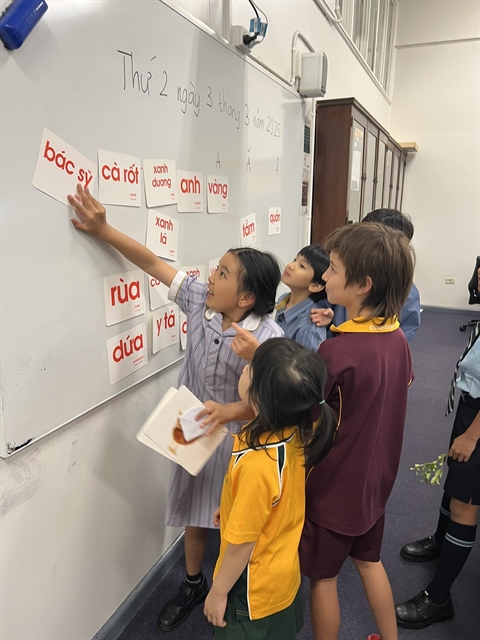 |
| Children of a Vietnamese community in Australia are learning at VietSchool. Photo Facebook of Tran Hong Van |
Joint efforts
Nguyễn Văn Hào moved to Cambodia with his family when he was young, so he was well aware of the difficulties facing children of Vietnamese community there in terms of gaining access to proper education.
Hào’s family sent him back to Việt Nam for secondary and high school and later he was fortunate to receive a scholarship supported by the Vietnamese Embassy in Cambodia to continue his university education in Việt Nam. He graduated in 2012 with a degree in mathematics and computer science from Ho Chi Minh City University of Education.
Feeling more fortunate than many others, Hào volunteered to return to Cambodia to teach Vietnamese to primary-level children. He is currently the principal of the Vietnam-Khmer Friendship Primary School and eight other smaller satellite schools.
The school was inaugurated in 2012 in Prey Veng Province with up to 80 per cent of the construction costs being supported by Việt Nam’s Đồng Tháp Province.
The school offers bilingual education in Vietnamese and Khmer, free and open to all, including Cambodians, and also provides backpacks and uniforms.
 |
| Pupils at Vietnam-Khmer Friendship Primary School express their joy at receiving new textbooks and notebooks. Photo courtesy of Nguyễn Văn Hào |
According to Hào, in addition to learning the host country's language for integration, it's essential to learn and speak Vietnamese.
"I am the only one with a teaching degree; the other teachers are not specialised, so they face many difficulties and lack materials and suitable methods,” said Hào.
However, due to their love for the profession, the teachers strive to stay. Because teaching Vietnamese is completely free, in addition to monthly support funds, they have to work various odd jobs to supplement their income. For instance, Hào still installs Windows and CCTV cameras for hire after hours.
"If I hadn't done those extra jobs, I wouldn't have been able to keep the school going for the past 13 years," he said.
Besides providing literacy to Vietnamese expats in Cambodia for community integration, Hào and the teachers at the school emphasise reinforcing and promoting Vietnamese cultural aspects, customs, and traditional holidays.
"Thanks to little pedagogical knowledge, I don't face difficulties in persuading Vietnamese families to send their children to school, as knowing an additional language is also beneficial for their business endeavours."
Hào was honoured among nearly 80 non-professional teachers and volunteers attending a training course this year organised by the State Committee for Overseas Vietnamese in conjunction with the University of Social Sciences and Humanities, Vietnam National University-Hanoi.
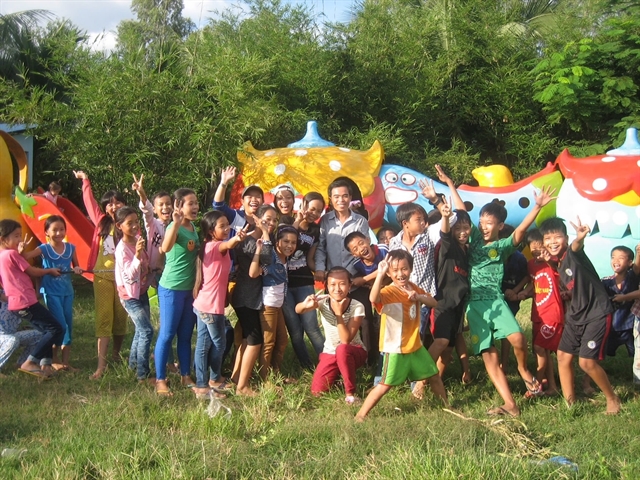 |
| Nguyễn Văn Hào and his students at the Khmer-Vietnam Friendship Primary School celebrate after a tug of war - a popular folk game. Besides Vietnamese lessons, Hào and other teachers often organise activities to help children learn about their traditions and culture. Photo courtesy of Nguyễn Văn Hào |
Like Hào, Đào Duy Anh, who has been living and working in Japan for 20 years, found the training course very helpful.
“Through annual training courses like this and global networks, we aim to achieve a more professional standard so that parents feel secure because their children are taught in a pedagogical environment. Though I'm not sure if it's truly professional yet, it's better than in the past. The desire is to ignite and maintain the passion,” said Anh.
He said that he conceived the idea of opening Vietnamese language classes for Vietnamese children in Japan in 2019.
A key advantage of this initiative is its alignment with the Việt Nam Communist Party and State's policy of preserving the Vietnamese language and disseminating Vietnamese culture within overseas Vietnamese communities.
“Many young Vietnamese parents in Japan -- even though they aren't proficient in Japanese -- are delighted when their children excel in Japanese, proudly declaring their child is fluent in Japanese," said Anh, who is currently the Principal of the GAG Japanese Language Institute in Fukuoka.
“However, when asked if their child knows Vietnamese, they often say no. I jokingly remarked that it's normal for children born and raised in Japan to be good at Japanese, but the most important thing is for them to know that they need to speak/use another language, which is Vietnamese," said Anh.
According to Anh, one of the difficulties in this work lies in textbooks, instructors, and maintaining classes.
“Honestly, it's very simple to establish a class, but hard to maintain, develop and ensure that parents trust sending their children to class so their children will become proficient in Vietnamese,” he said.
The 2025 training course for teaching Vietnamese to overseas Vietnamese teachers concluded with nearly 20 sessions, covering a wide range of practical topics such as modern Vietnamese teaching methods, digital technology applications, classroom organisation, and literary appreciation.
In addition, the programme included seminars, teaching practicums, and visits to historical sites, museums, and scenic spots in Hà Nội and neighbouring localities.
These aim to facilitate participants to gain rich experiences that would help nurture their emotional connection to their homeland and strengthen their motivation to continue promoting the Vietnamese language within Vietnamese communities around the world.
Speaking at the closing ceremony of the training course in late August, Professor Hoàng Anh Tuấn, principal of the University of Social Sciences and Humanities, said beyond organising training courses, the university had developed and compiled a set of teaching materials for various levels, expected to be officially published in the near future.
“These materials not only focus on language instruction but also integrate cultural and historical content, providing teachers with high-quality resources to share with their students,” said Tuấn.
Cultural identity
“As they grow up, having such roots helps them feel less lost. Especially when living in a country like Australia, which is culturally diverse, it gives them more confidence and a clearer sense of who they are in this world. Beyond learning another language, studying Vietnamese brings many benefits in terms of thinking skills, job opportunities and family connections,” said Vân.
“When we preserve the Vietnamese language, we also preserve our culture. It contributes to cultural diversity in the host country while maintaining our traditions and helping friends around the world learn about Việt Nam, Vietnamese culture, and become more interested in Việt Nam in many other aspects,” she added.
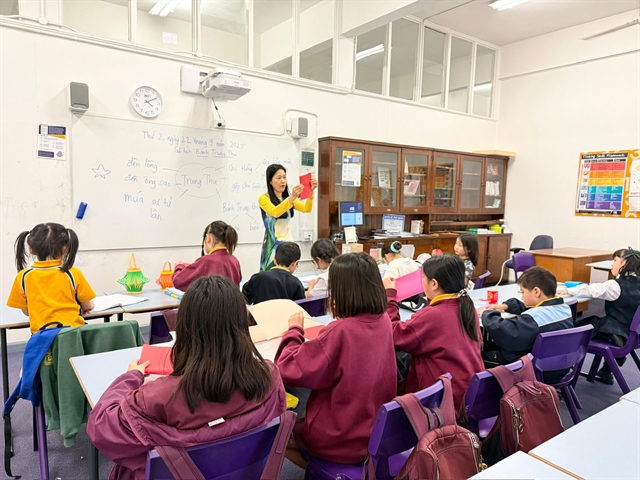 |
| Trần Hồng Vân, PhD, principal of VietSchool in Australia, guides children in crafting paper lanterns -- a beloved tradition of Việt Nam’s Mid-Autumn Festival. Photo Facebook of Tran Hong Van |
Recently, with support from the ASIF Foundation -- a charity organisation operating in both Australia and Việt Nam -- the Association of Vietnamese Intellectuals and Experts in Australia partnered with VietSchool to introduce VietNEST, an AI-based Vietnamese language learning programme.
Scheduled to serve the community from November, VietNEST serves as a nurturing space for language, knowledge and Vietnamese cultural identity for the younger generation, especially Vietnamese children in Australia and Vietnamese communities around the world.
In 2022, September 8 was designated annually as the Day of Honouring the Vietnamese Language in the Vietnamese Community Abroad. This initiative includes practical activities to honour the richness and beauty of the Vietnamese language, especially for the younger generation.
Discussing this year's celebration, Deputy Minister of Foreign Affairs Lê Thị Thu Hằng said: “Through practical activities we can further encourage and spread the community's interest and the participation of overseas Vietnamese, ensuring that we can not only preserve and conserve but also honour the Vietnamese language as a precious heritage of the nation.”
Nguyễn Trung Kiên, chairman of the State Committee for Overseas Vietnamese, described the language as a stream that flows through every Vietnamese soul.
"It begins with the lullabies sung by our grandparents and parents, with familiar proverbs and folk verses that gently seep into our hearts through poetry, music, and history lessons," Kiên said.
"It nurtures our love for the homeland and carries that spirit across borders, connecting Vietnamese communities around the world.” VNS
Society
 Society
 Society
 Society
 Society
 Society
 Society
 Society
 Society
 Society
 Society
 Society
 Society
 Society
 Society