 Politics & Law

LANDMARK Launches ‘Destination CENTRAL’: A District-Wide Invitation to Explore the Dynamism, Luxury, and Soul of Central
1.
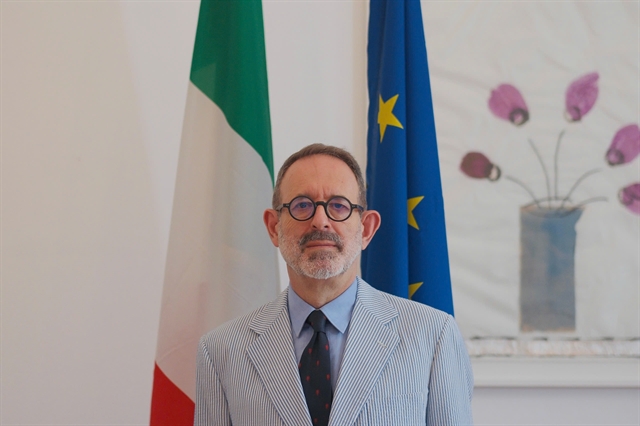 |
| Italian Ambassador to Việt Nam, Marco della Seta. Photo courtesy of the Italian embassy in Hà Nội |
On the occasion of the 80th anniversary of the Italian Republic on June 2, Italian Ambassador to Việt Nam Marco della Seta has written an article highlighting that bilateral ties between Italy and Việt Nam, elevated to a Strategic Partnership in 2013, extend far beyond trade.
June 2, 2026, marks the 80th anniversary of the Italian Republic, an occasion that invites an intriguing historical parallel with Việt Nam, which recently celebrated the 80th anniversary of its independence proclaimed on September 2, 1945.
Italy’s Republic emerged from the institutional referendum of 1946, when Italians voted to replace the monarchy with a republican system after the devastation of the Second World War. The vote carried further historic significance: for the first time, Italian women were granted the right to vote, becoming protagonists in rebuilding the country and shaping its democratic institutions.
In Việt Nam, meanwhile, the August Revolution of 1945 and President Hồ Chí Minh’s proclamation of independence in Ba Đình Square marked the birth of a new state after decades of colonial rule. While post-war Italy rebuilt its institutions through democratic participation and constitutional change, Việt Nam embarked on its own path towards sovereignty and national unity.
In both countries, the mid-1940s therefore represented a decisive turning point, the beginning of a new political era shaped by aspirations for self-determination and renewal.
Eight decades later, both nations once again find themselves reflecting on institutional evolution. Today, Italy has its first woman prime minister, a symbolic milestone in the long trajectory of political inclusion initiated in 1946.
Việt Nam, for its part, is entering a new era marked by the success of the 14th National Party Congress, the election of a new National Assembly and the appointment of renewed leadership and government. Italy and Việt Nam thus appear united by a shared moment of transition, looking to the future while building on the foundations of their modern statehood.
A meeting of values
Beyond the historical parallels in their respective national trajectories, Italy and Việt Nam have gradually discovered a growing convergence of strategic outlooks and, ultimately, values.
At the most fundamental level, both countries attach particular importance to the concept of independence, shaped by historical experiences that have fostered resilience and respect for the rule of law.
This alignment extends to a shared commitment to a rules-based international order anchored in international law and multilateralism. Such an outlook is embodied in their support for the United Nations system and the principles enshrined in the UN Charter, notably respect for sovereignty, independence and territorial integrity, as well as the settlement of disputes by peaceful means.
In the maritime domain, this shared orientation is evident in their adherence to the 1982 United Nations Convention on the Law of the Sea (UNCLOS), regarded by both countries as an essential legal reference.
At a time of growing geopolitical fragmentation, Rome and Hà Nội alike continue to view stable legal norms and international cooperation as necessary foundations for global governance and security.
The economic sphere offers a further illustration of this common vision. Italy and Việt Nam both support an open yet regulated approach to international trade. A notable example is the EU–Vietnam Free Trade Agreement (EVFTA), which, since 2020, has strengthened trade and investment ties while embedding bilateral cooperation within a broader multilateral legal framework.
From trade flows to flows of ideas
Relations between Italy and Việt Nam, formally established in 1973, have steadily deepened over the past five decades. Elevated to a Strategic Partnership in 2013, bilateral ties today extend far beyond trade.
In April, Vietnamese National Assembly Chairman Trần Thanh Mẫn chose Italy, where he also met Italian President Sergio Mattarella, for his first official visit abroad following his reconfirmation as head of the Vietnamese parliament. The visit highlighted growing cooperation in science and technology, innovation and artificial intelligence, alongside broader exchanges in culture, education and tourism.
At the same time, economic relations remain a central pillar of the partnership. Italian investments in Việt Nam now exceed €1 billion, with companies such as Piaggio, Fincantieri and Ariston expanding regional headquarters, production and research activities in the country.
Bilateral trade surpassed US$7 billion in 2025, confirming Italy as Việt Nam’s third-largest European export market and marking a 6.2 per cent increase compared with 2024. Vietnamese exports were led by coffee, worth around $700 million, a reminder of how Vietnamese beans contribute to the global success of Italy’s espresso culture.
Further momentum came with the Vietnam–Italy Business Forum held in Hà Nội in September last year during the visit of Italian Deputy Minister for Enterprises and Made in Italy Valentino Valentini.
Valentini also co-chaired a roundtable dedicated to the Just Energy Transition Partnership (JETP) and the opportunities emerging from Việt Nam’s energy transition market. Discussions included flagship infrastructure projects such as the Bắc Ái pumped-storage hydropower plant, designed to support the integration of renewable energy into the national grid.
Yet bilateral ties are no longer confined to economics alone. Science, technology, culture and education are becoming increasingly prominent dimensions of the relationship. Nine months ago, VAST’s National Space Centre chose to partner with leading Italian companies in the space sector, opening new avenues for cooperation between Italy and Việt Nam in research, science and technology.
In parallel, this year Việt Nam makes its debut at the Venice Biennale with a national pavilion, bringing a distinctly Vietnamese voice to one of Italy’s foremost cultural stages. Italian universities are also becoming an increasingly attractive destination for Vietnamese students, among them the next generation of professionals and public leaders, following the example of members of the current Vietnamese government who studied in Italy. A sign that the relationship is shaped not only by trade flows but also by flows of ideas.
Towards shared futures
After 53 years of diplomatic relations, the Italy–Việt Nam partnership can now be regarded as mature and increasingly multidimensional, spanning trade and investment, science and technology, culture and education.
Yet rather than reaching a plateau, the relationship appears to be entering a new phase. As geopolitical fragmentation, technological disruption and the green transition reshape the international landscape, both Rome and Hà Nội are positioning themselves for a further qualitative leap, defined not simply by bilateral cooperation but by their willingness to face global challenges together.
Politics & Law
 Politics & Law
 Politics & Law
 Politics & Law
 Politics & Law
 Politics & Law
 Politics & Law
 Politics & Law
 Politics & Law
 Politics & Law
 Politics & Law
 Politics & Law
 Politics & Law
 Politics & Law
 Politics & Law