 Politics & Law

Hà Nội adorned in red ahead of Liberation Day
1.
|
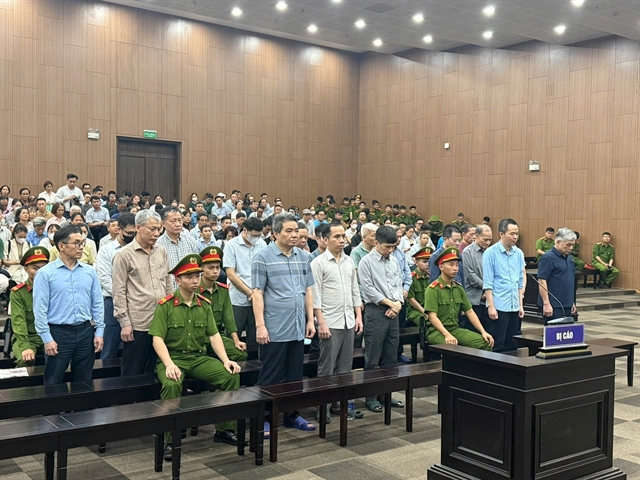
| Defendants at the hearing. — VNA/VNS Photo |
HÀ NỘI — The People’s Court of Hà Nội on Tuesday meted out sentences to former Deputy Minister of Agriculture and Rural Development Hoàng Văn Thắng and 22 other defendants involved in bribery and violations of bidding and accounting regulations that caused serious consequences.
The court sentenced former Deputy Minister of Agriculture and Rural Development Thắng to four years in prison for "receiving bribes" under Article 354 of the Penal Code.
Four other defendants from the Ministry of Agriculture and Rural Development (MARD, now the Ministry of Agriculture and Environment) also faced imprisonment penalties.
Among them, Trần Văn Lăng (former Director of Board No. 2) was sentenced to 13 years in prison, Trần Tố Nghị (former Acting Director of the Construction Project Management Department) six years, Nguyễn Hải Thanh (former Deputy Director of the Construction Project Management Department, also Director of Board No. 4 – a fugitive defendant, tried in absentia) five years, and Lê Văn Hiến (former Director of Board No. 8) three years and six months, all for the offence of "receiving bribes".
Nguyễn Văn Dân (Director of the Hoàng Dân Company) was imprisoned for two years for "giving bribes" under Article 364 of the Penal Code, nine years for "violating bidding regulations that caused serious consequences" under Article 222, and three years for "violating accounting regulations that caused serious consequences" under Article 221. The combined sentence for all three offences is 14 years behind bars.
The remaining defendants were sentenced to terms ranging from suspended 30 months’ imprisonment to seven years in prison for "violating bidding regulations that caused serious consequences" and "violating accounting regulations that caused serious consequences".
According to the first-instance trial’s verdict, the case involves multiple large-scale irrigation projects invested by the MARD’s Boards No. 1, 2, 4 and 8. They consist of Packages No. 13 and 17 of the Krong Pạch Thượng Reservoir project in Đắk Lắk province, Package No. 36 of the Ban Mong Reservoir project in Nghệ An Province, Package No. 21 of the Bản Lải Reservoir project in Lạng Sơn Province, and Package No. 17 of the Cánh Tạng Reservoir project in Hòa Bình Province.
During the bidding, winning and implementation of the above-mentioned projects, Nguyễn Văn Dân, director of the Hoàng Dân Company, exploited relationships with several MARD officials, including Thắng and Nghị, to seek introduction and influence over leaders of project management and construction boards. He agreed to pay bribes in exchange for favourable conditions that helped his company and its associated contractors win five bidding packages across the four projects, causing losses of over US$250 billion (nearly US$9.5 million at the current exchange rate) to the State.
In addition, during the construction process and business operations, Dân also instructed Bùi Cao Nguyên, in charge of finance, and Vũ Thị Kim Liên, Chief Accountant, to establish seven subsidiary companies and to create and operate two parallel accounting systems, causing losses of over VNĐ99 billion to the State.
The verdict stated that the defendants' actions posed a danger to society, infringing upon the fairness and order of state management in bidding and accounting, affecting transparency and accuracy in the operation of these fields, and causing serious damage to state assets. Their actions diminished the credibility of the state apparatus and triggered public anxiety.
Regarding those accepting bribes, the court held that the defendants violated the proper functioning of state agencies, breached regulations on the integrity of officials, and eroded public trust in the Party and the State. Therefore, a punishment commensurate with the nature and severity of the crime is necessary.
The jury considered the severity of the crimes and took into account aggravating and mitigating circumstances of each defendant to differentiate the offences and determine appropriate penalties. — VNA/VNS
Politics & Law
 Politics & Law
 Politics & Law
 Politics & Law
 Politics & Law
 Politics & Law
 Politics & Law
 Politics & Law
 Politics & Law
 Politics & Law
 Politics & Law
 Politics & Law
 Politics & Law
 Politics & Law
 Politics & Law