 Politics & Law

Vietnamese scientist wins ASEAN-US Science Prize for Women
1.
 |
| Polling area on the day of the General Election on January 6, 1946. — VNA/VNS File Photo |
HÀ NỘI — On January 6, 1946, for the first time, Vietnamese people directly cast their votes to elect their own National Assembly (NA).
The ballots from that first general election not only elected the first NA but also established the legitimate foundation for the new Vietnamese State, with the NA playing a central role in institutionalising the will and aspirations of the people and transforming them into sustainable development values for the nation and the well-being and prosperity of its people.
After the August Revolution of 1945, the young Democratic Republic of Việt Nam faced myriad difficulties and challenges: a devastated economy, famine and illiteracy; hostile forces mounting opposition and the risk of reinvasion.
In that context, an existential imperative arose: to swiftly establish a constitutional and legitimate representative institution to rally the people's support, consolidate revolutionary authority and serve as legal proof of identity for the nation and the world.
On September 8, 1945, Decree No. 14-SL, signed and promulgated by President Hồ Chí Minh, clearly stated: "Pursuant to the Resolution of the National People's Congress on August 16-17, 1945 in the liberated zone, which stipulated that Việt Nam will follow the democratic republic system and a People's Government of the whole nation will be elected by a National People's Congress through universal suffrage."
To advance preparations for the general election, President Hồ Chí Minh issued a series of decrees stipulating that the election would be conducted by universal, direct and secret ballot as well as creating more favourable conditions for candidates.
One day before the general election, on January 5, 1946, President Hồ Chí Minh issued a call to the nation to go to the polls, emphasising: "Tomorrow, January 6, 1946. Tomorrow is a day that will lead our nation onto a new path. Tomorrow is a joyful day for our compatriots, for tomorrow is Election Day, the first day in Vietnamese history when our people begin to exercise their democratic rights... Tomorrow, all voters must remember to go to the polls. Tomorrow, everyone should happily enjoy the rights of an independent and free citizen."
In response to President Hồ Chí Minh's call, on January 6, 1946, the people eagerly went to the polls to elect their NA, achieving a turnout of 89 per cent. In Hà Nội alone, it reached 91.95 per cent of voters.
As a result, 333 outstanding delegates were elected to the First NA, representing all classes, strata, ethnic groups and religions across the country.
The NA elected through the 1946 general election thus became the highest representative institution of the people, the direct outcome of the people exercising their mastery for the first time through universal, equal and direct suffrage.
Historical practice shows that the widespread, voluntary and responsible participation of voters nationwide in that first election reflected the people's strong sense of mastery and fervent aspiration for self-determination after centuries of lost independence.
Embodiment of people's will
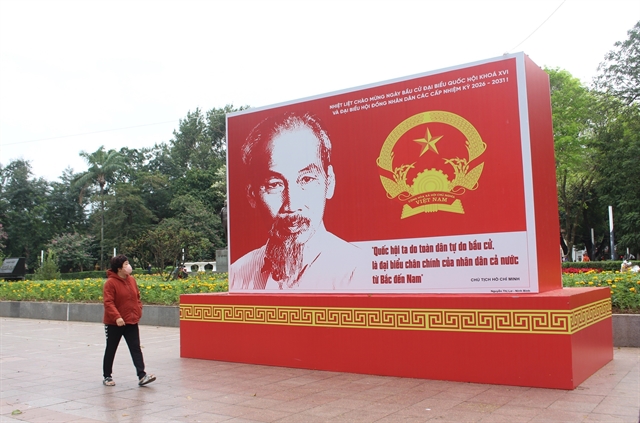 |
| Large-scale panneau clusters are urgently installed towards the General Election on March 15, 2026. — VNA/VNS Photo Nguyễn Thắng |
Eighty years on, the legacy of January 6, 1946, endures not merely as a historic milestone but as the foundation of a model of state power shaped and sustained through the first general election, with the NA at its centre in institutionalising the will and aspirations of the people.
State power does not operate solely through administrative command but through delegation, oversight and accountability.
That spirit has become a guiding thread in the building of the Vietnamese State from its founding days to the present.
Over more than 80 years of formation and development — through immense hardship as well as great achievements — the Vietnamese NA has remained closely connected with the people, accompanying the nation through successive stages of revolution: from the struggle for independence and national reunification to renewal, international integration and development.
Each term of the NA marks a stage in the country’s history, with major policy decisions and foundational laws reflecting the will, aspirations and legitimate interests of the people.
The NA has been continuously strengthened and renewed in both organisation and operation, increasingly asserting its role as the constitutional and legislative body, deciding important national issues and exercising supreme oversight over all state activities.
In speeches on many important occasions, General Secretary Tô Lâm has affirmed that the development of the Vietnamese NA has been a journey of steadfastness, creativity and constant renewal.
The NA accompanies the nation, where major policies embodying the people's will and aspirations are democratically discussed, carefully adopted and resolutely implemented.
NA Chairman Trần Thanh Mẫn has also repeatedly affirmed that, as it accompanies the nation, the NA has continually renewed itself, reinforcing its position and role as the highest representative body of the people and the highest state power organ of the Socialist Republic of Việt Nam, leaving many important imprints and achievements of historical significance.
Contributing to those common accomplishments are the intellect, resolve, dedication and strong sense of responsibility of generations of NA deputies across different periods.
From the aspiration for independence and the sense of mastery to the aspiration for national strength, from the truth "Nothing is more precious than independence and freedom" to the goal of "a strong, prosperous, happy Việt Nam standing shoulder to shoulder with the great powers of the five continents," the nation continues on a long journey of aspiration.
Upholding the spirit of January 6, 1946, means continuing to nurture and safeguard the people’s mastery in new conditions, ensuring all policies and directions are aimed at the goal of a rich people, strong nation, democracy, equity and civilisation. — VNS
Politics & Law
 Politics & Law
 Politics & Law
 Politics & Law
 Politics & Law
 Politics & Law
 Politics & Law
 Politics & Law
 Politics & Law
 Politics & Law
 Politics & Law
 Politics & Law
 Politics & Law
 Politics & Law
 Politics & Law