 Politics & Law
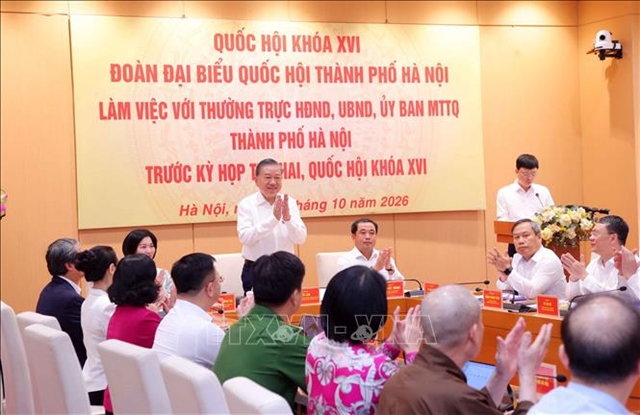
Hà Nội's National Assembly deputies urged to fulfill commitments to voters
1.
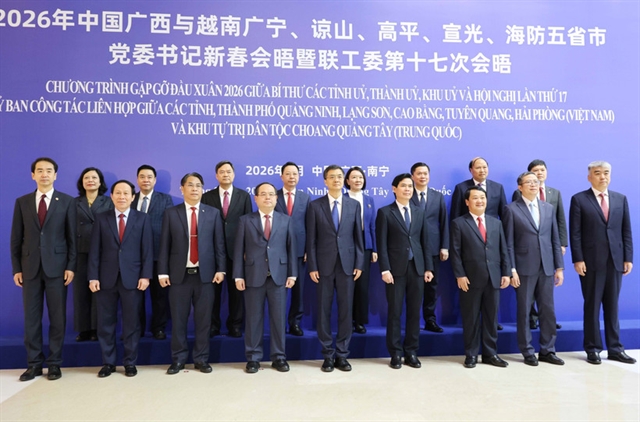 |
| Leaders of five provinces and cities of Vietnam and China’s Guangxi Zhuang Autonomous Region pose for a group photo. VNA Photo |
BEIJING – A meeting in early Spring between the Secretaries of the Party Committees of Việt Nam’s Quảng Ninh, Lạng Sơn, Cao Bằng, Tuyên Quang and Hải Phòng and the Secretary of the Party Committee of China’s Guangxi Zhuang Autonomous Region took place on February 11 in Nanning, Guangxi, China.
This mechanism has been implemented over the years, expanding in scale and improving in quality. It has become an important platform for promoting practical and comprehensive cooperation between Việt Nam’s northern localities and Guangxi.
Addressing the meeting, Secretary of the Party Committee of China’s Guangxi Zhuang Autonomous Region Chen Gang said that under the guidance of high-level leaders of the two Parties and countries, Việt Nam–China political trust and friendship have continued to strengthen. He affirmed Guangxi’s readiness to deepen exchanges with the five Vietnamese localities, share experience in Party building, lawmaking and development, and organise people-to-people exchanges to translate mutual trust into concrete cooperation projects in trade, infrastructure connectivity, people-to-people exchanges and border development.
Both sides agreed to boost economic, trade and investment cooperation, promote cross-border e-commerce, and facilitate Vietnamese exports, particularly aquatic products and fruits, via Guangxi into China and third markets. They also encouraged Chinese investment in Việt Nam in clean energy, AI, mechanical manufacturing and smart agriculture, while welcoming Vietnamese enterprises to expand activities in Guangxi, including in the marine economy.
The localities also agreed to promote collaboration in transport connectivity, smart border gates, border management, crime prevention, disaster response and AI applications in border areas.
Reviewing the overall cooperation outcomes, Secretary of the Quảng Ninh provincial Party Secretary Quản Minh Cường stressed that after 10 early Spring meetings and 16 sessions of the Joint Working Committee, this mechanism has delivered tangible results, helping translate the shared perceptions of the high-ranking leaders of the two countries into concrete action and further deepen the traditional Việt Nam–China friendship at the local level.
Leaders of the Vietnamese localities also proposed priorities for 2026 and beyond, including deeper people-to-people exchanges and stronger infrastructure connectivity.
Vietnamese Ambassador to China Phạm Thanh Bình affirmed that, based on the specific proposals put forward at the meeting, the Vietnamese Embassy in China stands ready to play an active bridging role in promoting and strengthening cooperation between the two sides, while closely coordinating with Việt Nam’s ministries, sectors and localities to accelerate the implementation of connectivity projects.
The leaders agreed that Hải Phòng City would host the 2027 meeting. On the same day, the 17th Joint Working Committee meeting among the six localities wrapped up on a successful note. VNS
Politics & Law
 Politics & Law
 Politics & Law
 Politics & Law
 Politics & Law
 Politics & Law
 Politics & Law
 Politics & Law
 Politics & Law
 Politics & Law
 Politics & Law
 Politics & Law
 Politics & Law
 Politics & Law
 Politics & Law