 Politics & Law
Việt Nam, Singapore promote cooperation through Party-to-Party channel
1.
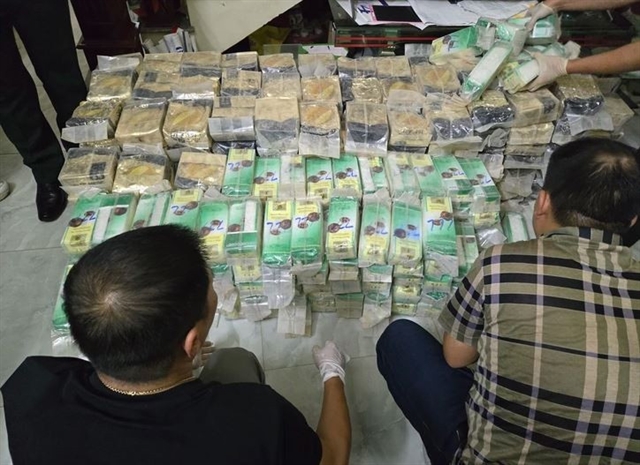 |
| Police seized 777kg of synthetic drugs as 13 suspects tried to smuggle them from the Golden Triangle into Việt Nam in late September. — Photo courtesy of Việt Nam's anti-drug police (C04) |
HÀ NỘI — National Assembly (NA) deputies highlighted the need to establish and operate an effective 24/7 hotline between Vietnamese authorities and neighbouring countries to exchange information and coordinate timely actions when detecting transnational drug-related cases.
Responding to the media regarding the dismantling of a drug trafficking ring transporting 1.2 tonnes of drugs from the Golden Triangle into Việt Nam, deputies stressed that this type of crime is highly internationalised and tightly organised, requiring strengthened prevention efforts and strict, resolute handling.
Assessing the complexity and sophistication of this type of crime, Phú Thọ Province’s Deputy Thái Quỳnh Mai Dung stated that these trafficking networks are often directed by masterminds and ringleaders who live in the Golden Triangle area, and connect with domestic individuals to form criminal organisations with clear division of roles and hierarchy, and independent, closed operations.
The criminals use highly sophisticated methods to conceal drugs, mixing them into civilian cargo shipments and exploiting favourable customs procedures and e-commerce policies for transportation. Their transport routes are also flexible, frequently shifting across multiple pathways. The offenders make full use of technology, like using highly secure communication applications and fake identities, to direct activities and communicate in order to avoid monitoring and detection by law enforcement forces, Dung said.
Notably, the individuals involved in these trafficking networks are often extremely aggressive and ready to resist law enforcement forces when detected. Many of the ringleaders are fugitives who are wanted criminals hiding abroad, she added.
Echoing this view, Deputy Phạm Văn Hòa from Đồng Tháp stated that the illegal drug trade is becoming increasingly sophisticated and cunning; the quantity and scale have not decreased but instead are rising to more alarming levels.
Hòa assessed that at present, almost all provinces and cities across the country have drug addicts. The activities of processing, trading, and transporting drugs across borders, especially in the northern border areas and along the border with Cambodia, are extremely dangerous.
Therefore, he emphasised that prevention, interdiction, arrest efforts, as well as the responsibilities of customs and border guard units in border areas, are critically important.
Emphasising that drugs are a borderless threat and that transnational drug crimes are constantly evolving, Dung stated that preventing transnational drug-related crimes faces numerous challenges due to limitations and shortcomings in border and checkpoint management, as well as in coordination mechanisms among law enforcement forces.
Therefore, she proposed that comprehensive solutions are needed, ranging from increased investment in equipment, administrative procedure reform, and improvement of legal frameworks, to enhancing the capacity and responsibility of law enforcement forces, while also promoting more substantive and effective international cooperation.
Specifically, it is necessary to perfect the Law on Drug Prevention and Control No.73/2021/QH14, and review and supplement mutual legal assistance treaties on criminal matters and extradition with other countries, especially those in the Golden Triangle region and nations linked to major drug-trafficking networks. This will help expedite the process of arresting and transferring offenders who are hiding abroad.
In addition, a legal framework should be established for the use of advanced technologies in investigations, she stressed, highlighting the importance of promoting the application of information technology and artificial intelligence (AI) in data analysis, and improving the national database system.
The deputies also proposed maximising the support of international organisations such as the United Nations Office on Drugs and Crime (UNODC), Interpol, and ASEANAPOL in providing training, professional development, and equipment for Việt Nam’s drug prevention and control forces. — VNA
Politics & Law
 Politics & Law
 Politics & Law
 Politics & Law
 Politics & Law
 Politics & Law
 Politics & Law
 Politics & Law
 Politics & Law
 Politics & Law
 Politics & Law
 Politics & Law
 Politics & Law
 Politics & Law
 Politics & Law