 Politics & Law
Polish PM’s Việt Nam visit to strengthen bilateral ties: Ambassador
1.
.jpg) |
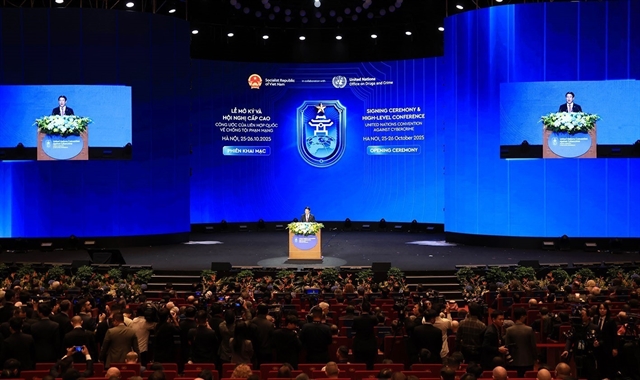
| Việt Nam's State President Lương Cường delivers remarks at the opening session of the signing ceremony of the United Nations Convention against Cybercrime (also known as the Hanoi Convention). VNA/VNS Photo |
Nguyễn Thu Hằng
HÀ NỘI — The signing ceremony of the United Nations Convention against Cybercrime (The Hanoi Convention) marks a historic milestone of the beginning of a new era of global cooperation in cyberspace.
It not only signifies the birth of a universal legal instrument but also reaffirms the enduring vitality of multilateralism, where nations transcend differences and shoulder shared responsibilities for the common good of peace, security, stability and development.
State President Lương Cường delivered this message at the United Nations Convention against Cybercrime (The Hanoi Convention) signing ceremony held on Saturday morning in Hà Nội.
The President emphasised that, under the theme “Combating Cybercrime, Sharing Responsibility, Shaping the Future,” the signing ceremony reflects the spirit of international solidarity and the shared commitment of countries to build a safe, healthy and sustainable cyberspace.
Highlighting that humanity had entered a digital realm where each data stream, technological operation and online interaction can profoundly affect national security, economic growth and the future of nations, the President said that cyberspace would be both a new frontier for development and a new battleground for global security, where opportunities and challenges intertwine, and where technological progress must go hand in hand with ethics and responsibility.
He also said alongside the rapid advances of digital technology, cybercrime had been growing swiftly in scale, sophistication and impact, posing a direct threat to the security and development of every country and to the wellbeing and happiness of every individual in the digital age.
“Therefore, safeguarding sovereignty, national interests and cybersecurity is not only a demand of the times but also an essential condition for each nation to achieve rapid and sustainable development, thereby contributing to peace, stability and shared prosperity,” he said.
President Lương Cường stressed that, in the face of mounting cyber threats, the birth of the Hanoi Convention, a global multilateral treaty against cybercrime, stood as a vivid testament to solidarity, respect for the rule of law and the vitality of multilateralism, while affirming the central role of the United Nations.
According to the President the Hanoi Convention conveys three clear and profound messages of lasting significance to the world.
First, it reaffirms the international community’s commitment to shaping an orderly, secure and lawful cyberspace based on international law.
Second, it upholds the spirit of sharing, companionship and mutual support among nations.
Third, it underscores the ultimate goal of all efforts to serve the people, ensuring that technology improves lives, that development brings opportunities for all, and that no one is left behind in the global digital transformation.
The President affirmed that these three messages, encapsulating the core spirit of the Hanoi Convention, also reflected the guiding principles that Việt Nam steadfastly upholds in its process of international integration: law as the foundation, cooperation as the driving force, and the people as both the subject and the ultimate goal of every endeavour.
He further noted that, with a foreign policy of independence, self-reliance, peace, cooperation and development, and of multilateralisation and diversification, Việt Nam had been an active, responsible and trustworthy member of the international community.
Hosting the signing ceremony and becoming the first country to sign the Hanoi Convention demonstrated Việt Nam’s strong commitment to the rule of law, full compliance with international obligations, and its contribution to strengthening the global legal order in cyberspace.
President Lương Cường called on all member states to swiftly ratify the Convention, so that it may soon enter into force, thereby laying the foundation for a fair, inclusive and rules-based digital order.
.jpg) |
| Secretary-General of the United Nations António Guterres delivers remarks at the opening session of the signing ceremony of the United Nations Convention against Cybercrime. VNA/VNS Photo |
Powerful instrument
Speaking at the Opening for Signature of the United Nations Convention against Cybercrime (The Hanoi Convention) in Hà Nội on Saturday, the Secretary-General of the United Nations António Guterres said the UN Cybercrime Convention would be a powerful, legally binding instrument to strengthen our collective defences against cybercrime.
"It is a promise that fundamental human rights such as privacy, dignity, and safety must be protected both offline and online.
"It is a testament to the continued power of multilateralism to deliver solutions.
"And it is a vow that no country, no matter their level of development, will be left defenceless against cybercrime.
The convention delivers a number of major breakthroughs, according to the Secretary-General.
One of the most significant is the sharing of digital evidence across borders.
This has long been a major obstacle to justice, with perpetrators in one country, victims in another, and data stored in a third.
The convention provides a clear pathway for investigators and prosecutors to finally overcome this barrier.
It is also a victory for victims of online abuse.
For the first time in any international treaty, the non-consensual dissemination of intimate images is recognised as a criminal offence.
The convention also encourages strong protections for victims, including access to recovery, compensation, and the removal of illicit content.
By creating binding obligations, the convention turns our commitments into practical safeguards.
It complements the Pact for the Future and the Global Digital Compact, which seek to bridge the digital divide, and strengthen global digital cooperation.
And it is consistent with the objectives of the recently established Global Dialogue on AI Governance and the Independent International Scientific Panel on AI.
Together, these commitments and mechanisms form a strong foundation to make digital spaces safe and secure.
“Today’s signing is an important milestone in our shared journey to a safer digital world. But it is only the beginning,” he said.
"The true power of the Convention will lie in turning signatures into tangible action.
"It must be ratified and entered into force, without delay. It must be implemented, effectively and in full.
"And it must be lived up to every day, by every party.
"The United Nations is here to walk this path with you."
Through the UN Office on Drugs and Crime - the Secretariat of the Convention - and the UN Office of Legal Affairs, the Secretary-General said the UN would help countries bring this treaty into force, build capacity, strengthen investigations, and deepen cooperation across borders.
"I would like to thank Việt Nam for hosting this signing ceremony and for its leadership in bringing us together.
"The United Nations is proud to partner with Việt Nam in making this day possible.
“Let us seize this moment, and maximise the potential of this landmark agreement. Let us build a cyberspace that respects everyone’s dignity and human rights.
"And let us ensure that the digital age delivers peace, security, and prosperity for all."
A resounding statement to multilateralism
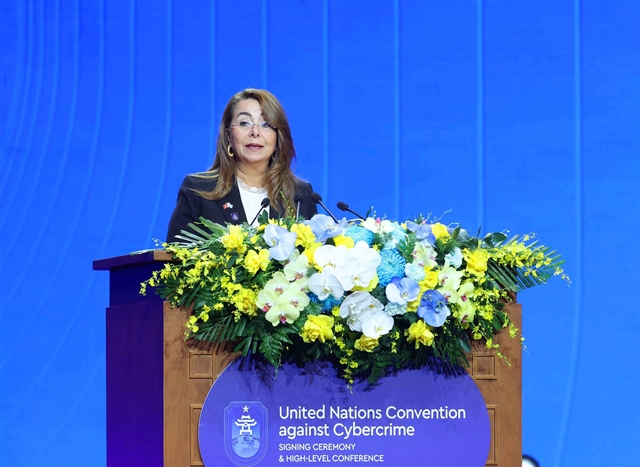
"The UN Convention against Cybercrime is a resounding statement to multilateralism and the commitment of the international community to address cybercrime," said Ghada Waly, Executive Director of the United Nations Office on Drugs and Crime (UNODC) as she addressed the signing ceremony of the convention in Hà Nội on Saturday.
The document, also known as the Hanoi Convention after its signing location, took over five years of negotiations involving more than 150 member states, and enriched by 160 stakeholders from international organisations, NGOs, academia and the private sector.
“A new age of cyber crime is here,” stressed the UNODC executive director, citing how advances in software and artificial intelligence are redefining the scope, scale, and sophistication of cyber threats.
Large-scale ransomware attacks, phishing attempts and AI-powered online scams are becoming more common, while criminals are also becoming less and less constrained by borders, according to Waly.
Online sexual exploitation and abuse, especially cases involving children, is a particularly serious issue. The WeProtect Alliance found that reports of child sexual exploitation and abuse material increased by 87 per cent between 2019 and 2023.
“The impact of cybercrime on people is catastrophic, depriving them of their savings, livelihoods, safety, dignity, or even their lives,” Waly noted.
The United Nations Convention against Cybercrime was initiated by the United Nations in 2019, stemming from the urgent need to build a comprehensive legal framework to address global challenges in non-traditional security, climate change and sustainable development. After five years of negotiations, the United Nations General Assembly officially approved the convention by consensus on December 24, 2024.
The convention, consisting of nine chapters and 71 articles, provides a comprehensive approach to preventing and combating the global scourge of cybercrime and upholding human rights principles. It addresses technical and legal challenges by adapting traditional criminal investigation methods to the information and communications technology environment, while enhancing international cooperation.
Throughout the drafting process of the convention, Việt Nam has played an active and proactive role, demonstrated by hosting numerous international workshops that brought together experts from the United Nations Development Programme (UNDP), the World Health Organisation (WHO) and the United Nations Office on Drugs and Crime (UNODC).
These discussions helped shape the convention’s content, focusing on key areas such as cybersecurity, environmental protection and poverty reduction.
Việt Nam’s initiatives, including the proposal of a support mechanism for least developed countries and the integration of climate change considerations, received strong backing from the international community, contributing significantly to the development of a globally relevant document.
The UN's decision to select Hà Nội as the venue for the convention signing ceremony marks a historic milestone in Việt Nam’s multilateral diplomacy and nearly five decades of the Việt Nam–UN partnership.
This is the first time a location in Việt Nam has been associated with a global multilateral treaty addressing an issue of profound international concern.
The selection underscores the country’s rising international stature and credibility as a proactive advocate of multilateralism, a participant in shaping global digital governance frameworks, and a defender of cybersecurity and national sovereignty in cyberspace. It also lays the groundwork for Việt Nam’s successful implementation of its digital transformation strategy, paving the way for a new era of Việt Nam - an era of prosperity and development.
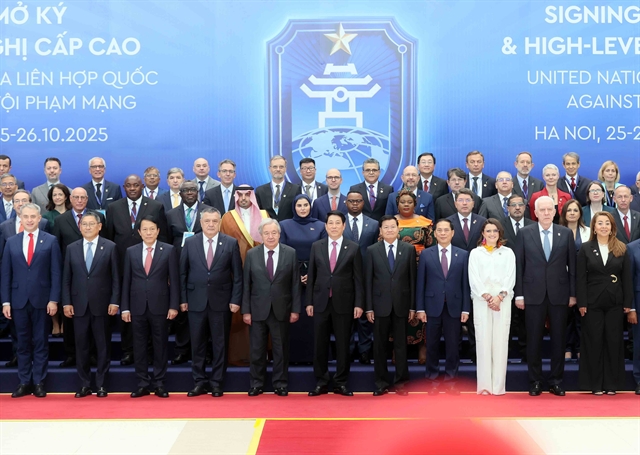
Within the framework of the Signing Ceremony and the High-level Conference of the UN Convention against Cybercrime, a plenary session co-chaired by Prime Minister Phạm Minh Chính and UN Secretary-General António Guterres will take place.
The programme will also include a series of high-level bilateral meetings and side events on topics such as protecting citizens in the digital transformation era, global cooperation against online scams, implementing the UN Convention against Cybercrime with capacity building as a pillar of global cooperation, and sharing experience in investigating and collecting electronic evidence in cases involving virtual assets and money laundering, among others. VNS
Politics & Law
 Politics & Law
 Politics & Law
 Politics & Law
 Politics & Law
 Politics & Law
 Politics & Law
.jpg) Politics & Law
Politics & Law
 Politics & Law
 Politics & Law
.jpg) Politics & Law
Politics & Law
 Politics & Law
 Politics & Law
.jpg) Politics & Law
Politics & Law
 Politics & Law

.jpg)