 Opinion

AIMCONNECT 2026 Held in Singapore, Bringing Global Automotive Leaders Together to Explore the Future of AI, Trust and Connected Mobility
1.
 |
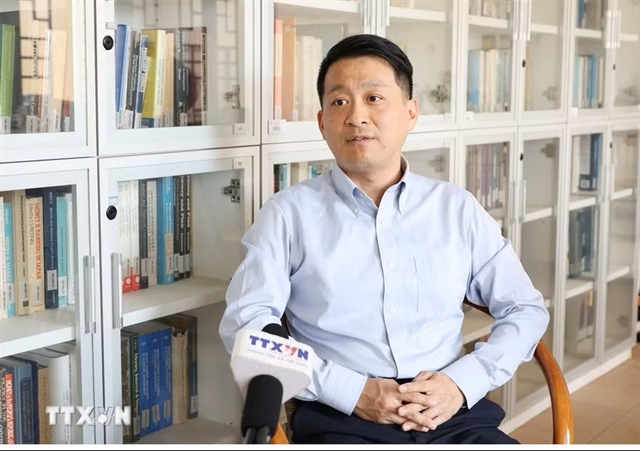
| Nguyễn Đình Thọ, Deputy Director of the Institute of Strategy and Policy on Agriculture and Environment. — Photo vov1.vov.vn |
Offshore wind, green hydrogen, marine tourism and other blue economy sectors are opening new growth frontiers for Việt Nam. But realising that potential will require stronger institutions, greater investment in science and technology and deeper international cooperation.
Việt Nam News and Law reporter Trần Như spoke with Nguyễn Đình Thọ, Deputy Director of the Institute of Strategy and Policy on Agriculture and Environment, about what Việt Nam's blue economy offers and what stands between potential and reality.
As Việt Nam pursues its green growth targets and moves toward a functioning carbon market, how will the role of local authorities evolve in greenhouse gas inventory and emissions reduction planning?
Greenhouse gas inventory and emissions reduction planning have long been delegated to local governments, with provincial-level environment agencies, now reorganised as Departments of Agriculture and Environment, serving as the responsible bodies.
As Việt Nam transitions to a two-tier local government model, these responsibilities have been further decentralised, covering inventory work, emissions reduction planning and oversight of emitting facilities at the local level.
When businesses enter the carbon market and take on compliance obligations, coordination between local authorities and central regulators will be especially critical.
The Ministry of Agriculture and Environment has already completed the carbon credit registry system, while the Ministry of Finance and other relevant agencies are developing the trading mechanism needed to bring the domestic carbon market online. This infrastructure will be the foundation for an effective market going forward.
Once the carbon market is fully operational, what options will businesses have for meeting their emissions reduction commitments?
The carbon market will give businesses a range of pathways. They can invest in technological innovation and generate carbon credits for trading; participate in emissions allowance auctions; buy and sell credits on centralised exchanges; or conduct bilateral transactions through direct agreement.
More broadly, the carbon market will create real economic incentives for decarbonisation. Once emissions carry a financial value, businesses will have stronger grounds to invest in clean technology, energy transition and more efficient resource use.
How important is international cooperation to the development of Việt Nam's blue economy?
International cooperation is essential, particularly in the marine economy and renewable energy space.
Việt Nam has more than 3,200km of coastline and enormous offshore wind potential. According to World Bank assessments, the country could develop up to 512GW of offshore wind capacity, a resource that could underpin entirely new industries and allow the country to integrate more deeply into regional energy value chains.
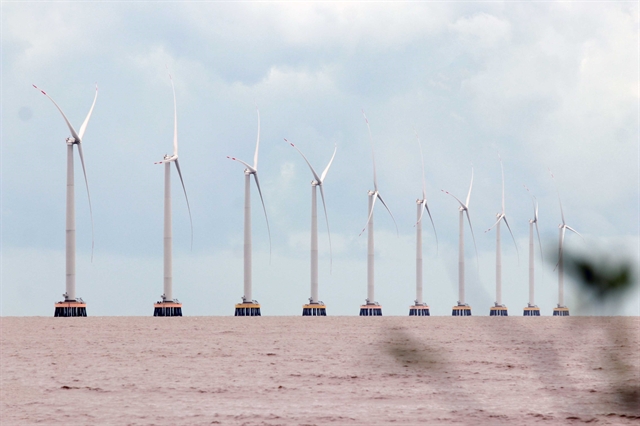 |
| Offshore wind turbine in the southern province of Cà Mau, August 2025. — VNA/VNS Photo |
Looking ahead, Việt Nam is well-positioned to join ASEAN regional grid connectivity initiatives and cross-border energy networks that a growing number of countries are actively pursuing.
Việt Nam is also a party to numerous international conventions on nature conservation and biodiversity, which means marine ecosystem protection must advance in parallel with economic development. This balance between resource use and conservation reflects a broader global direction.
Which sectors hold the greatest breakthrough potential for Việt Nam's marine economy in the years ahead?
Offshore wind has the potential to anchor an entirely new economic ecosystem, spanning power generation, transmission and energy storage. Green hydrogen is particularly promising as a means of storing renewable energy and supplying clean fuel for transport, industry and a wide range of other sectors.
International experience shows that many countries have successfully woven together renewable energy, nature conservation and ecotourism into coherent sustainable development models. Việt Nam can draw on those lessons to make better use of its maritime assets while staying on track toward its green growth goals.
Over the longer term, this will also be a key instrument for meeting Việt Nam's greenhouse gas reduction commitments and sharpening the competitiveness of its businesses abroad.
Việt Nam's marine economy represents a vast development opportunity. If the country makes good on renewable energy, green hydrogen, green technology and international cooperation, while working through its institutional and investment constraints, the blue economy can become one of the country's most important growth engines and a vehicle for Việt Nam's ambition to be a strong, prosperous and sustainable maritime nation. — VNS
Opinion
.jpeg) Opinion
Opinion
 Opinion
 Opinion
 Opinion
 Opinion
 Opinion
 Opinion
 Opinion
 Opinion
 Opinion
 Opinion
 Opinion
 Opinion
 Opinion