.jpg) Opinion
Opinion

Việt Nam, Denmark issue joint statement on establishment of Comprehensive Strategic Partnership
1.
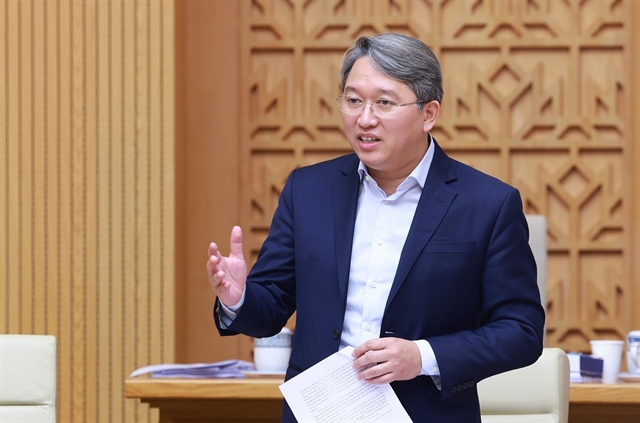 |
| Minister of Justice Nguyễn Hải Ninh. — VNA/VNS Photo Bùi Văn Lanh |
HÀ NỘI — The Politburo’s Resolution 66 represents a strategic breakthrough in reforming lawmaking and enforcement, serving as a clear call to action for deep institutional reform and contributing to a modern, effective and efficient socialist rule-of-law state with citizens and businesses at its core, according to Minister of Justice Nguyễn Hải Ninh.
Ninh, who is also a member of the Party Central Committee, told the press in a recent interview that after the resolution was issued on April 30 last year, the Politburo and Secretariat convened a nationwide hybrid conference to disseminate its contents. The event reached more than 1.5 million officials and Party members at 37,000 locations nationwide.
All 22 ministries and ministry-level agencies, Government-affiliated bodies and all 34 provinces and centrally governed cities have since issued schemes or action plans to implement the Resolution. Several have gone further by establishing dedicated Steering Committees to oversee its delivery.
Under the Party’s leadership and guided by the Resolution’s directions, the National Assembly, Government, Supreme People’s Court, Supreme People’s Procuracy and relevant agencies have worked in a concerted and responsible manner to renew legislative thinking and strengthen coordination. They have translated Party guidelines and Politburo strategic resolutions into law, creating a comprehensive legal framework that supports the streamlining of the political system, the rollout of a two-tier local administration model, deeper decentralisation and delegation of authority and administrative reform. Together, these efforts have removed long-standing bottlenecks and unlocked resources for national development.
The minister described Resolution 66 as a foundational political driver behind a series of strategic and unprecedented lawmaking decisions. It marked a shift away from the old mindset of banning what cannot be easily managed, transforming institutions into a source of competitive advantage and opening new development pathways. Notably, the Resolution’s goal of largely eliminating legal and regulatory bottlenecks by the end of 2025 has already been achieved.
In 2025 alone, the Government submitted a resolution amending and supplementing key articles of the 2013 Constitution along with 99 laws and legal resolutions, the highest number recorded in any single year. It also issued 377 decrees and legal resolutions, while ministries and agencies drafted and promulgated 1,404 legal documents, the largest total of the current term. Local authorities issued about 13,000 legal documents.
Law enforcement efforts have been closely aligned with Resolution 66, with strong emphasis placed on removing legal obstacles and overhauling administrative procedures in areas such as land, environment, healthcare, education, science and technology and social welfare.
According to Ninh, the Resolution has generated strong and far-reaching momentum for institutional and legal reform across the political system from central to local levels. It has received broad support from state agencies, the public, legal experts, lawyers and the business community.
The year 2026 is seen as pivotal for translating Party resolutions into concrete outcomes. Priority will be given to promptly reviewing and converting the major policy orientations set out in the documents of the 14th National Party Congress and the Politburo’s nine strategic resolutions into law, in line with the 2026 working agenda of the Central Steering Committee on Institutional and Legal Reform.
A core task will be to develop a strategy to refine Việt Nam’s legal system for the new era, ensuring it is rationally structured, comprehensive, democratic, equitable, coherent, unified, open, transparent, feasible and stable. The strategy will guide legislative planning for the term and annual agendas that are proactive, flexible and responsive to emerging realities. At the same time, 2026 will focus on revising and supplementing legal documents linked to the two-tier local administration model, while addressing adjustments made under Government and National Assembly Standing Committee resolutions, with the aim of fully resolving remaining legal bottlenecks by March 1, 2027, in line with National Assembly Resolution 206 and the Law on Organisation of Local Governments.
Greater resources will be devoted to improving legislative techniques and professional law drafting, with emphasis on scientific rigour, feasibility and effectiveness. This includes finalising a national law-drafting handbook along with standardised criteria, technical guidelines and training programmes for lawmaking officials.
Efforts will also intensify to strengthen the institutional framework and processes for consolidating legal documents. Major reforms to consolidation practices will ensure consolidated texts serve as the official reference for citation and application, are submitted alongside amended instruments and use streamlined technical methods. The scope will expand to include local-level documents and a wider range of eligible texts.
Work will continue on upgrading the national legal documents database, launching a large-scale legal data project and advancing full digital transformation in legal dissemination and education, including the application of artificial intelligence for legal guidance and interpretation. The national legal portal will be further developed as a central hub for policy and legal information, a digital interface between the State, citizens and businesses, a channel for feedback on legal documents and an online platform for public participation in institutional and legal reform, he added. — VNA/VNS
Opinion
 Opinion
 Opinion
 Opinion
 Opinion
 Opinion
 Opinion
 Opinion
 Opinion
 Opinion
 Opinion
 Opinion
 Opinion
 Opinion
 Opinion