 Life & Style

Top leader receives Dominican Republic’s United Left Movement delegation
1.
|
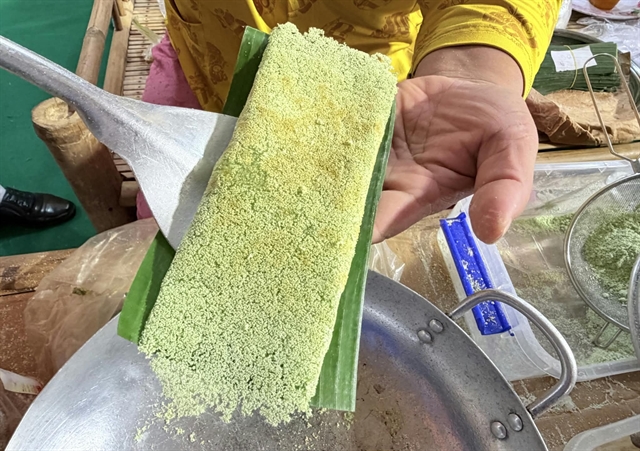
| LACE IN THE MAKING: Bánh rây, or om chiếl, is a special but popular cake in An Giang Province, attracting people with its multi-layer of flavour. — VNA/VNS Photos |
Thanh Sang
The Khmer people of southern Việt Nam craft a rich variety of traditional cakes using simple, local ingredients like glutinous rice, coconut, and palm sugar, each brought to life through distinct techniques.
Among them, bánh rây, or om chiếl in Khmer, stands out for its unique preparation. Rather than being rolled, moulded, or poured, the flour is sifted directly onto a hot pan, instantly forming a delicate, lace-like shell around its rich filling. The technique (sifting) results in the cake's name: rây.
The outer layer is made from glutinous rice flour, while the filling typically consists of grated coconut, palm sugar, crushed roasted peanuts, or mung beans. Pandan leaves are used to provide a distinctive colour and aroma.
According to Mỹ Xuyên, a cake seller in Long Xuyên Ward, the most difficult stage lies in preparing the flour.
|
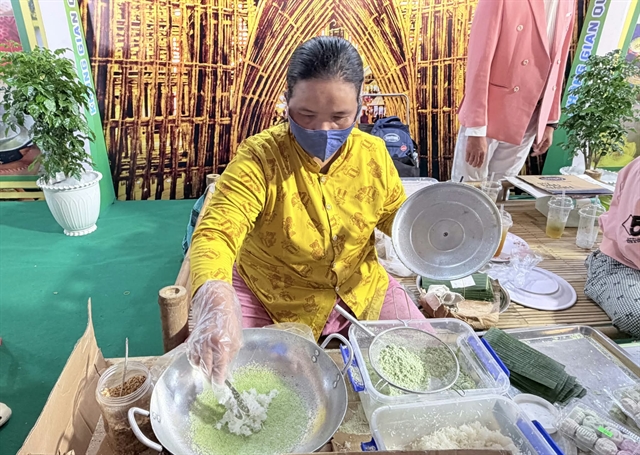
| CULINARY ARTISTRY: Chef must provide a master’s touch: deft hand movements, deep familiarity with the craft, and razor-sharp precision to make delicious cakes. |
Glutinous rice is soaked until soft, ground into a fine powder, and kneaded with pandan leaf extract, which imparts a vibrant green hue, to achieve the ideal consistency.
The flour must remain moist enough to bind instantly upon contact with heat without turning mushy. It is then sifted carefully to remove any lumps, leaving a smooth, velvety powder ready for cooking.
To make the cakes, Xuyên places a pan on the stove; no oil or fat is needed. Holding a small sieve filled with flour, she gently shakes it in a circular motion, allowing the flour to fall evenly onto the pan’s surface. Upon contact with the heat, the tiny, damp grains of glutinous rice flour instantly bind together, forming a thin and delicate layer.
Xuyên says she has to control and balance pan temperature and sifting speed with practised precision: too much heat burns the delicate flour instantly, while too little keeps it from binding. Done right, the outer crust emerges thin, supple, and lightly chewy, bounded by edges cooked just to a gentle crisp.
|
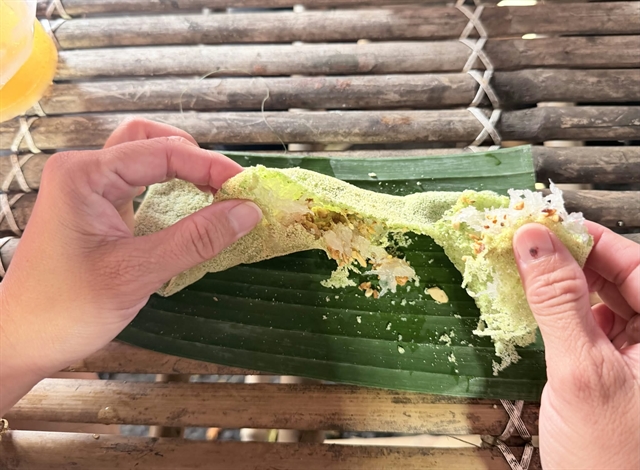
| LOCAL DELICACY: The cake is made of a glutinous rice wrapper and mix of nuts, coconut and palm sugar filling. |
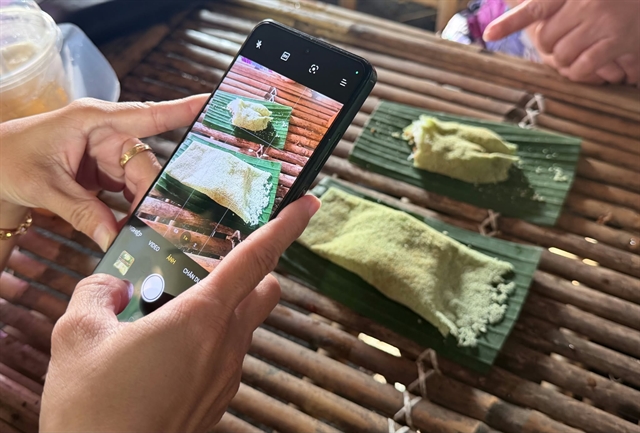
The filling is then placed in the cake. It is a mixture of grated coconut mixed with palm sugar which provides a rich, sweet flavour, while roasted peanuts or mung beans add a pleasant nuttiness along with a great smell similar to vanilla of pandan leaf extract. It is the reason why the cake is also called bánh dứa (pandan cake).
At this stage, Xuyên swiftly folds the edges of the pastry into a square or rectangular shape, then lifts it out and places it onto a fresh banana leaf.
The entire process takes less than a minute, a true display of craftsmanship that looks simple at first glance but actually demands dexterity, practised familiarity, and exact precision.
Distinctive sweet
Bánh rây is best enjoyed fresh off the pan. It offers a multi-layered sensory experience: a thin, soft, and slightly chewy glutinous rice wrapper encases a rich, sweet filling of fresh coconut. Interwoven throughout are the nutty crunch of peanuts or mung beans, the subtle aroma of pandan leaves, and the distinctive warmth of local palm sugar. Paired with a warm cup of tea, it makes for an ideal afternoon treat.
|
| HERITAGE FLAVOURS: Bánh rây is appealing with its beautiful colour made of pandan leaf extract. |
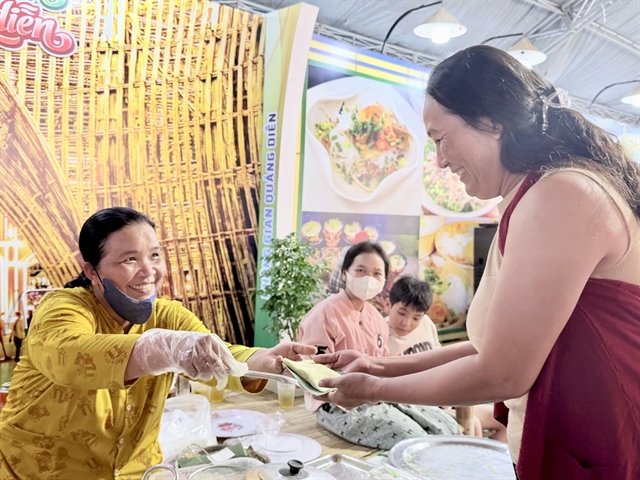
Xuyên says she receives support from many people every day, from young people who enjoy sharing the sweet treat over casual conversations, to older generations seeking the nostalgic flavours of their childhood, and even curious passersby drawn in by the cake’s inviting aroma and vibrant colour.
Bánh rây, for the Khmer people in An Giang, is much more than a street food delight. It holds a sacred connection to their community life and Buddhist traditions.
During major religious festivals such as Chol Chnam Thmay (New Year), Sene Dolta (Ancestors Day), or Robe Offering Ceremonies, families meticulously handcraft these cakes to bring to local pagodas as offerings for the monks as a gesture of respect and to share among neighbours.
|
| SWEET TRADITION: The cake is favourite for both old and young people. |
Xuyên says bánh rây is no longer confined to the Khmer community. Depending on the location, people have introduced variations in colour to the cake. They make the cakes pink from dragon fruit, orange from spiny bitter gourd, or purple from magenta plant or simply keep the natural white colour of the glutinous rice flour.
The cake is so famous that it is regularly featured at cultural events like the annual Southern Traditional Cake Festival in An Giang, and it is a highly recommended souvenir for tourists to buy for family and friends. — VNS
Life & Style
 Life & Style
 Life & Style
 Life & Style
 Life & Style
 Life & Style
 Life & Style
 Life & Style
 Life & Style
 Life & Style
 Life & Style
.jpg) Life & Style
 Life & Style
 Life & Style
 Life & Style