 Life & Style

Masan’s earnings more than double in Q3
1.
HÀ NỘI — Prime Minister Lê Minh Hưng on September 30 issued Directive No. 35/CT-TTg on the organisation of Vietnamese Culture Day (November 24) in conjunction with the National Great Unity Festival (November 11) in 2026.
|
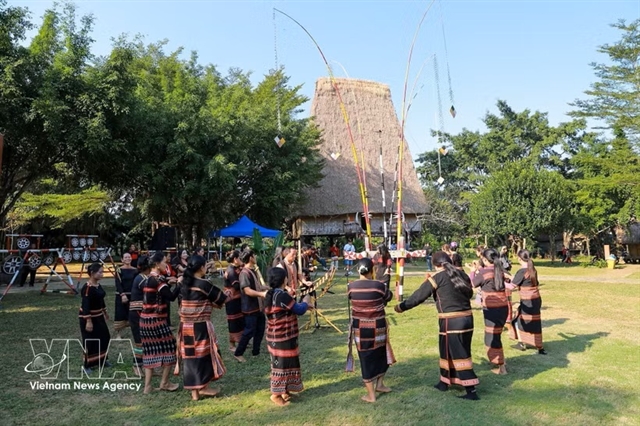
| A performance at the Great National Unity Festival 2025 held at the Việt Nam National Village for Ethnic Culture and Tourism. — VNA/VNS Photo: VNA |
A week-long cultural programme
Politburo Resolution No. 80-NQ/TW dated January 7, 2026 on developing Vietnamese culture designated November 24 each year as Vietnamese Culture Day to honour traditional cultural values, foster patriotism, national solidarity and pride, and affirm culture as the spiritual foundation, endogenous resource and driving force for national development.
The observance is also intended to expand access to culture, encourage creativity, improve people’s enjoyment of culture, and encourage intellectuals, artists and artisans to create and transmit cultural values, contributing to the comprehensive development of Vietnamese people in the new period.
The PM requested ministers, heads of ministerial-level agencies, and secretaries and chairpersons of provincial-level People’s Committees to resolutely, synchronously and effectively implement assigned tasks and solutions.
The activities will connect the National Great Unity Festival on November 18 with Vietnamese Culture Day on November 24, forming a vibrant, meaningful and practical week-long programme promoting national great unity and creating a lasting impact in residential communities and society.
People placed at centre of cultural activities
The PM requested that activities marking Vietnamese Culture Day and the National Great Unity Festival be organised extensively, diversely, creatively and joyfully across communities, residential areas, villages and residential groups nationwide, in line with the Party’s guidelines and the State’s policies and laws.
People must be placed at the centre as participants, creators and beneficiaries, with the activities helping foster patriotism, national pride, civic responsibility and the aspiration to contribute to national development, particularly among younger generations.
The directive calls for major renewal of organisational methods and implementation, mobilising the entire political system while promoting the role of the Việt Nam Fatherland Front, socio-political organisations, mass organisations and respected figures. Greater participation by people, communities and businesses should go hand in hand with efforts to preserve the cultural identity and fine customs of each locality and region.
Activities should provide greater opportunities for cultural experiences in communities, cultural institutions and public spaces, while remaining practical and effective and avoiding excessive administrative formalities, ostentation and superficiality. Waste, negative practices and violations must be prevented.
A wide range of creative and culturally distinctive activities are encouraged, including cultural, artistic and culinary festivals, folk songs and dances, traditional costumes, folk games and sports, and the practice and transmission of traditional cultural heritage.
Localities should promote cultural products, traditional crafts and craft villages, while increasing exchanges among people from different walks of life, ethnic communities, generations and localities. These activities should strengthen national great unity, preserve cultural identities and facilitate the intergenerational transmission of cultural values, particularly to younger generations.
Museums, libraries, heritage sites, cultural centres and creative spaces should be used effectively for exhibitions, film screenings, artistic performances and exchanges with authors and creators. Mobile cultural activities should be prioritised for people in remote, border and island areas and ethnic minority communities.
Cultural exchanges and activities promoting Việt Nam’s image, people, national cultural heritage and traditional values should also be expanded among Vietnamese communities abroad and international audiences.
Each provincial and communal-level locality is required to select at least one outstanding cultural activity, product, story or cultural space for introduction and promotion, linking it with tourism promotion, demand stimulation and the development of cultural industries.
Each commune or ward should select at least one suitable activity or model to maintain after Vietnamese Culture Day and the week-long programme, contributing to building culturally rich grassroots communities that are bright, green, clean and beautiful.
The directive calls for stronger information and communications work, along with improvements in landscape, decoration and visual communications for Vietnamese Culture Day and the week-long cultural programme.
Science and technology, digital transformation, multimedia communications, virtual reality and artificial intelligence (AI) should be increasingly applied to introduce distinctive cultural stories to communities, families and people nationwide, as well as Vietnamese communities abroad and international audiences.
In the directive, the PM assigned the Ministry of Culture, Sports and Tourism to complete and put into operation the Vietnam Cultural Digital Map before November 15, providing information on locations, programmes, events and activities marking Vietnamese Culture Day and the week-long cultural programme.
It will regularly monitor and assess implementation, address difficulties within its authority and report on the implementation of the directive to the PM before December 20. — VNA/VNS
Life & Style
 Life & Style
 Life & Style
 Life & Style
 Life & Style
 Life & Style
 Life & Style
 Life & Style
 Life & Style
 Life & Style
 Life & Style
 Life & Style
 Life & Style
 Life & Style
 Life & Style