 Life & Style

AIMCONNECT 2026 Held in Singapore, Bringing Global Automotive Leaders Together to Explore the Future of AI, Trust and Connected Mobility
1.
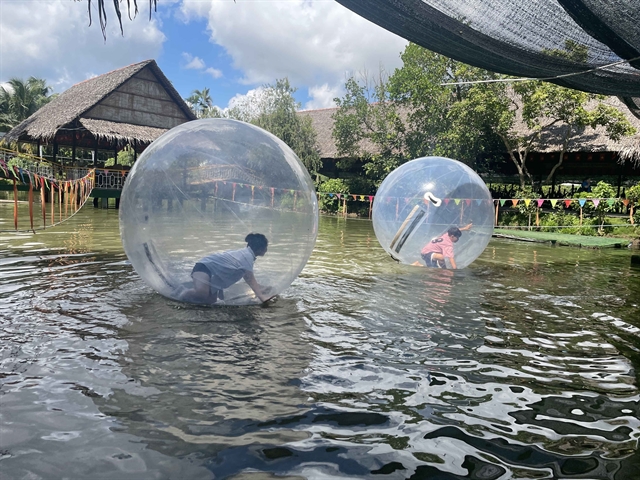 |
| Tourists play games at the Cồn Phụng Tourism Area in Phú Túc Commune of Vĩnh Long Province. — VNA/VNS Photo Phúc Sơn |
VĨNH LONG Vĩnh Long is betting on tourism to become a spearhead of its economy, with the Mekong Delta province targeting 10 million visitors and tourism revenue of VNĐ12 trillion (US$456 million) by 2030.
According to the provincial authorities' recent resolution, the province aims to welcome 10 million visitors by 2030, and total tourism revenue is expected to reach VNĐ12 trillion (US$456 million), contributing between 6 and 8 per cent to its gross regional domestic product (GRDP).
The tourism sector aims to account for 10 per cent of the province’s GRDP by 2045.
Dương Hoàng Sum, director of the provincial Department of Culture, Sports and Tourism, said Vĩnh Long has an advantageous location, with three sides bordered by rivers and one side bounded by the sea, and a coastline of more than 130 kilometres.
It also combines favourable natural conditions, such as rivers and mangrove forests, with man-made attractions, including orchards and cultural and historical sites.
Sum said that, with distinctive advantages in strategic location and rich cultural resources, the province has implemented measures to develop tourism as a spearhead economic sector, making an important contribution to its sustainable growth.
He added that the province is developing the “One Route – Three Destinations” strategy to maximise its potential and spatial connectivity.
Vĩnh Long has prioritised investment in infrastructure and technical facilities. It expects to complete main traffic routes connecting to tourism areas and sites, and a system of inland ports and wharves in the 2026 - 2030 period.
The province is working on investment incentive policies and mechanisms to mobilise private capital, accelerate digital transformation, and build a smart tourism and digital media ecosystem.
The province is calling for investment in resorts and ecological complexes.
The tourism sector is working with local authorities to build diverse tourism products based on local cultural values, the sea, rivers and orchards to attract domestic and international tourists.
Vĩnh Long is strengthening cooperation with HCM City and the Mekong Delta provinces, as well as international travel companies, to connect destinations and build routes along the Mekong.
The province is also offering training for the tourism workforce to improve their foreign-language skills and customer service.
Vĩnh Long is home to 214 national and provincial relics and 16 national intangible cultural heritages, such as coconut culture, pottery, memorial sites and temples. It has hundreds of accommodation establishments and tourist attractions, such as mangrove forests and orchards on islets along the Tiền, Hậu and Cổ Chiên rivers.
These are favourable conditions for the province to promote cultural tourism, ecotourism, MICE (meetings, incentives, conferences and events) tourism, medical tourism and educational tourism, as well as the night-time economy.
Vĩnh Long welcomed 3.2 million visitors in the first six months of 2026, achieving total tourism revenue of over VNĐ3 trillion ($114 million). — OVN/VNS
Life & Style
 Life & Style
 Life & Style
 Life & Style
 Life & Style
 Life & Style
 Life & Style
 Life & Style
 Life & Style
 Life & Style
 Life & Style
 Life & Style
 Life & Style
 Life & Style
 Life & Style