 Life & Style
HCM City shifts focus to multi-value salt economy
1.
TRINH NGUYỄN
I never planned to keep crabs.
Like many people living in a city apartment, I simply wanted a bit more greenery around me. That was how I came across terrariums – miniature ecosystems built inside glass containers. Before long, I found myself drawn to semi-aquatic setups, where moss, ferns, rocks and driftwood surrounded small pools of water, creating a habitat for tiny creatures as well as plants.
Then I discovered vampire crabs.
They are unlike any pet I had kept before. They are so tiny with the size less than 4cm (including their legs), surprisingly colourful and quite easy to care for. Before long, I had built a semi-aquatic terrarium and introduced a few crabs into their new home.
What impressed me most was how different the crabs looked. One had a bright yellow shell and purple claws. Another was almost entirely purple, with oversized yellow eyes that gave it a permanently startled expression. One was tomato red. My favourite was the tricolour, with a shell that blended shades of bright blue, yellow and brown, finished off with bright red legs and claws.
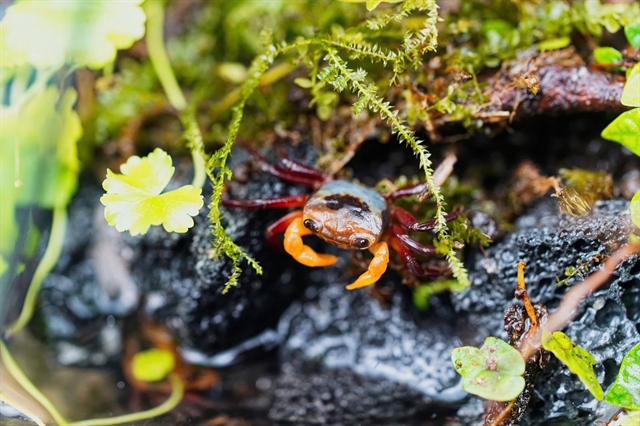 |
| Despite its name, the tricolour vampire crab actually has four colours: shades of blue, yellow and brown on its shell, with bright red legs and claws. Photo Trinh Nguyen/ VNS |
Like many city dwellers, I wanted a little more greenery in my apartment. Houseplants were nice, but terrariums felt different. They looked like miniature forests sealed inside glass containers, complete with moss, ferns and carefully arranged pieces of wood and stone.
The internet made it look simple, but reality was a bit different. I soon realised a terrarium wasn't just a pretty glass garden. With some vampire crabs in it, it was a living ecosystem, and keeping one healthy took more trial and error than I had expected.
The moss started turning yellow after a few weeks. Tiny worms appeared in the water. I spent evenings searching online, trying to figure out whether there was too much humidity or not enough. I adjusted the lights, changed the water, moved the tank indoors and outdoors and probably checked on it far more often than I needed to.
One of my crabs lost a leg after moulting. Another disappeared for several days. I was convinced it had died until it suddenly appeared from underneath a piece of wood as if nothing had happened.
Keeping a terrarium, I realised, isn't about making everything perfect. It's about learning how a tiny ecosystem works.
In Việt Nam, terrariums have quietly gained popularity over the past two decades. Enthusiasts have developed a variety of styles, from closed glass gardens to aquatic setups and semi-aquatic habitats that combine plants with small animals.
One of the people helping to build this community is Bùi Thị Trúc Liêm, founder of Cua Vampire in Hồ Chí Minh City. She has spent years creating terrariums and caring for the tiny creatures that live in them.
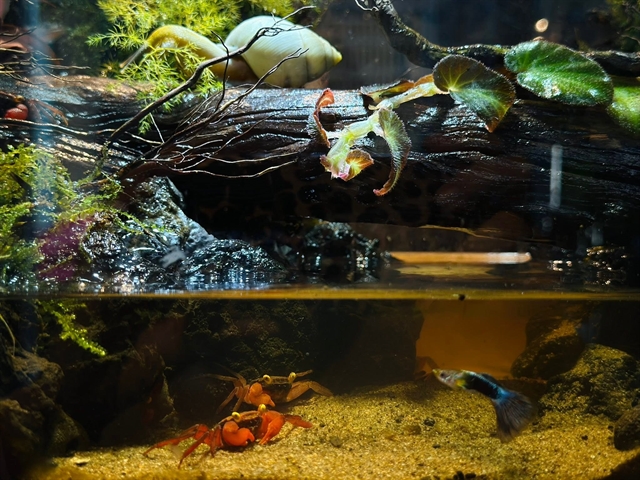 |
| A corner of a semi-aquatic terrarium featuring ferns, moss, a shallow pool and small animals. Photo courtesy of Vampire Crab |
"The terrarium community in Việt Nam is quite large and diverse," Liêm said.
"Some people enjoy dry terrariums, others prefer aquatic setups. Ours focuses mainly on semi-aquatic systems."
She believes people are looking for something many city homes are missing.
"Nowadays, more and more people want a green space in their homes, whether it's a small setup on a desk or a larger display," she said.
"And when that green space includes crabs, snails, fish or shrimp, it becomes much more interesting to watch."
According to Liêm, vampire crabs are actually quite easy to keep once their environment is right. Humidity should stay around 90 per cent, with temperatures between 24 and 28 degrees Celsius. Because the crabs are excellent climbers, they also need plenty of places to hide.
"They need a humid environment and lots of shelters," she said.
"A well-designed terrarium gives them space to climb, explore and hide."
Over time, the tank settled down, and so did I. The crabs became more confident. Some would come out almost as soon as food appeared. Watching them slowly pick up tiny pieces of grape or apple with their claws became part of my evening routine.
 |
| A chance encounter between two vampire crabs on their way to find food. Photo Trinh Nguyen/ VNS |
It probably sounds strange to anyone who has never kept them. But after a long day, standing quietly in front of the tank for five or ten minutes felt surprisingly relaxing.
A terrarium filled only with plants is already beautiful. Add a few small creatures moving through the moss and the whole scene changes. It feels much more alive.
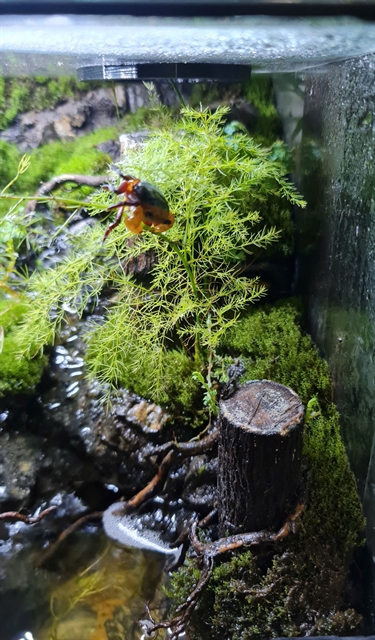 |
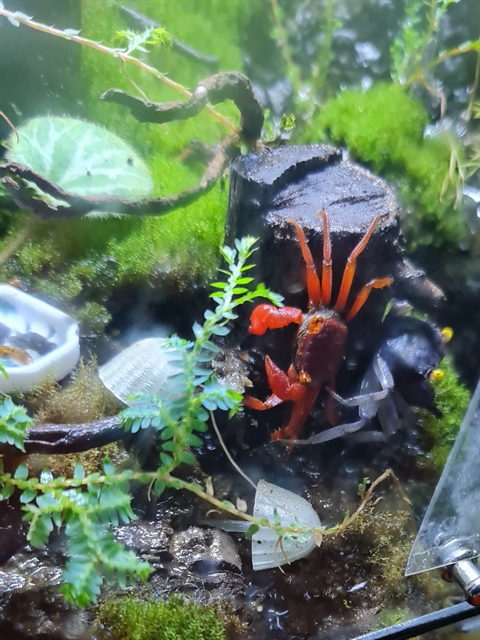
| A semi-aquatic terrarium comes to life with small animals. This little vampire crab seems to enjoy climbing branches. Photo Trinh Nguyễn |
That may explain why terrariums have become increasingly popular, especially among younger people living in cities. They do not need much space, and they do not require constant attention. Many people even build them using old glass jars or bottles, giving everyday containers a second life instead of throwing them away.
Liêm hopes more people will discover the hobby, not because everyone should keep crabs, but because anyone can build a small green corner at home.
A terrarium will never replace a real forest. But in a busy apartment surrounded by concrete, it can bring a small piece of nature a little closer. And some days, that's enough. VNS
Life & Style
 Life & Style
 Life & Style
 Life & Style
 Life & Style
 Life & Style
 Life & Style
 Life & Style
 Life & Style
 Life & Style
 Life & Style
 Life & Style
 Life & Style
.jpg) Life & Style
Life & Style
 Life & Style