 Life & Style

Another 58 sets of martyrs’ remains recovered at Lê Thị Riêng Park
1.
|
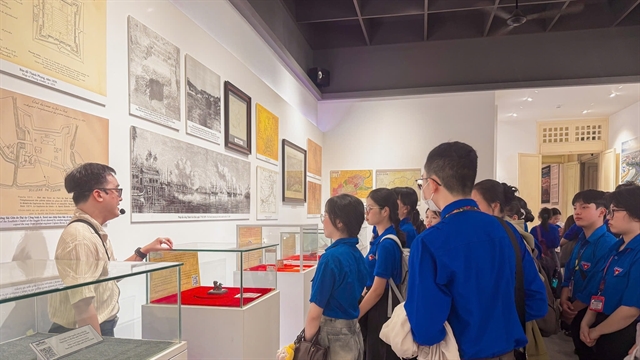
| Young people learn about the history of HCM City at the Museum of HCM City. — File photo from the museum fanpage |
HCM CITY — HCM City’s cultural authorities and experts are seeking to enhance the operations of state-owned and private museums in the city to attract visitors.
Speaking at a conference on building and developing the system of museums in HCM City organised by the Department of Culture and Sport on Friday, Mã Thanh Cao, former director of the HCM City Museum of Fine Arts, said: “The museums should promote scientific research on artefacts and collections to learn deep information and documents on the exhibits that will become stories told to visitors.”
Cao, a lecturer at Văn Lang University, said the museums need to expand their link with schools and universities and provide opportunities and support for students to research heritage.
She gave an example of her students from the Applied Art Faculty who are encouraged to conduct in-depth research on heritage and then apply knowledge to create their future products as a channel for promoting national traditional culture.
She added that the application of technology in displaying exhibits, building online tours and enhancing museum experiences contributes to bringing heritage closer to the public and attracting visitors in the country and abroad.
In early 2026, HCM City Museum renewed its storytelling with 3D/360 smart interactive activities that help visitors immerse themselves in historical time and space.
The War Remnants Museum applied virtual reality (VR) to recreate artefacts. It uses containers and visual and audio effects to stimulate a prison.
The Southern Women's Museum uses 3D holograms and VR technologies to screen images of historical characters and objects.
Meanwhile, the Fine Arts Museum is applying VR and artificial intelligent to digitalise national treasures, including the Vườn Xuân Trung – Nam – Bắc (Spring Garden in the Centre, South and North), a massive lacquer piece, up to 5.4 metres wide, by Nguyễn Gia Trí (1908-1993), a pioneer in the art of lacquer painting in Việt Nam; and another lacquer painting called Thanh Niên Thành Đồng (Youth of the Land of Steel and Copper Wall), which measures 1.45m in height and 2.45m in length, by Nguyễn Sáng (1923 – 1988).
Huỳnh Ngọc Vân, director of the private Áo Dài Museum in Long Phước Ward, pointed out that diversifying museum activities is a sustainable development strategy and an effective way to attract visitors.
Vân said that when her museum shifted its business model from showcasing artefacts alone to offering more interactive experiences and community engagement activities, the number of visitors increased significantly.
The change also helped to raise the public's awareness of heritage values, she added.
The museum opened in 2014 to share the history of áo dài (traditional long dress). It displays 1,300 áo dài designs dating back to the 17th and 18th centuries and their subsequent evolution.
Some are owned by theatre icons such as People’s Artists Kim Cương and Bạch Tuyết, considered gurus of cải lương (reformed opera). Others include garments owned by national heroine Nguyễn Thị Định, the first woman major general in the Việt Nam People's Army, and Former Vice President Nguyễn Thị Bình.
Over ten years, the museum has organised numerous áo dài fashion shows and photo and painting exhibitions capturing Vietnamese culture and lifestyles across Việt Nam and abroad. It has also promoted cultural exchange events with other countries such as Japan, Indonesia, Malaysia and India.
Conference attendees emphasised that museums highlight not only objects from the past but also contemporary life.
Nguyễn Thị Hậu, general secretary of the HCM City Historical Science Association, said the city’s museum system should be divided into four parts, including the museum hub telling the overall story of the city’s formation and development and urban characteristics, and the thematic museum highlighting specialised topics such as art, war, migration, or urban economics.
The two others are living heritage spaces reflecting activities of urban life such as markets, residential areas, alleys and craft villages, and the digital museum linking the entire museum system through VR technology and open databases, she added.
Phạm Định Phong, deputy director of the Department of Cultural Heritage under the Ministry of Culture, Sports and Tourism, asked the city’s Department of Culture and Sports to focus on new experimental and interactive activities to improve visitors’ experiences and accelerate digital transformation and digitalisation of artefacts to link to the national database.
He said the department should concentrate on human resources and international cooperation, such as participating in international conferences or expert meetings.
He also asked the department to pay more attention to private museums that aim to diversify themes and activities of the city’s museum system.
Trần Thế Thuận, director of the Department of Culture and Sports, concluded the conference, saying that in the period of 2026 and 2030, the city’s museums should improve the quality of their collections, collect new objects and exchange items with other museums to renew the collections and display methods to serve visitors and tell stories of traditional values.
According to the department, the city now has 14 state-owned museums and 11 private museums, preserving around 700,000 artefacts and documents, including 24 national treasures.
There are seven state-owned museums recognised as national first-grade museums and members of the International Council of Museums.
The city's museums welcomed more than 4.4 million visitors in 2025. — VNS
Life & Style
 Life & Style
 Life & Style
 Life & Style
 Life & Style
 Life & Style
 Life & Style
 Life & Style
 Life & Style
 Life & Style
 Life & Style
 Life & Style
 Life & Style
 Life & Style
 Life & Style