 Life & Style
Hà Nội adorned in red ahead of Liberation Day
1.
by Hoàng Nguyễn Ánh Vân
At the Vietnam Fine Arts Museum, fallen leaves rise from the ground and take on new life.
They drift across canvases as rivers, rooftops and winding village paths, reshaping the ordinary into something quietly extraordinary.
In the exhibition Cuộc Chơi Với Lá (A Game with Leaves), visitors do not simply view artworks — they step into a lifetime of patience, observation and quiet devotion.
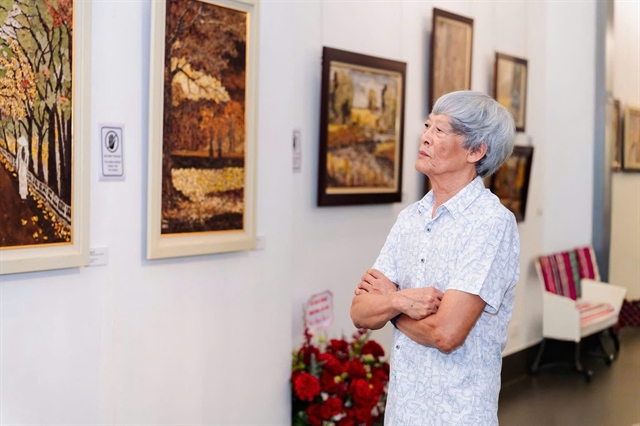 |
| Artist Tạ Hải at his leaf art exhibition 'Cuộc Chơi Với Lá' (A Game with Leaves) in Hà Nội. — Photo courtesy of Tranh Lá Tạ Hải |
At the Việt Nam Fine Arts Museum, an exhibition marks more than six decades of creative pursuit by artist Tạ Hải, featuring dozens of works selected from a body of over 500 pieces crafted entirely from natural materials.
Self-taught and working outside formal artistic traditions, he has spent a lifetime turning fallen leaves into a medium of expression, one that reflects both nature and human experience.
For Hải, leaves are not discarded remnants but something far more enduring.
“People see fallen leaves as something to throw away,” he said. “But I see in them a life of their own.”
Life of leaves
His journey began not in a studio but in quiet moments of noticing.
Since creating his first work in 1965, Hải has followed a path defined less by formal training than by instinct and persistence. He admits that even today certain conventional techniques like portrait drawing remain a challenge. Yet what he lacks in academic background, he makes up for in a deeply personal way of seeing.
“I don’t paint what I see,” he told Việt Nam News. “If that were the case, I would just take a photograph. I paint what I feel.”
That feeling is rooted in his contemplation of nature, particularly the fleeting life of leaves. To him, a leaf’s journey — from growth to decay — carries a quiet lesson about existence.
“The life of a leaf is short, but meaningful. It gives everything, then quietly steps aside. I wish people could live like that,” he said.
It is this philosophy that gives his works their emotional weight. Each composition is not merely assembled from leaves but shaped by memory, reflection and an enduring sensitivity to the natural world.
Searching colour
If leaves are his medium, then colour is his lifelong pursuit — and perhaps his greatest challenge.
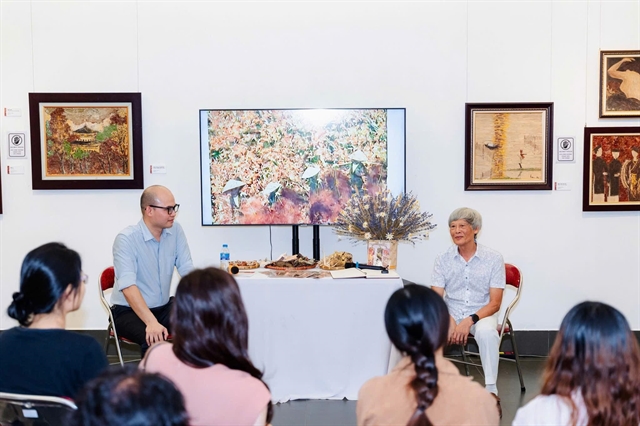 |
| Artist Tạ Hải (right) shares insights into his creative journey during a talk held alongside the exhibition. — Photo courtesy of Tranh Lá Tạ Hải |
Unlike conventional painters, Hải does not rely on manufactured pigments. His palette is built entirely from what nature offers, often through years of searching, experimenting and at times failing.
“To make leaf paintings, you have to create your own colour store,” he said. “You have to search, test and accept failure.”
The search for colour has taken him across landscapes and into unexpected encounters.
There was the deep red he once sought obsessively, only to find it through a chance connection with a betel seller — a colour that, to him, carried echoes of maternal warmth. There were strands of corn silk and husks he collected during his time working in former Thái Bình Province and the enduring white of garlic, which he notes never fades.
Some colours, however, remain elusive. The search for certain shades, especially blues that retain their vitality over time, has proven particularly demanding, requiring both patience and repeated trial.
“There are things you try to find but cannot,” he said. “And sometimes, what you’re not looking for appears on its own.”
Even failure becomes part of the process. On one trip abroad, he filled suitcases with leaves in the hope of expanding his palette. Not all of them could be used, but each attempt added to his understanding of the material.
In this sense, his work extends beyond composition. It is also an ongoing dialogue with nature that demands humility, curiosity and endurance.
“What makes Tạ Hải’s work remarkable is his ability to turn something as ordinary as fallen leaves into a refined artistic language. His works not only reflect nature but also evoke memory and a deeply personal sense of aesthetics,” said Associate Professor Nguyễn Đỗ Bảo, PhD in Art.
The art of slowness
There is a quiet resistance embedded in Hải’s practice, a refusal to rush.
In a world driven by speed and instant production, his work demands the opposite: stillness, attention and time. Each leaf must be observed, selected, treated and arranged with care. The process cannot be hurried.
“You have to be meticulous and slow down to observe,” Hải said. “Without passion, you cannot do this.”
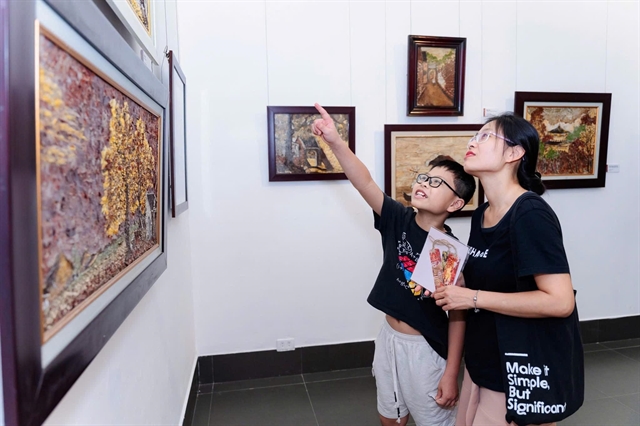 |
| Visitors view leaf artworks at the exhibition 'Cuộc Chơi Với Lá' in Hà Nội. — Photo courtesy of Tranh Lá Tạ Hải |
This philosophy of slowness shapes not only his art but also his way of living. He spoke of always paying attention to small details, never dismissing what appears trivial. Sometimes, the things one searches for most intensely remain out of reach while unexpected discoveries emerge by chance.
It is a mindset that values patience over urgency and depth over immediacy — a quiet counterpoint to the rhythms of contemporary life.
“My son was very curious and kept asking questions about how the leaves were turned into paintings,” said Lê Thị Minh Thu, who visited the exhibition with her child.
“For me, it’s not just about the artworks, it’s about helping children learn to appreciate small things in nature.”
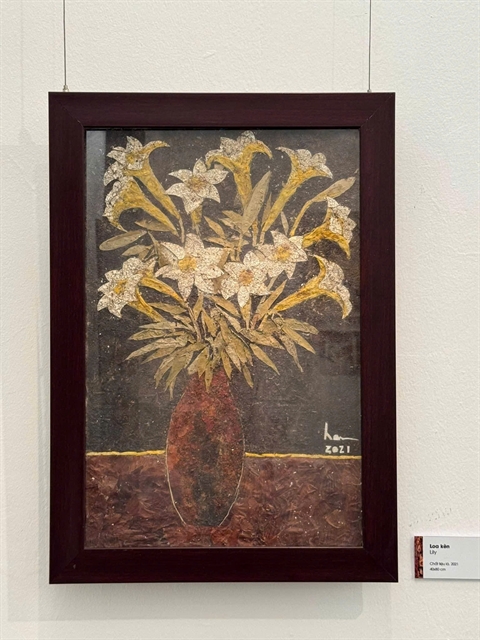 |
| Leaf artwork entitled 'Loa Kèn' (Lily) by Tạ Hải. — VNS Photo Ánh Vân |
Despite the scale and significance of the exhibition, Hải resists framing it as a grand artistic statement.
Instead, he offers a simpler description that captures both his humility and his enduring curiosity.
“This is not an exhibition,” he said. “It’s just my game with leaves.”
Yet within that game lies a lifetime of work: of noticing, collecting, experimenting and feeling. Each leaf, once fallen and forgotten, is given a second life, not only as part of an artwork but as a quiet testament to time, memory and the overlooked beauty of the natural world.
In the end, what rises from the ground in Hải’s work is not just form, but a quiet way of seeing.
Like the leaves that return on his canvases, the ordinary is reshaped into something that asks us to pause, look again and find meaning in what we once overlooked.-- VNS
Life & Style
 Life & Style
 Life & Style
 Life & Style
 Life & Style
 Life & Style
 Life & Style
 Life & Style
 Life & Style
 Life & Style
 Life & Style
 Life & Style
 Life & Style
 Life & Style
 Life & Style



