 Life & Style

Vietnamese Prime Minister meets Cambodian National Assembly President
1.
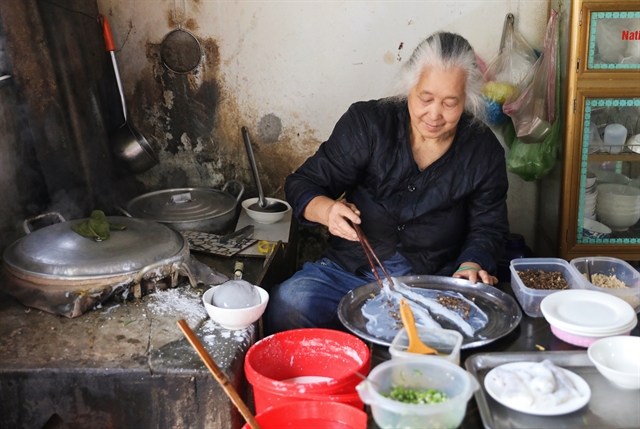 |
| TIME TESTED: Madame Ngần’s little shop has been serving Hà Giang-style bánh cuốn and ấu tẩu porridge for more than 40 years. — VNS Photo Đoàn Tùng |
Nguyễn Mỹ Hà
Hà Giang is a land that never runs out of new discoveries. After going to the mountains of Hà Giang many times, I still don't know if I've tried all of its delicacies. But cháo ấu tẩu (monkshood rice porridge) is a must-try when you go to Hà Giang.
Over three days, our itinerary took us to the city of Hà Giang, then the town of Mèo Vạc and further to Đồng Văn. Each location has its own signature shop selling monkshood porridge.
But our dining guide suggested we try the shop owned by Madame Ngần in Mèo Vạc. Located on a street corner just a few minutes' walk from the stadium in the centre of town, the shop looked cozy and familial. Madame Ngần sat by the door, ladling hot bánh cuốn (steamed rice pancakes) as clients came in and grabbed seats.
We were six. With only a handful of other customers, we still had to wait as Madame Ngần, in her 70s, made the dish by hand, she has some help from another lady who clears the table.
Bánh cuốn, rolled steamed rice pancakes with pork, may be another national dish that varies in each province due to local customs and tradition.
While in Hà Nội we're used to having the rolls dipped in marinated fish sauce, in Hà Giang, Cao Bằng and Lạng Sơn, the fish sauce is replaced by a pork or chicken bone broth. The dipping sauce was hot and matched the hot rolls perfectly, so they disappeared really fast as we dug in.
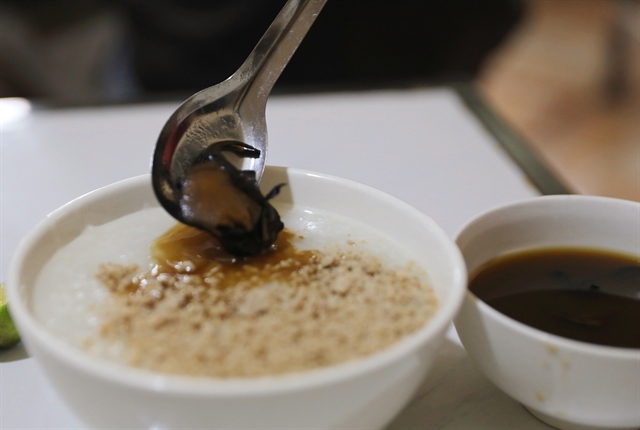 |
| BITTER TEST: Measure your ability to handle bitterness. — VNS Photo Đoàn Tùng |
Next came the much-anticipated bowl of porridge, which at first looked unimpressive to me. Some chopped purple mint and green onion were placed in the bowl before Madame Ngần ladled porridge over it. On top she layered some minced pork. Was that it?
Then another worker brought out a dish the size of a dessert bowl, which had slices of something that looked like traditional medicine sitting in black liquid.
"This is ấu tẩu," she said. "Add as you please."
I tasted the monkshood, but it was really bitter. After mixing a tablespoon full of the liquid and a few slices of the root into the bowl of porridge, I slowly enjoyed the new yet familiar taste of bitterness.
Locals say this porridge helps kill aches, pains and general soreness in your body.
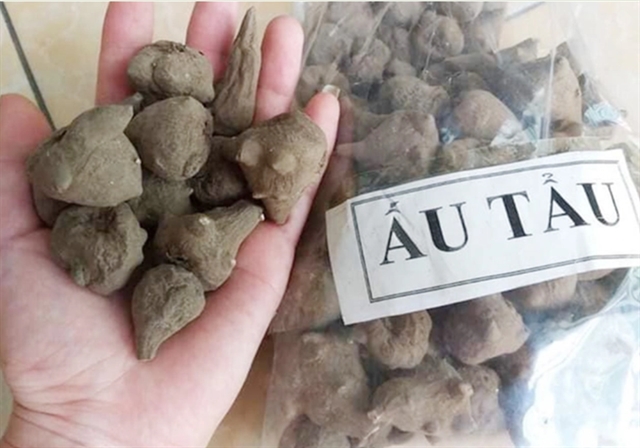 |
| POISONOUS PLANT: Stay away from these roots, as they are highly toxic. Photo suckhoedoisong.vn |
Also known as the poisonous porridge, the dish is cooked with toxic monkshood roots. The roots are scientifically known as Aconitum fortunei Hemsl, from the Ranunculaceae family. Grown naturally in Sa Pa and Hà Giang, they are an ingredient in age-old recipes from traditional medicine.
Monkshood mother roots are about 0.6 per cent alkaloids. High alkaloid concentrations can be highly toxic to humans and animals, causing symptoms including nausea, and severe gastrointestinal discomfort.
Alkaloids can also have an impact on the nervous system, leading to tremors, paralysis, convulsion or hallucinations.
The plant also has aconitin, which can be hydrolysed and become less dangerous.
Due to the special chemicals in the roots, monkshood can actually be used in pharmaceuticals.
When Madame Ngần and other local residents cook monkshood, they turn the otherwise poisonous ingredients into a medicinal food.
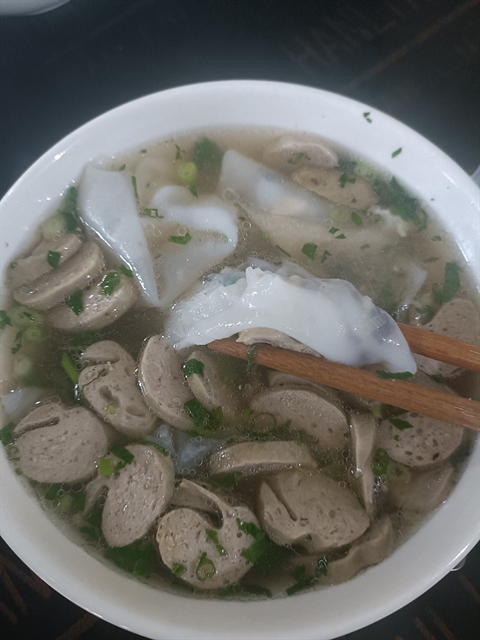 |
| MOUNTAIN ROLLS: Bánh cuốn Hà Giang with pork bone broth and green onions. — VNS Photo Đoàn Tùng |
This is a traditional recipe of the Mông people, and under no circumstances should anyone else try to cook or eat these plants in any way, as they can be dangerous.
Highly valued for its medicinal properties, the monkshood roots are soaked with alcohol to take away body pains. Locals say the porridge works best if you have it for dinner and digest the meal overnight.
As an old saying goes, 'bitter medicine cures diseases and the truth always upsets or hurts'.
Bitter flavours have always been a part of Vietnamese cuisine. Since childhood, I was always taught by my mother, who learned it from her mother-in-law, that women should learn to accept bitter flavours as part of daily nutrition. It's very good for your health.
Throughout the country, people cook with bitter vegetables. Examples include ngải cứu (mugwort) to make egg omelettes or rau đắng (endives) to accompany marinated fish hotpot or noodles, a delicacy from the Mekong River Delta. These veggies are available in any market, and are not poisonous, nor do they need a special method of cooking.
Until our next trip to Hà Giang to taste monkshood porridge again, the closest spot to try it is the Ba Tàu porridge joint in Tuyên Quang City, only three hours drive from Hà Nội. Hope to see you there. — VNS
Life & Style
 Life & Style
 Life & Style
 Life & Style
 Life & Style
 Life & Style
 Life & Style
 Life & Style
 Life & Style
 Life & Style
 Life & Style
 Life & Style
 Life & Style
 Life & Style
 Life & Style