 Life & Style
Ministry proposes allowing foreign investors to participate in market infrastructure
1.
|
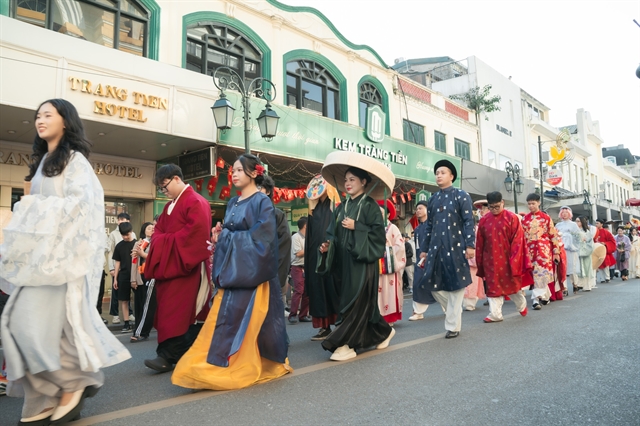
| A parade titled Bách Hoa Bộ Hành (Parade of Flowers) is one of regular activities held in Hà Nội and received huge attention of local people and visitors. —Photo courtesy of Bách Hoa Bộ Hành Club |
HÀ NỘI — More than two months after the implementation of Resolution No 80-NQ/TW on cultural development in the new era, experts say its groundbreaking provisions reaffirm the central role of culture and people in Việt Nam’s sustainable development strategy.
According to Dr Bùi Văn Tuấn, deputy director of the Hà Nội Studies and International Training Institute at Hà Nội Metropolitan University, earlier resolutions mainly viewed culture as the spiritual foundation of society. Resolution No 80, however, broadens and elevates this perspective by recognising culture not only as a spiritual value but also as an important endogenous resource for national development.
Resolution No. 80 defines culture as the spiritual foundation of society, the goal and the intrinsic motivation of development, with human beings as the centre, the subject, the goal and the driving force of cultural development.
Tuấn said the approach reflects a shift in development thinking. Culture, once regarded as a supplementary sector to the economy, is now seen as a foundation for development centred on people and cultural values. Whereas material growth was emphasised in the past, greater priority is now placed on development quality, cultural depth and human creativity.
This new perspective is not only significant for understanding but also provides an important theoretical basis for integrating culture into the entire process of planning and implementing socio-economic development strategies such as urban development, education and training, science and technology, innovation and international integration.
He added that in the new era of national rise, placing culture and people at the centre is key to building a sustainable, humane and distinctive development model while strengthening the nation’s soft power and competitiveness.
Tuấn believes Resolution No. 80 reaffirms the goal of building well-rounded Vietnamese people, while also redefining the concept of the cultural person to better suit the new context. The focus has shifted from building an ideal person to developing individuals who are comprehensive, dynamic and creative.
Resolution No. 80 stresses that Vietnamese people should possess cultural resilience in international integration, along with creative capacity, innovative thinking and the ability to adapt to global social, technological and environmental changes.
|
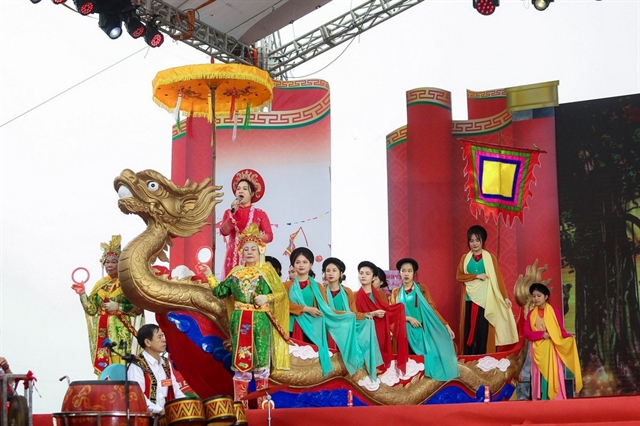
| Chèo (traditional opera) is considered a quintessential form of Vietnamese folk art, deeply intertwined with the cultural and spiritual life of the people. — VNA/VNS Photo |
The resolution affirms that cultural development is inseparable from economic development, with people serving as both creators of culture and participants in the cultural market and cultural industry.
This reflects a new understanding of culture, which not only orients the economy towards values but also directly generates added value, jobs, brands and national competitiveness.
“In this new approach, Vietnamese people are not only recipients of culture but also artists, creators and creative citizens in the digital and urban spaces,” said Tuấn.
Cultural ecosystem
Resolution No. 80 emphasises that human development is inseparable from the cultural environment and living space.
Accordingly, culture exists not only in traditional institutions such as museums, libraries and cultural centres but also in rural and urban life, public spaces, creative spaces and the digital environment.
Dr Tuấn said this provides an important theoretical basis for developing creative spaces linked to heritage, connecting cultural education with experience, practice and creativity, and developing urban areas in a humane and distinctive way.
“Vietnamese people are seen as active agents of cultural integration, diplomacy and national image promotion,” said Tuấn.
“This approach goes beyond mere preservation and protection, aiming to nurture confident individuals capable of dialogue, creativity and competition based on cultural values.”
Associate Professor Dr Bùi Hoài Sơn of the National Assembly’s Committee of Culture and Society said the resolution underscores culture’s key role in the new development period, not only as a contributor to growth but also as a driver of human resource development.
“People are now at the core of development. When culture and human factors are positioned appropriately within the development framework, it will greatly enhance the effectiveness of our policy system,” he said.
He added that Hà Nội was the first locality to issue a specific resolution on cultural industry development and considered culture a new driving force for growth. However, developing the cultural industry is not simply about commercialising cultural products, but about elevating creative value based on cultural identity.
|
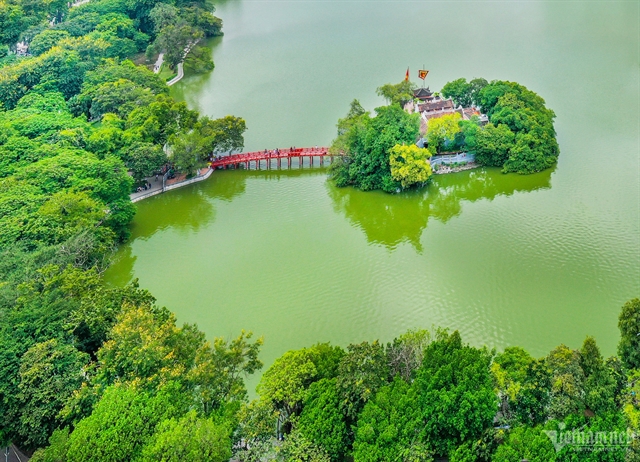
| Hồ Gươm seen from above. It is one of the most famous sightseeing destinations in Hà Nội. — Photo vietnamnet.vn |
Hà Nội is home to many historical heritage sites, including Khuê Văn Các (Constellation of Literature) pavilion and Turtle Tower, which are symbols of the city in particular and of Việt Nam in general. Other structures include buildings from the French colonial period, while new constructions have become impressive landmarks, embodying Vietnamese history, spirit and values.
He suggested that preserving these values requires comprehensive solutions. Hà Nội and other localities should develop a creative ecosystem and a supportive environment to connect resources and promote cultural growth rooted in national identity while embracing global values. — VNS
Life & Style
 Life & Style
 Life & Style
 Life & Style
 Life & Style
 Life & Style
 Life & Style
 Life & Style
 Life & Style
 Life & Style
 Life & Style
 Life & Style
 Life & Style
 Life & Style
 Life & Style