 Life & Style
Israeli agricultural know-how takes root in Việt Nam
1.
|
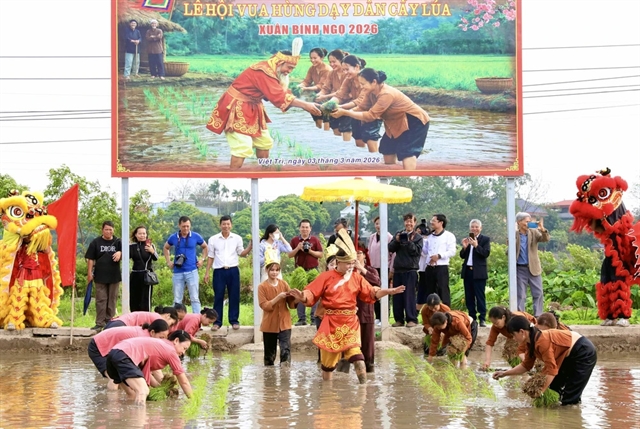
| A reenactment of the Hùng King entering the fields to teach villagers how to transplant rice seedlings at the Tịch Điền altar in Việt Trì Ward, Phú Thọ Province. — VNA/VNS Photos Tạ Toàn |
PHÚ THỌ — The 'Hùng King Teaching People to Plant Rice' Festival was held at the Tịch Điền altar in Việt Trì Ward, Phú Thọ Province on March 3 (the 15th day of the first lunar month of the Year of the Horse 2026), paying tribute to the Hùng Kings who are credited with laying the foundations of agriculture in the early days of nation-building.
The festival is considered the only celebration of its kind that symbolically marks the birth of wet-rice cultivation among ancient Vietnamese communities during the Hùng Kings era. It also officially launched a series of activities for the 2026 Hùng Kings’ Commemoration and Hùng Temple Festival in the province.
Honouring the founders of agriculture
According to legend, in ancient times people did not know how to cultivate rice and relied mainly on wild roots, vegetables and game for sustenance. Observing that riverbanks became more fertile after seasonal floods deposited layers of alluvium, the Hùng King guided his subjects to build embankments to retain water.
One day, the King’s daughters followed villagers to fish by the river and saw flocks of birds circling above the fields. A bird dropped a rice panicle onto the hair of one princesses, who brought it back to the King. Considering it a good omen, he ordered the collection of the grains.
In the following spring, the King and his people carried the seeds to the fields. He used a pointed stick to make holes in the soil and sow the grains. When seedlings sprouted, people still did not know how to transplant them. The King then uprooted the young rice shoots and waded into the paddies to demonstrate how to replant them. The princesses and villagers followed his example.
Later generations, grateful for his guidance, revered him as the founding patriarch of agriculture. They built the Tịch Điền altar facing southwest on the very mound where the King was said to have taught rice planting, established a granary on Lúa Hill, stored straw on Rơm Hill, and named the local market Chợ Lú.
In an effort to preserve and promote the distinctive cultural heritage of the Hùng Kings era and to meet the spiritual needs of the community, the former Việt Trì City People’s Committee restored the festival in 2018 after comprehensive and systematic research into its history and traditional customs.
The festival consists of two main parts. The ritual section includes the cáo yết (announcement ceremony), offerings to the God of Agriculture, and solemn worship rites. Notably, the reenactment of 'Hùng King teaching people to plant rice' is performed with full ceremonial dignity by local leaders and residents.
The festive section features rice-planting competitions among village teams and a range of traditional folk games, drawing enthusiastic participation from locals and visitors alike.
By recreating typical agricultural rites associated with the first ploughing of the fields, the festival helps safeguard a unique intangible cultural heritage while celebrating the diligence and creativity that shaped the cultural identity of the ancient Văn Lang capital.
Phú Thọ has also incorporated the preservation of traditional rice varieties into its land-use planning, gradually developing agricultural products linked to tourism and services. The effort includes collecting and supplementing valuable artefacts such as the so-called 'sacred rice grains' found in Lú Village, Việt Trì Ward.
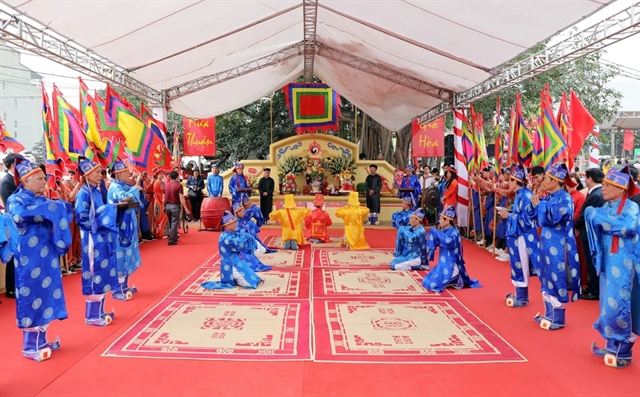
|
| Village elders perform ritual offerings at the Tịch Điền altar during the Hùng King Teaching People to Plant Rice Festival in Phú Thọ Province. |
Lăng Sương Temple Festival opens
On the same day, the opening ceremony of the 2026 Lăng Sương Temple Festival was held at the Lăng Sương National Historical Site in Tu Vũ Commune, Phú Thọ Province, marking the start of a series of traditional spring festivals in the former Thanh Thủy District, now Tu Vũ Commune.
In a solemn atmosphere, delegates offered incense, flowers and ritual items in tribute to Đức Thánh Tản Viên Sơn Thánh (the Tản Viên Mountain God), his family and his two generals Cao Sơn and Quý Minh – revered deities credited with helping people control floods, reclaim land and protect communities. The traditional worship ceremony followed, expressing deep respect for these ancestral figures.
Beyond the ritual segment, this year’s festival features diverse cultural performances, sports activities and folk games imbued with the distinctive identity of the ancestral land, attracting large numbers of residents and visitors.
Lăng Sương Temple is dedicated to Tản Viên Sơn Thánh, one of the 'Four Immortals' in Vietnamese folk belief, along with his father, mother, foster mother and generals. It is the only temple in Việt Nam that worships his entire family.
The site has been recognised as a National Historical and Cultural Relic, and its traditional festival was inscribed as National Intangible Cultural Heritage in 2018.
The Lăng Sương Temple Festival is not only an occasion to commemorate ancestral merits and pray for favourable weather and abundant harvests in the new year, but also a vibrant cultural event that draws people back to the spiritual roots of the nation each spring. — VNS
Life & Style
 Life & Style
 Life & Style
 Life & Style
 Life & Style
 Life & Style
 Life & Style
 Life & Style
 Life & Style
 Life & Style
 Life & Style
 Life & Style
 Life & Style
 Life & Style
 Life & Style