 Environment

Deputy PM requests to make profound impression in first year of Việt Nam Culture Day
1.
|
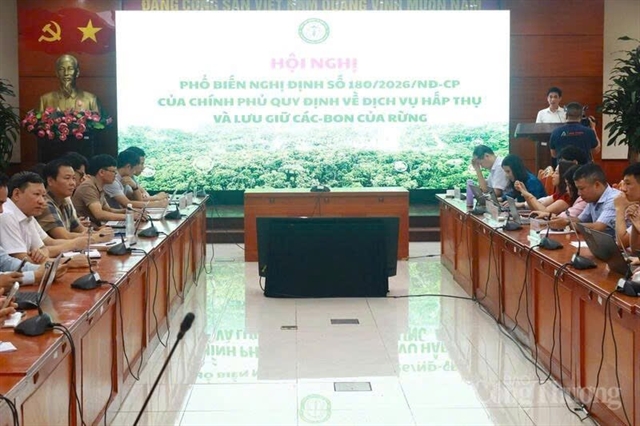
| The conference introduces the Government’s Decree 180/2026/NĐ-CP on forest carbon sequestration and storage services, alongside a draft National Standard for Forest Carbon Credits on Thursday. Photo Tâm Tâm |
HÀ NỘI — A new Government decree regulating forest carbon sequestration and storage services will establish a unified legal framework for forest carbon credits, laying the groundwork for national standards and a transparent carbon market that supports Việt Nam's emissions reduction commitments, forestry officials said on Thursday.
Speaking at a conference introducing the Government’s Decree 180/2026/NĐ-CP on forest carbon sequestration and storage services as well as a draft National Standard for Forest Carbon Credits on Thursday, Phạm Hồng Lượng, deputy director of the Department of Forestry and Forest Protection, described the decree as a milestone for carrying out the Forestry Law and developing a domestic forest carbon market.
Issued on May 21, the decree will take effect on July 15. It comprises four chapters, 20 articles and six appendices detailing project documentation, methods for allocating emissions reduction targets, contract templates and financial management requirements.
“The decree creates a comprehensive legal basis for forest carbon services and provides a clear framework for generating, managing and trading forest carbon credits in Việt Nam," Lượng said.
He noted that the country has gradually developed its forest environmental services policy over nearly two decades. Pilot payments for forest environmental services began in 2008, followed by a Government decree in 2010 establishing the payment mechanism. The 2017 Forestry Law subsequently recognised forest carbon sequestration and storage as one of the five legally defined forest environmental services.
Over the years, the forestry sector has worked with international organisations, research institutes, universities and technical experts to design mechanisms for a forest carbon market.
One of the strongest foundations for the new decree was the successful implementation of the North Central Region Emissions Reduction Programme, under which more than 11.3 million tonnes of carbon emissions reductions were transferred, generating approximately US$56.5 million for nearly 80,000 beneficiaries.
According to the decree, forest carbon credits may be generated from a range of eligible activities, including reducing deforestation and forest degradation (REDD+); afforestation and assisted natural regeneration; enrichment and restoration of natural forests; improving productivity and extending harvesting cycles in plantation forests; and agroforestry and scattered tree planting.
Projects must be developed, registered, measured, reported and independently verified in accordance with prescribed procedures before becoming eligible for carbon credit issuance.
From January 1, 2028, carbon credit generation must follow methodologies recognised by the Ministry of Agriculture and Environment or comply with the National Standard for Forest Carbon Credits to be issued by the Ministry of Science and Technology.
Carbon credits may only be supplied to the market after authorities certify emissions reduction results or confirm that the credits satisfy all market requirements.
Alongside the implementation of Decree 180, the ministry is finalising the draft National Standard for Forest Carbon Credits to establish a consistent technical framework for project development and credit issuance.
According to Việt Nam Forest Certification Centre Director Vũ Tấn Phương, the proposed standard will introduce uniform requirements covering the entire carbon credit cycle, including project development, carbon measurement, validation, verification, registration and issuance.
“It will serve as a key technical foundation to ensure the quality and integrity of forest carbon credits, enhance transparency and facilitate the development of the carbon market,” Phương said.
The draft standard consists of six main sections: the scope of application, requirements for forest carbon credits, project eligibility, carbon measurement, reporting and accounting, validation and verification procedures and credit registration and issuance.
It requires all forest carbon credits to originate from legitimate forestry and land-use projects that comply with legal requirements on project registration and applicable standards. Carbon accounting must follow methodologies developed by the Intergovernmental Panel on Climate Change, while all projects must undergo independent validation and verification before credits can be registered and issued.
Five categories of eligible projects are identified in the draft: REDD+; afforestation and assisted natural regeneration; restoration and enrichment of natural forests; improving productivity and extending plantation forest rotations; and agroforestry and scattered tree planting.
Projects must demonstrate legal rights to land and forest resources, comply with land, forestry and environmental regulations, clearly define project boundaries on maps and provide sufficient data for carbon accounting.
A central component of the proposed standard is its detailed guidance on measuring, reporting and verifying greenhouse gas emissions and carbon removals.
Beyond technical requirements, the draft standard includes environmental and social safeguards requiring compliance with relevant laws, protection of workers' rights, stakeholder consultation, equitable benefit sharing and effective grievance mechanisms.
Validation and verification procedures must be aligned with international standards, including ISO 14064, ISO 14065 and ISO 14066, while independent validation bodies must demonstrate the technical competence required to assess projects before credits are approved.
The Department of Forestry and Forest Protection said the ministry is also developing supporting regulations, including a national forest carbon pricing framework, implementation guidelines, a national carbon database and an enhanced measurement, reporting and verification system.
Training programmes will also be expanded to strengthen the capacity of Government agencies and forest owners.
The ministry will oversee the development of national standards, certify emissions reduction results and manage forestry sector mitigation targets, while provincial People's Committees will be responsible for implementing projects, managing local databases and submitting periodic reports.
Officials said the new legal framework is expected to gradually establish a transparent and efficient forest carbon market, mobilising additional financial resources for forest protection and sustainable development, improving local livelihoods and supporting Việt Nam's goal of achieving net zero emissions by 2050. — VNS
Environment
 Environment
 Environment
 Environment
 Environment
 Environment
 Environment
 Environment
 Environment
 Environment
 Environment
 Environment
 Environment
 Environment
 Environment