 Environment

Việt Nam, China seek stronger substantive parliamentary cooperation
1.
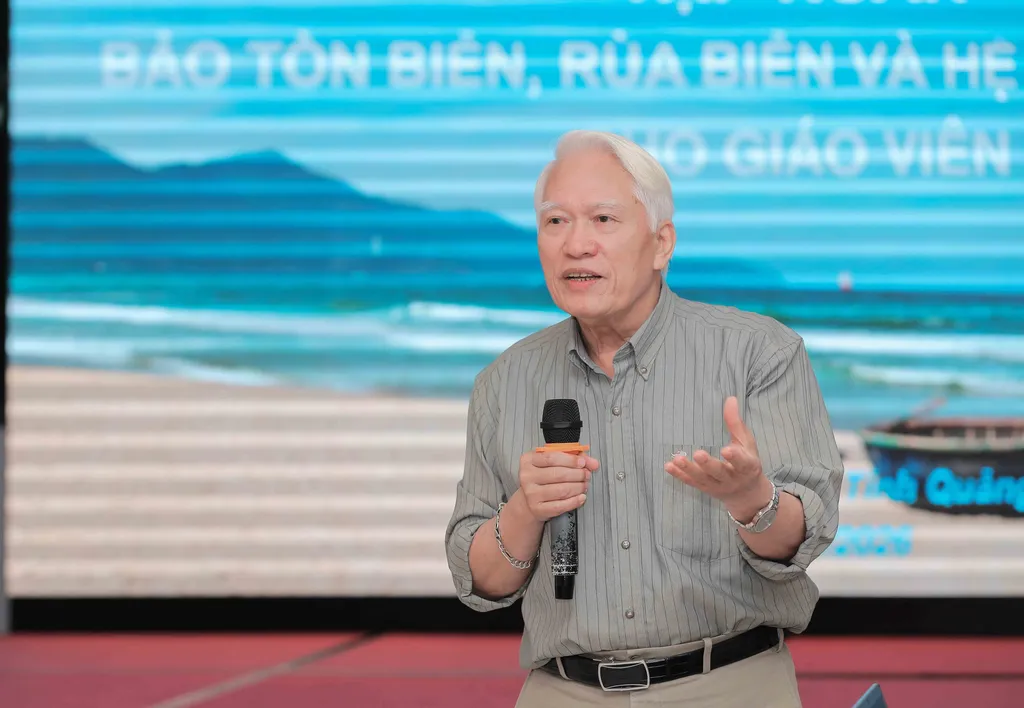 |
| TEACHING TIDES: Associate Professor Dr Nguyễn Chu Hồi leads a training course for Lý Sơn local teachers on marine conservation. VNA/VNS Photo An Phương |
Việt Nam’s marine ecosystems, including those around Lý Sơn Special Zone, are under growing pressure. Việt Nam News and Law reporter Mai Khuyên speaks to Assoc Prof Dr Nguyễn Chu Hồi, permanent vice president of the Việt Nam Fisheries Society and deputy of the 15th National Assembly (2021-25), about the role of Marine Protected Areas and efforts to protect the coastal marine environment.
Could you analyse specific features of Việt Nam's marine ecosystem and the sea area around Lý Sơn Special Zone in particular?
Việt Nam has a large sea with a long coastline stretching along the meridian and cutting through many natural-ecological regions. This creates a rich diversity of biodiversity and natural landscapes, including about 25 tropical marine and coastal ecosystems, including coral reefs, seagrass beds and mangrove forests.
These ecosystems are widely distributed throughout the sea and coastal areas, serving as a "common home" for approximately 12,000 marine organism species, including many specialised aquatic species and over 100 economically valuable fish species.
Furthermore, these ecosystems also determine connectivity, possess high marine conservation potential and act as carbon sinks. They provide the resource basis for developing a sustainable and responsible fisheries sector in Việt Nam.
The Vietnamese marine environment is transboundary and influenced by seasonal currents, so most marine organisms are migratory. Therefore, marine biodiversity and fisheries management must prioritise protecting species’ habitats and regulating the activities of marine users through effective management of Marine Protected Areas (MPAs) and threatened species.
Among the 16 national MPAs in the country, one is located in the Lý Sơn Special Economic Zone in the central province of Quảng Ngãi. Coral reefs in this area are dominant and of the fringing reef type, developing on the foundation of ancient volcanic islands, including Đảo Lớn (Large Island) and Đảo Bé (Small Island).
The environmental characteristics and resources here are similar to those mentioned above, but this nearshore area is directly influenced by activities on the island (covering an area of about 10sq.km), which has the highest population density (2,500 people per square kilometre) among other special administrative zones in Việt Nam.
The marine ecosystems are not only a source of sustainable livelihood for local communities, but also a prerequisite for the zone's sustainable marine economic development. In particular, alongside the unique landscape of ancient volcanoes, as well as the historical and maritime cultural values, the nearshore waters around Lý Sơn provide a foundation for the development of island marine tourism and recreational fisheries.
From your professional standpoint, what are the major issues that have been and will threaten the country's marine ecosystem?
The marine environment and ecosystems of Việt Nam have been and will continue to face significant challenges that degrade coastal marine ecosystems, causing marine pollution.
First, the country's coastal areas, seas and islands annually suffer from natural disasters, climate change, oceanic changes (including sea level rise) and human-induced environmental incidents, with increasing frequency, severity and extremity.
Next are the impacts of land-based pollution, especially non-biodegradable plastic waste. In particular, the tense, complex and unpredictable situation in the East Sea (internationally known as the South China Sea) poses a major challenge, both in the short and long term, to the country’s marine resources and environment.
As a consequence, the area of important marine ecosystems has decreased by 40–60 per cent, with coral reef coverage reduced to only about 1 per cent in very good condition, about 31 per cent in poor condition, and 41 and 26 per cent in relatively good and good condition, respectively.
Untreated waste from river basins and coastal areas is discharged into the sea, causing pollution in some coastal areas, while red tides are appearing more frequently and over a wider area.
Marine animal populations tend to move further offshore due to changes in coastal circulation patterns, river-sea interactions in estuaries, and the loss of important natural habitats for species that live in coastal areas and migrate seasonally from continental shelf areas. Marine living resources are declining in reserves, yields and size. The productivity of extensive shrimp farming in mangrove forests has decreased, and the yield of fisheries per unit of marine ecosystem has also declined.
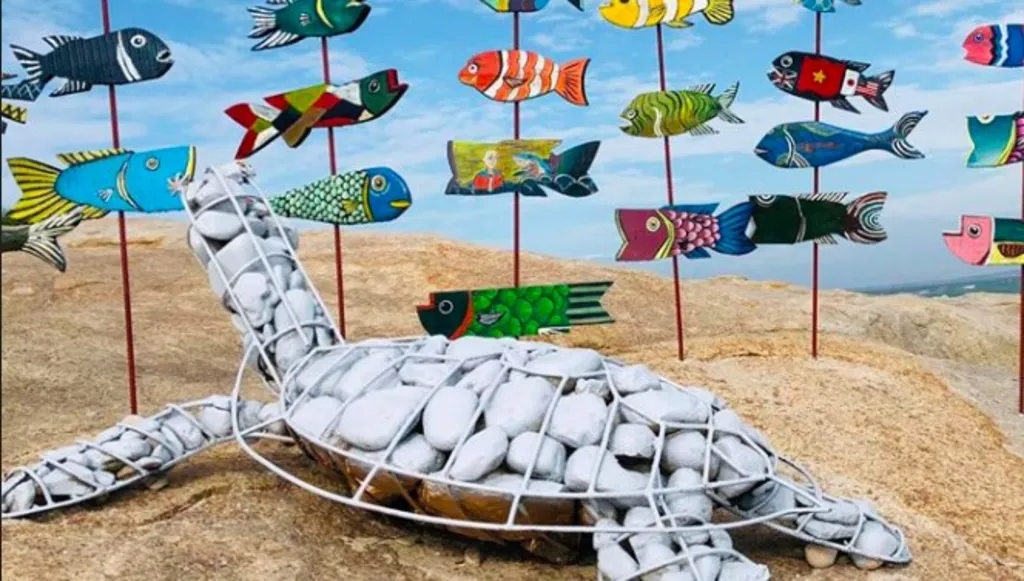 |
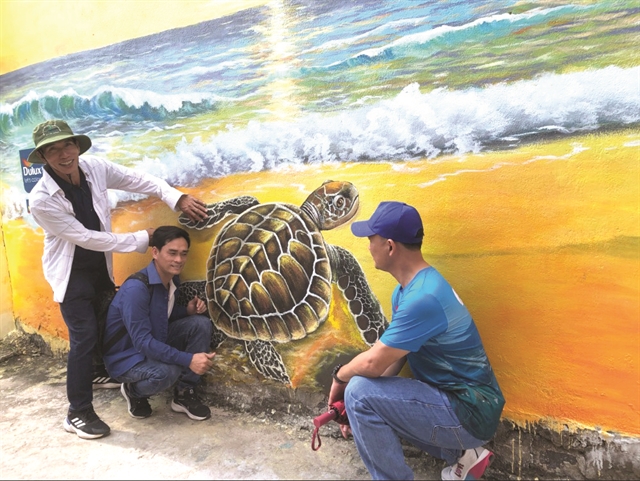
| TURTLE TROVE: An art installation created by IUCN volunteers promotes the conservation of the marine ecosystem, particularly sea turtles and other species in Hòn Cau Marine Protected Area. Photo courtesy of IUCN Việt Nam |
Meanwhile, marine resources in nearshore waters show signs of over-exploitation due to a rapid increase in the number of small fishing vessels, a decline in community structure and falling fishing efficiency. Marine fish stocks have dropped by about 14 per cent compared to the pre-2010 year, including decreases in species diversity and the density of food fish.
Consequently, some harmful organisms are proliferating, particularly the crown-of-thorns starfish (Acanthaster planci), a coral-eating pest.
How about the implementation of the Government's policies in improving the situation of Việt Nam's marine ecosystem conservation and in Lý Sơn?
As mentioned above, marine and coastal ecosystems provide the resource base for the nation’s marine economic development in general, and the fisheries and marine tourism sectors in particular.
The environmental quality and service values of marine ecosystems are crucial to the sustainability of the country’s marine economy and the welfare of people in 21 coastal provinces and cities as well as in 13 special zones, including Lý Sơn.
To cope with the degradation of the marine environment and ecosystems, the Vietnamese Government has prioritised and focused on marine conservation activities.
Accordingly, with the efforts of environmentalists and the support of international organisations, especially the International Union for Conservation of Nature (IUCN), in 2010 the Prime Minister approved a master plan for a system of 16 MPAs in Việt Nam.
The plan has helped conserve the total area of marine protected areas to approximately 270,271 hectares of marine area, including about 70,000 hectares of coral reefs, 20,000 hectares of seagrass beds and a portion of mangrove forests, mostly spawning and breeding grounds, and habitats of economically important aquatic species.
Nearly 100 endemic and endangered species are managed within these MPAs. This initial system of 16 MPAs represents the entire marine region of the country, covering 21 coastal provinces and cities.
If well managed, it is expected to create ecological balance across the whole marine region. After three to five years of good management, the MPAs will also achieve a recovery effect, with a spillover effect in subsequent years, spreading seeds and nutrients into the surrounding large marine waters.
Could you comment on the support of the IUCN in the management of MPAs, marine ecosystems and especially turtle species in Lý Sơn?
Over many years of successfully supporting Việt Nam in programmes on marine and sea turtle conservation, such as those in Nha Trang, Côn Đảo and Cù Lao Chàm, the IUCN has compiled a set of good practices.
Recently, the MPA in Lý Sơn has received technical support from the IUCN in collaboration with local authorities, sharing experiences and improving skills for marine conservation officers, fishermen and stakeholders.
Activities include programmes to protect and restore turtles and marine mammals, as well as transferring knowledge to fishermen in the special zone to test the application of digital literacy in processing information on the accidental capture of species during fishing at sea.
This approach to species conservation linked with ecosystem conservation is useful for Lý Sơn, and if implemented well, it can further refine techniques and be developed into a model for replication in other special economic zones and coastal localities across the country.
As a deputy of the 15th National Assembly with extensive experience in marine affairs, what have you proposed to the NA?
During the 15th NA sessions (2021-25), drawing on my specialised knowledge and experience in research, management and teaching of marine science and marine management policies, I offered my opinions on legal documents and decisions of the NA in many fields, focusing heavily on laws and policies related to marine and island affairs, the marine economy, and sustainable and responsible fisheries.
One of my main concerns was the system of policies and laws, which I proposed should comprehensively address three issues: fishermen, fisheries and fishing grounds.
Addressing these three issues will help achieve the goal of developing sustainable and responsible fisheries in Việt Nam. It is also a supportive way to prevent, mitigate and eventually eliminate illegal, unreported and unregulated (IUU) fishing.
My proposals have been considered and recognised by the NA and used as references in refining and improving policies and laws in line with the country’s realities.
What recommendations do you have for the implementation of Government programmes promoting and supporting marine conservation work at the local level?
My concern about marine conservation and environment protection focuses on the effectiveness of managing MPAs.
To date, in our country, there is still no unified institutional model for managing and governing the MPAs in a way that implements inter-sectoral coordination mechanisms and MPA’s integrated management. This is because impacts on MPAs mainly come from outside the protected areas. Meanwhile, human resources, equipment and finances for conservation often fall short of the MPA’s Management Boards' expectations.
In reality, local people living near and within MPAs and businesses as the users of the sea, remain on the sidelines. These two supporting forces are crucial to the effective operation and management of MPAs, filling gaps in manpower and funding for conservation so these have to be involved into the MPA management process. — VNS
Environment
 Environment
 Environment
 Environment
 Environment
 Environment
 Environment
 Environment
 Environment
 Environment
 Environment
 Environment
 Environment
 Environment
 Environment