 Environment

Việt Nam, China seek stronger substantive parliamentary cooperation
1.
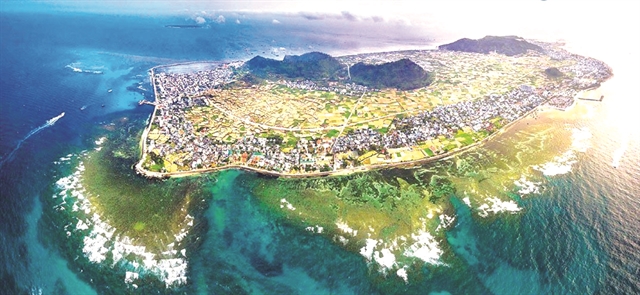 |
| ISLE VISTA: A panoramic view of Lý Sơn Special Zone from above. — Photo baoquangngai.vn |
Mai Khuyên
LÝ SƠN — For more than three decades at sea, fisherman Phạm Dũng never gave much thought to concepts like sustainability or conservation – until a training course forced him to rethink everything he knew about the ocean.
Dũng, 53, from the central province of Quảng Ngãi’s Lý Sơn Special Zone, and hundreds of local fishermen in his native village in An Vĩnh residential area said that during fishing trips, their minds were occupied only with lessons about sea waves, wind patterns, and, most importantly, how to fill the net – all with the sole goal of bringing in enough to feed their families.
These lessons, passed down through generations from their forefathers, remain obligatory for every fisherman and are still taught to sons who wish to go fishing at sea in the future.
Changing mindsets
However, their perspectives have completely changed after attending special training courses provided by environmental campaigners and experts from the International Union for Conservation of Nature (IUCN), the Lý Sơn Marine Protected Area (MPA) Management Board, and the Quảng Ngãi Fisheries Association.
 |
| SEA SAGE: Fisherman Phạm Dũng (right) speaks with experts about current issues affecting the marine ecosystem around Lý Sơn, drawing on more than 30 years of fishing experience. VNS Photo Mai Khuyên |
The courses are part of a long-term programme aimed at improving knowledge, raising awareness, instilling a sense of responsibility and encouraging the involvement of local communities in marine protection and conservation.
They have been held annually over the past two years, with different themes tailored to different groups of locals, such as fishermen, teachers, and students, depending on timing, but always focusing on a common key objective: strengthening marine conservation and sea environment protection.
Speaking about his initial attitude towards the courses, Dũng said: “When I first received an invitation to attend a course, I refused outright and thought it was nonsense because nature and the sea have unlimited resources and we just have to follow our tradition and our forefathers' fishing lessons to get a living.”
According to Dũng, despite his refusal, the board continued to send more persuasive letters until he accepted, initially out of curiosity and without thinking it would change his perspective.
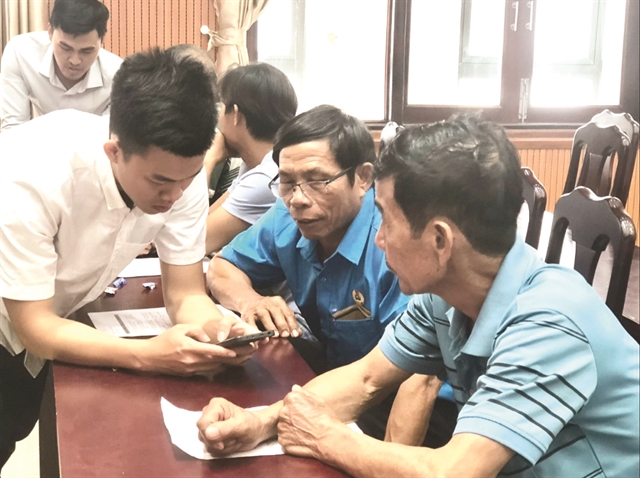 |
| APP TIDE: Fishermen from Lý Sơn learn to use an app at a training course provided by IUCN in collaboration with the Lý Sơn MPA Management Board on March 23 to support marine conservation in local waters. — VNS Photo Mai Khuyên |
Learning at sea
“I have actually changed after the course," Dũng said. "It was not what we thought before but a really useful experience because we were taught precious new lessons about how to use our fishing skills in a way that can ensure the effectiveness of netting but still not cause damage to the sea environment.”
Previously, whenever Dũng went offshore, he would try to catch as many fish and other sea animals as possible, solely to provide food for the family or generate income, regardless of species.
But now, after attending several courses, he understands that nature – particularly the marine environment – has been seriously damaged by multiple factors.
Along with the lessons in traditional fishing skills learned from his forefathers, his knowledge about natural conservation has been significantly enriched.
“Through knowledge that I have been trained on the courses, I know that the sea provides us with food but it is facing serious damage due to many reasons such as over-exploitation, climate change and the boom of tourism development,” Dũng said.
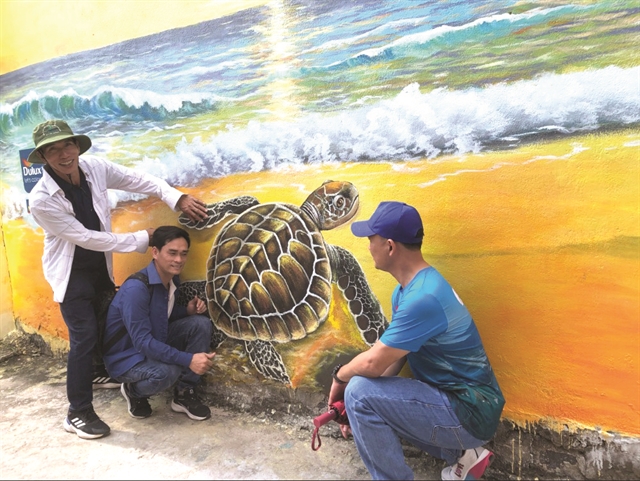 |
| TURTLE TALE: A mural promotes the conservation of sea turtles and other marine species on An Bình Island in Lý Sơn Special Zone. — VNS Photo Mai Khuyên |
He confirmed that some species were facing extinction, such as rays and sea turtles, which he could once see in large numbers coming ashore to lay eggs, but are now very rare or even absent in some years.
“Thanks to the courses, we now know a list of sea animals which are being threatened and we should protect them. We are also trained how to do that. For example, if we catch the turtles, we should release or carry them live to the functional authority, especially the (MPA) Management Board," he said.
“Therefore, I commit to working with authorities to promote the preservation and protection of the marine ecosystem in Lý Sơn.”
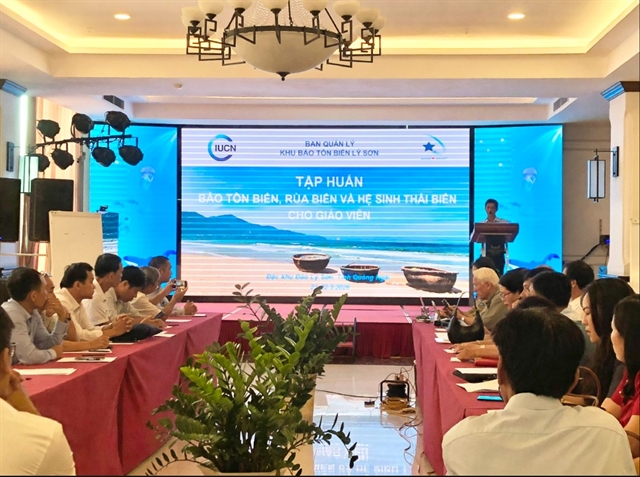 |
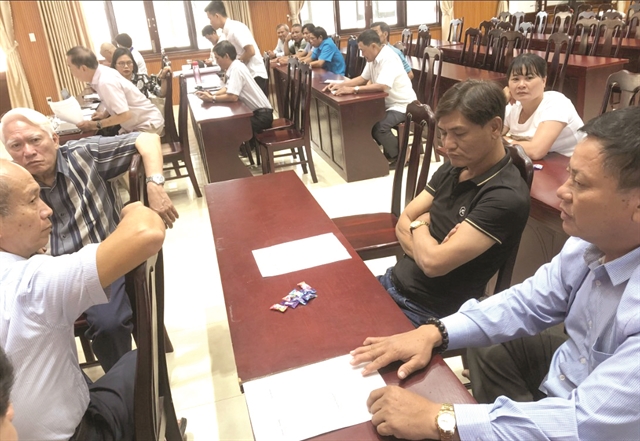
| SEA LESSON: About 60 teachers from secondary schools across Lý Sơn attend a training course on marine ecosystem protection, focusing on sea turtles and other species. VNS Photo Mai Khuyên |
Education role
Meanwhile, Trần Đức Nhân, a teacher from the An Vĩnh Secondary School in Lý Sơn, said he attended a training course last week about the sea ecosystem and the importance of conserving sea animals for the first time.
He was among 60 teachers from secondary schools across Lý Sơn, who spent a full day learning about the marine environment, particularly the protection of sea turtles, which are threatened by rapid tourism development and climate change.
Nhân said the course was highly valuable for his teaching, as teachers play a key role in raising awareness of urgent environmental issues.
“I will integrate this knowledge into the curriculum to help students better understand the marine environment and contribute to its protection,” he said.
Bùi Thị Thu Hiền, IUCN programme manager for marine and coastal areas, said that leading environmental problems were partly caused by human neglect, lack of knowledge, and even greed.
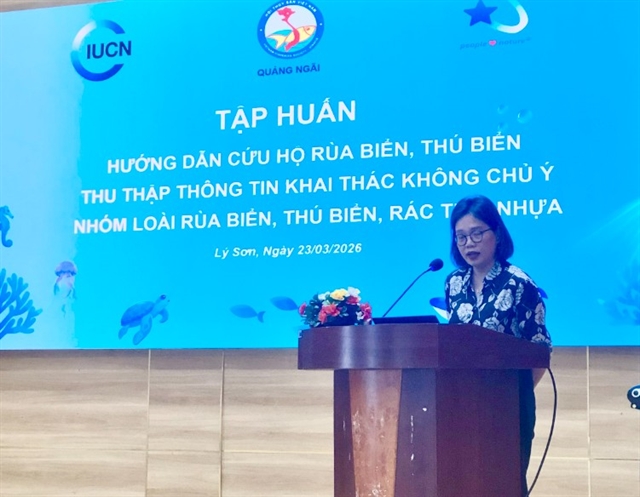 |
| SEA SAVVY: Bùi Thị Thu Hiền, IUCN programme manager for marine and coastal areas, highlights leading environmental problems at a training course for fishermen in Lý Sơn. VNS Photo Mai Khuyên |
She emphasised that widespread change was needed in both cultural and behavioural practices, with the participation of all community groups.
According to Hiền, local community groups, particularly teachers and fishermen, play an extremely crucial role in collaborating with authorities, specialised agencies, scientists, and conservation teams.
“They don’t need to do anything drastic; they just need to start by building habits, guiding behaviour and raising awareness among students, fishing households and coastal communities,” she said at a training course for Lý Sơn teachers in March.
Also speaking at the two training courses held by the IUCN and the Lý Sơn MPA Management Board for teachers and fishers in Lý Sơn Special Zone in March, Huỳnh Ngọc Dũng, director of the board, emphasised that the ocean is not only a living space for coastal inhabitants but also a repository of invaluable ecosystems such as coral reefs, seagrass beds and intertidal zones, which are habitats for endangered species.
“However, climate change, environmental pollution and unsustainable exploitation are posing serious challenges to these ecosystems,” he said.
The programme, he added, equipped teachers and fishermen with practical tools, including digital applications to report and monitor marine ecosystems and species such as sea turtles.
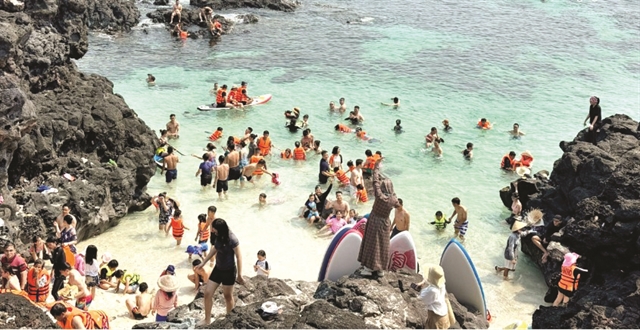 |
| ISLE PRESSURE: Tourists check in at Đảo Bé (An Bình Island) in Lý Sơn Special Zone. A surge in tourism is among the factors threatening the local marine ecosystem. — Photo courtesy of baoquangngai.vn |
Conservation goals
In 2024 the Prime Minister approved a project to boost activities in marine protection and conservation in the country’s sea and island areas.
The project focuses on expanding and establishing new marine and fisheries protected zones, while restoring marine ecosystems, with the target that by 2030, Việt Nam will ensure marine and coastal protection and conservation zones cover 6 per cent of the nation’s natural sea area.
Accordingly, about 27 marine protected areas will be established, expanded, and effectively managed, ensuring that by 2030, the total area of MPAs will reach approximately 0.46 per cent of the country’s total natural sea areas.
At the same time, 59 protected areas for aquatic resources and 63 others where fishing in the sea is prohibited for a limited time will be effectively managed, ensuring the total area of designated aquatic resource protected areas and sea animal breeding protected areas reaches 2.30 per cent of the total natural sea areas.
According to a report from the IUCN, the current percentage of marine conservation areas in the country is only 2.9 per cent, lower than the target of 6 per cent set in the Government's Resolution 36 issued in 2018 and Resolution 48 issued in 2023, and significantly lower than the initiative’s goal of 30 per cent of the ocean protected by 2030.
More than 40 per cent of coral species and one-third of shark, ray and whale shark species are facing extinction, the report says.
To date, just over 174,740 hectares of marine area nationwide have been conserved –accounting for just over 0.17 per cent of the total natural marine area.
Although several major MPAs have been established across the country, global targets – including protecting 10 per cent of the ocean by 2020 – have yet to be achieved.
Experts say expanding and effectively managing MPAs will help restore ecosystems, improve fish stocks and support sustainable livelihoods, while also mitigating the impacts of climate change and natural disasters.
For fishermen like Dũng, the sea is no longer just a place to earn a living, but something to protect. And as awareness spreads from classrooms to fishing boats, the hope is that this new understanding will help ensure that the ocean can continue to sustain future generations. – VNS
Environment
 Environment
 Environment
 Environment
 Environment
 Environment
 Environment
 Environment
 Environment
 Environment
 Environment
 Environment
 Environment
 Environment
 Environment