 Environment

Smart Banking 2026 to open next week in Hà Nội
1.

|
| First foreign tourists visit Huế Imperial Citadel yesterday after its closure following recent flooding. VNA/VNS Photo Nguyên Lý |
HÀ NỘI – Prime Minister Phạm Minh Chính, in his urgent dispatch issued on November 2, commended local Party committees, authorities, residents, and military and public security forces for their coordinated actions against recent floods in the central region, guided by the 'four-on-the-spot' principle and the spirit of solidarity and mutual support.
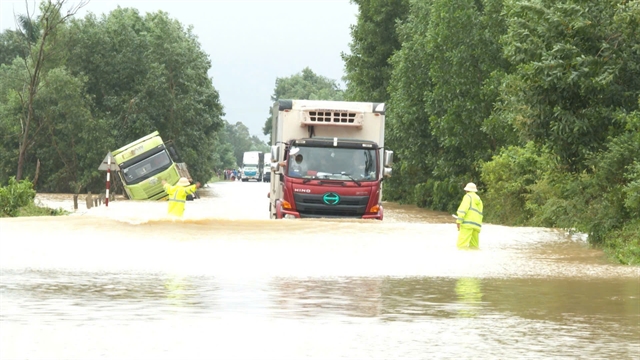
According to the dispatch, heavy rainfall and floods struck central localities in late October, causing significant loss of life and severe damage to homes and property.
Party General Secretary Tô Lâm, permanent member of the Party Central Committee’s Secretariat, along with other Party and State leaders, closely monitored the situation, directed response efforts, and personally visited affected areas to offer support and encouragement.
The Government, the Prime Minister, Deputy Prime Ministers, and leaders of ministries, sectors, and localities directly oversaw emergency operations, pooling all available resources to assist residents and mitigate the impact of floods and landslides. Their efforts helped reduce losses and stabilise lives in disaster-stricken areas.
The PM ordered secretaries of the Party Committees and chairpersons of the People’s Committees of Thừa Thiên-Huế, Đà Nẵng, Quảng Ngãi, Quảng Trị and Hà Tĩnh, as well as heads of relevant ministries, to continue post-disaster recovery measures with the highest sense of urgency and effectiveness to restore normal life as quickly as possible.
Earlier, to accelerate the progress of the Party and State’s people-centred policies and improve disaster management efficiency, the National Civil Defence Steering Committee was established under the PM’s decision dated July 23, merging the former Central Steering Committee for Disaster Prevention and Control and the former National Committee for Disaster Response and Search and Rescue. Its guiding principle is 'Proactive, decisive, preventive, and ready to respond at the highest level to worst-case scenarios.'
As an inter-agency coordination body, the National Civil Defence Steering Committee advises the Government and the PM on organising and managing civil defence nationwide. It directly oversees civil defence commands of ministries, agencies, and provinces.
Specifically, the committee advises the PM on building and enforcing policies, laws, strategies, projects, and plans related to civil defence, disaster response, and search and rescue. It coordinates with ministries, government agencies, organisations, and localities to ensure effective prevention, response, and recovery efforts across the country.
PM Chính serves as the committee’s head. Deputy PM Trần Hồng Hà acts as permanent deputy head, alongside Minister of National Defence Gen. Phan Văn Giang, Minister of Public Security Gen. Lương Tam Quang, Minister of Agriculture and Environment Trần Đức Thắng, and Minister of Health Đào Hồng Lan. Other members include leaders from ministries and state agencies such as the Vietnam News Agency.
Under the Government’s Decree No. 200/2025/NĐ-CP, effective on August 23, 2025, each province’s Civil Defence Command is led by the provincial People’s Committee chairperson, with a vice chairperson serving as permanent deputy head.
At the communal level, the Civil Defence Command is headed by the communal People’s Committee chairperson, supported by a vice chairperson as permanent deputy head.
The provincial Civil Defence Command is responsible for building and launching civil defence and disaster prevention plans, receiving and managing disaster-related information, advising the chairperson of the provincial People’s Committee on declaring or lifting civil defence levels, and directing response and recovery operations.
Since 2021, under Regulation No. 01/QĐ-TWPCTT issued by the Central Steering Committee for Disaster Prevention and Control, provincial disaster response performance has been assessed using specific criteria through 2025. The goal is to establish measurable and objective indicators to evaluate each province’s annual disaster management performance.
This framework enables authorities to quantify results across prevention, response, and recovery phases, allowing performance comparisons among localities. By using the disaster prevention index, central and local agencies can identify strengths and weaknesses in their disaster management strategies, enabling targeted improvements.
The index comprises four groups, 24 criteria, and 52 sub-indicators, totalling 100 points, with 15 for organisation and planning, 45 for prevention, 20 for response, and 20 for recovery.
Localities scoring above 80 per cent are rated as performing well; those between 50 per cent and 80 per cent are considered adequate but in need of improvement; and those below 50 per cent fail to meet requirements and must strengthen their disaster response efforts.
To earn recognition from the PM and the National Civil Defence Steering Committee during the response to storms Bualoi and Matmo (No. 10 and 11 in 2025), local leaders, particularly chairpersons of provincial People’s Committees, must demonstrate decisiveness and effectiveness in assisting affected residents. Evaluations are based on specific, pre-approved criteria rather than general assessments.
Under the Politburo’s Directive No. 45-CT/TW dated April 14, all provincial Party secretaries appointed for the 14th National Party Congress must not be natives of their respective provinces.
Further, the Politburo’s Conclusion No. 201-KL/TW dated October 31, clearly stated the requirement that all chairpersons of the people’s committees, heads of inspection committees, and chief inspectors be non-locals, with full implementation due by December 15, 2025. The policy aims to prevent localism and factionalism and ensure officials act impartially and free from conflicts between personal ties and official duties.
In areas such as disaster response and recovery, leaders are expected to act as representatives of the Party and the people, serving all citizens rather than prioritising personal or local interests. VNA/VNS
Environment
 Environment
 Environment
 Environment
 Environment
 Environment
 Environment
 Environment
 Environment
 Environment
 Environment
 Environment
 Environment
 Environment
 Environment