 Economy

Three international exhibitions open in Hà Nội
1.
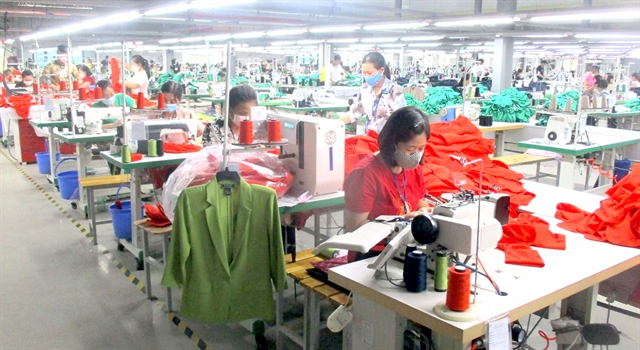 |
| Production at Sơn Hà Garment Export Factory in Thanh Hoá Province. — VNA/VNS Photo |
HÀ NỘI — The UK-Vietnam Free Trade Agreement (UKVFTA) has helped boost Việt Nam’s textile and garment exports to the UK, but maintaining market share and achieving sustainable growth will require exporters to adapt to increasingly stringent market requirements.
Textiles and garments are among Việt Nam’s major exports to the UK and one of the sectors benefiting significantly from the trade agreement.
According to the Vietnam Textile and Apparel Association (VITAS), exports to the UK accounted for 1.7 per cent of Việt Nam’s total textile and garment export turnover in 2020. The share rose to 2 per cent last year, reflecting the growing importance of the UK as Vietnamese businesses diversify their export markets.
Under the UKVFTA’s tariff commitments, 42.5 per cent of tariff lines were eliminated from January 1, 2021, with the remainder phased out over two, four or six years, helping improve the price competitiveness of Vietnamese products in the UK.
The outlook for exports remains positive. The UK economy is gradually stabilising, while easing inflation is expected to support consumer purchasing power. At the same time, efforts by UK importers to diversify their supply chains are creating additional opportunities for Vietnamese suppliers.
Alexandra Smith, British consul general in HCM City and trade director for Việt Nam, told Công Thương (Industry and Trade) newspaper that there remained significant room for cooperation between the two countries.
She said further progress could be achieved by focusing on areas where the UK has strengths and Việt Nam has clear development needs, as more businesses take advantage of favourable trade conditions.
Despite rising export turnover, Việt Nam’s share of the UK textile and garment market remains modest, with the UK importing around US$20 billion worth of textiles and garments annually.
One major challenge is compliance with the UKVFTA’s two-stage rule of origin, under which both fabric production and garment manufacturing must take place in Việt Nam or the UK for products to qualify for preferential tariffs. Việt Nam, however, remains heavily dependent on imported fabrics.
VITAS data shows that fabric imports increased from $11.9 billion in 2020 to about $15 billion last year, reaching $8.9 billion in the first seven months of this year.
The UKVFTA provides some flexibility by allowing Vietnamese exporters to use fabrics imported from South Korea, which has a free trade agreement with the UK. However, Korean fabrics are generally more expensive than those from China and Taiwan.
Beyond tariffs and rules of origin, exporters face increasingly demanding compliance requirements. Environmental standards, emissions, labour practices, social responsibility, traceability and supply chain transparency are becoming important criteria for UK buyers when selecting suppliers.
VITAS chairman Vũ Đức Giang said brands and importing markets were imposing multiple layers of requirements, ranging from audits to origin certification. This requires businesses to develop management systems and software capable of demonstrating the origin of goods, the validity of customs declarations and other relevant data.
The Ministry of Industry and Trade has recommended that textile and garment businesses strengthen production capacity, move into higher-value stages of production, diversify sources of raw materials across the region and develop domestic supply chains.
Businesses should also improve their understanding of rules of origin, closely monitor market demand and select orders that match their capabilities.
In the longer term, product quality will remain crucial. Businesses also need to gradually reduce their dependence on contract manufacturing and increase investment in design, branding and digital transformation, while developing direct relationships with UK retailers and distributors. — VNS
Economy
 Economy
 Economy
 Economy
 Economy
 Economy
 Economy
 Economy
 Economy
 Economy
 Economy
 Economy
 Economy
 Economy
 Economy