 Economy


Three international exhibitions open in Hà Nội
1.
 |
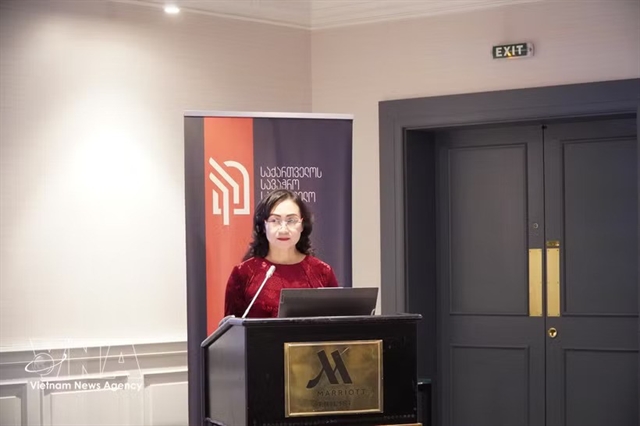
| Hồ Thị Út, a member of the Dubai Business Women Council. — VNS Photo |
HÀ NỘI — Vietnamese enterprises have significant room to expand in the Middle East, particularly in agricultural and food products, industrial and construction-related goods and technology, but establishing a lasting presence in the region will require more than finding an importer and securing initial orders.
In an interview with Việt Nam News reporter Ly Ly Cao, Hồ Thị Út, a member of the Dubai Business Women Council, discussed opportunities for Vietnamese enterprises in agriculture, food, industrial products and technology, as well as the barriers that continue to deter smaller companies from entering the region.
What opportunities does the Middle East offer Vietnamese enterprises?
The opportunities are quite broad because the Middle East is essentially an open market. One of its characteristics is that many countries cannot produce enough goods or grow enough food domestically, so they depend considerably on imports.
That creates opportunities for Vietnamese companies in agricultural, food, industrial and construction-related products, as well as artificial intelligence and other technologies.
Dubai, in particular, is investing heavily in tourism while increasingly developing its role as a major transit and re-export centre for the region. People and businesses from more than 200 countries are active there. By establishing a presence in Dubai, Vietnamese companies can connect with partners from many markets instead of travelling separately to numerous countries.
Việt Nam has strong agricultural production capabilities, so Vietnamese companies can gain an advantage if they understand what the Middle Eastern market actually requires.
What is the biggest obstacle preventing Vietnamese businesses from establishing a stronger presence there?
The biggest difficulty is not having representatives directly in the region. Once a company has people on the ground, many other problems can gradually be resolved.
However, building a local team is expensive. Most Vietnamese businesses are small and medium-sized enterprises, and some are very small, so committing that level of investment can be difficult.
Another problem is insufficient understanding of local laws. The Middle East comprises many different countries, so there are both common requirements and country-specific regulations. Businesses need considerable patience and a long-term mindset when navigating them.
A recurring weakness is consistency. Some Vietnamese companies successfully deliver their first and second orders at the required quality, but subsequent shipments can vary slightly. This is something importers frequently complain about.
Businesses therefore need to invest properly in factories, product quality and raw materials and develop a long-term investment plan. Once production facilities and processes are properly established, overseas partners can provide support to facilitate exports.
How can companies reduce risks when choosing partners in the Middle East?
The first requirement is legal due diligence.
Corporate licensing in the Middle East differs from that in Việt Nam. Licences may need to be renewed annually, so companies must verify whether a potential partner's licence remains valid.
They should also check whether the company has a registered tax identification number, whether the proposed transaction falls within the business activities specified in the partner’s licence and whether the person signing the transaction is legally registered and authorised to represent the company.
Having a business licence alone is not enough. Businesses need to examine the details behind the documents.
After legal due diligence comes financial due diligence. Exporters should investigate the potential partner's operating history, import scale, distribution network and payment capacity.
The size of a proposed transaction should also be reasonable relative to the company's financial capacity.
A transaction that is disproportionately large compared with the scale of the buyer should be treated cautiously.
Companies should then assess commercial capacity. They need to determine whether the counterparty is a distributor, an agent or merely a broker, and establish who ultimately has the ability and responsibility to pay.
What payment methods should Vietnamese exporters consider when dealing with new Middle Eastern customers?
For new customers and new transactions, I would not recommend deferred payment.
Depending on the level of trust, businesses should consider instruments such as a letter of credit (LC) and a standby letter of credit (SBLC). I generally recommend that Vietnamese sellers consider an SBLC because it provides a bank-backed payment mechanism if the buyer fails to pay.
However, LC and SBLC transactions can still involve risks. Companies must verify the institutions and parties involved and understand who ultimately receives and processes the financial instrument.
What should companies pay particular attention to when finalising export contracts?
Contracts and logistics need to be controlled carefully.
Contracts should specify which version of Incoterms applies, together with quality standards, inspection procedures, delivery schedules and destinations. Everything should be set out as clearly and explicitly as possible.
Businesses should not be reluctant to ask questions or negotiate details. In international trade, unclear contractual provisions can ultimately become costly. — BIZHUB/VNS
Economy
 Economy
 Economy
 Economy
 Economy
 Economy
 Economy
 Economy
 Economy
 Economy
 Economy
 Economy
 Economy
 Economy
 Economy