 Economy


Orion improves school facilities for students at two schools in Đồng Nai
1.
|
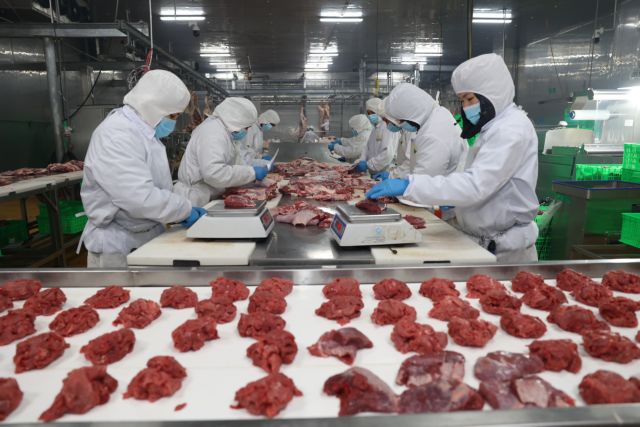
| Pork is sorted at a processing plant in Tây Ninh Province. — VNA/VNS Photo |
HÀ NỘI — The livestock industry is shifting its focus from expanding production to meeting increasingly stringent environmental, food safety and traceability standards as export markets tighten import requirements, industry executives have said.
Major importers including China, the EU, Japan and the US are imposing stricter rules on traceability, carbon emissions, environmental protection and food safety, prompting producers to adopt more data-driven management systems.
The tighter standards come as regulators increasingly require exporters to provide detailed information on farming practices, feed sources, antibiotic use, slaughtering processes, greenhouse gas emissions and animal welfare. Producers are also expected to maintain electronic records that allow products to be traced throughout the supply chain.
China, one of Việt Nam's largest agricultural export markets, has strengthened digital risk-based controls on imported livestock products, including meat, dairy products, edible bird's nests and animal feed.
Exporters are required to maintain comprehensive electronic records covering farms, slaughterhouses, processing facilities, biosecurity systems and compliance histories.
The changing regulatory environment is also increasing pressure on Việt Nam's livestock industry - a large-scale sector with millions of farmers and businesses - to improve supply chain management and transparency.
Carbon emissions have emerged as another challenge, with methane from livestock, waste management and energy consumption among the sector's main emission sources.
The industry is also facing tighter restrictions on antibiotic residues, veterinary drugs and growth promoters, particularly in the EU, Japan and the US, where regulators have lowered maximum residue limits and banned certain substances.
Some major producers have begun restructuring operations to meet the new requirements.
David John Whitehead, chairman of Mavin Group, said the company had incorporated environmental, social and governance (ESG) principles into its business strategy since 2022 with support from the International Finance Corporation (IFC), a member of the World Bank Group.
Mavin had adopted an integrated 'Feed-Farm-Food' production model, implemented an SAP enterprise resource planning system and published sustainability reports based on international standards while securing green financing from HSBC in 2024 and 2025, he said.
C.P. Vietnam Corp said it continued to expand its integrated 'Feed-Farm-Food' model to strengthen product quality and traceability.
The company operates 21 factories and more than 2,500 company-owned and contract farms nationwide.
Its CPV Food Binh Phuoc complex, a $250 million processing facility, meets international food safety standards and exports processed chicken products to Japan, Singapore, Hong Kong (China), Russia and Mongolia.
Montri Suwanposri, vice chairman of C.P. Vietnam Corporation, said expanding value-added food processing and exports would be among C.P. Group's key investment priorities in Việt Nam.
The company planned to expand poultry processing capacity, invest in new production facilities and complete its integrated hygienic slaughtering chain, he said.
Other major producers, including Greenfeed, TH and Vinamilk, are also investing in circular economy initiatives, emissions management and digital technologies to meet increasingly stringent requirements in global food supply chains.
As technical barriers continue to tighten in key export markets, industry executives said adopting transparent, low-emission production systems that comply with international standards would be essential to improving the sector's long-term competitiveness and expanding exports. — VNS
Economy
 Economy
 Economy
 Economy
 Economy
 Economy
 Economy
 Economy
 Economy
 Economy
 Economy
 Economy
 Economy
 Economy
 Economy



