 Economy



Meet the canines on the front-line of security protection
1.
|
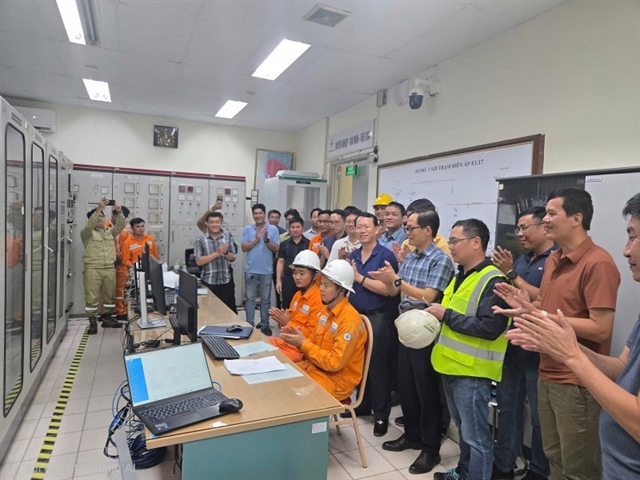
| EVNHANOI staff witness the successful energisation of the BESS system at the Bắc Thăng Long 110kV substation on July 5, 2026. — Photos nangluongvietnam.vn |
HÀ NỘI — Hà Nội’s electricity sector is accelerating its shift from a traditional power network to a data-driven smart grid, turning science, technology and digital transformation policies into practical solutions for critical infrastructure.
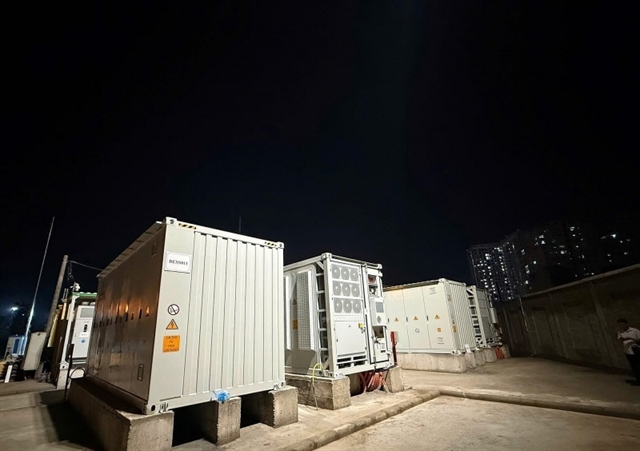
The Hanoi Power Corporation (EVNHANOI) has completed the installation and operation of five battery energy storage systems (BESS) with a total capacity of 50MW/100MWh at five 110kV substations, marking the first large-scale application of energy storage technology in the capital’s power grid.
The systems have been deployed at Bắc Thăng Long, Quang Minh, Sài Đồng 2, Phùng Xá and Thanh Oai substations. Each has a capacity of 10MW/20MWh and is integrated into the distribution network to support grid operation, regulate electricity loads and improve system flexibility.
The project is part of broader efforts to modernise electricity infrastructure as Hà Nội faces rising power demand, particularly during periods of extreme heat. The storage systems allow electricity to be stored and released when needed, helping improve grid stability and reliability.
The transformation reflects the implementation of Resolution No 57-NQ/TW, which places science, technology, innovation and digital transformation at the centre of Việt Nam’s new growth model, with a focus on applying advanced technologies to improve productivity, modernise management and create digital infrastructure for future development.
For the power sector, this means moving beyond equipment upgrades towards a comprehensive shift from traditional management methods to data-based operations.
EVNHANOI currently manages a large-scale power system comprising 68 substations of 220kV and 110kV, 159 transformers of 220kV and 110kV, more than 1,129km of 110kV transmission lines and nearly three million customers across the capital.
A key foundation of its digital transformation has been the replacement of all mechanical electricity meters with electronic meters connected to remote data collection systems.
The technology allows real-time monitoring of power consumption, supporting load analysis, improving operational management and gradually forming a digital ecosystem in the electricity sector.
|
| The battery energy storage system (BESS) at the Bắc Thăng Long 110kV substation. |
Operations that previously required workers to be present at facilities, such as switching equipment, monitoring parameters and responding to incidents, are now largely handled from the Hanoi Power System Control Centre.
Thousands of operational signals from substations and grid equipment are transmitted continuously, allowing operators to monitor the entire network, identify risks and make faster decisions.
Nông Ngọc Anh, deputy director of the Hà Nội Power System Control Centre, said digital transformation had changed the way engineers manage the grid.
“In the past, handling incidents required coordination among different units and on-site inspections before solutions could be developed," Anh said.
"Now, real-time data and analytical tools help operators make faster and more accurate decisions, significantly shortening response times.”
According to Trần Cẩm Linh, deputy head of EVNHANOI’s Science, Technology and Digital Transformation Department, building a smart grid is not only about investing in modern equipment but also transforming the way the power system is managed.
“Following the spirit of Resolution 57-NQ/TW, EVNHANOI sees science, technology and digital transformation as key to improving operational efficiency and power reliability,” Linh said.
“The goal is to develop a smarter grid capable of analysing data and automatically responding to different operating scenarios.”
As part of the modernisation process, EVNHANOI has converted all 220kV and 110kV substations to an unmanned operation model, with monitoring and control activities handled remotely from the control centre.
The company is also applying automation technologies that allow the grid to detect faults, isolate affected areas and restore power more quickly, reducing the need for manual intervention.
These solutions are expected to shorten response times, limit outage areas and improve the reliability of electricity supply across the capital.
The application of technology and automation has delivered measurable improvements in electricity services.
The System Average Interruption Duration Index (SAIDI) in Hà Nội fell from 163.1 minutes in 2021 to 29.81 minutes in 2025, a reduction of more than 80 per cent.
The System Average Interruption Frequency Index (SAIFI) dropped from 0.98 times to 0.48 times, while the Momentary Average Interruption Frequency Index (MAIFI) decreased from 1.81 times to 0.51 times.
Power losses were also reduced from 3.5 per cent to 3.07 per cent.
As Hà Nội advances its digital economy and smart city development, EVNHANOI said smart grid technologies demonstrate how science, technology and innovation under Resolution 57 can strengthen critical infrastructure and support sustainable growth. — VNS
Economy
 Economy
 Economy
 Economy
 Economy
 Economy
 Economy
 Economy
 Economy
 Economy
 Economy
 Economy
 Economy
 Economy
 Economy