 Economy


Talent a strategic national resource for development: Deputy PM
1.
|
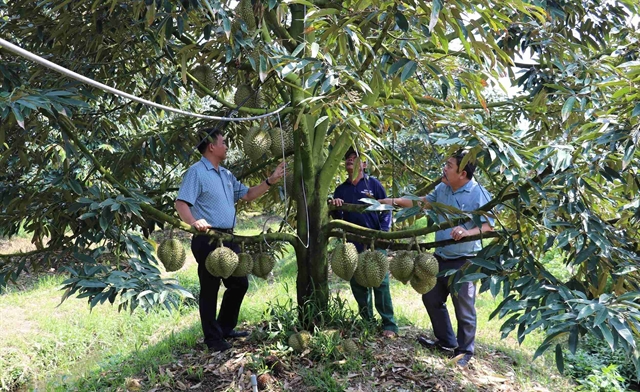
| A durian orchard in Đồng Tháp province strictly adheres to regulations regarding planting area codes. VNA/VNS Photo |
HÀ NỘI — Decree 38/2026/NĐ-CP on the management of growing area codes and packing facility codes is expected to mark a major shift in Việt Nam's agricultural export strategy, from prioritising quantity expansion to improving quality, strengthening post-certification oversight and enhancing data transparency.
The policy aims to safeguard the reputation of Vietnamese agricultural products in international markets. Growing area codes and packing facility codes are considered mandatory conditions for exported agricultural products.
However, as importing countries tighten requirements on phytosanitary control, food safety and traceability, obtaining a code is no longer the ultimate goal. Maintaining compliance and product quality throughout the production process has become even more critical.
Decree 38 is regarded as an important institutional milestone in standardising, improving transparency and enhancing the effectiveness of state management of agricultural exports.
According to the Ministry of Agriculture and Environment, as of May 2026, Việt Nam had issued 9,546 growing area codes and 1,525 packing facility codes serving exports to multiple markets. Of these, 4,323 growing area codes and 1,332 packing facility codes had been approved specifically for exports to China.
However, the rapid expansion has also increased pressure on quality control. Since 2025, Chinese authorities have issued non-compliance warnings for 403 growing area codes and 240 packing facilities from Việt Nam. Among them, 167 growing area codes and 99 packing facilities were temporarily suspended or revoked.
These figures underscore a key challenge for Việt Nam's agricultural sector: not issuing more codes, but ensuring the long-term quality and compliance of those already granted.
The core objective of Decree 38 is to formalise and standardise the decentralised management mechanism that has been implemented in recent years, according to the ministry.
Under the decree, provincial People's Committees are responsible for organising the issuance and management of growing area and packing facility codes within their jurisdictions. They must also allocate resources for post-certification inspections, supervision and handling violations.
This reflects a new governance approach under which local authorities are expected to closely monitor growing areas and packing facilities, ensuring technical standards are maintained continuously rather than focusing solely on the initial approval stage.
In practice, some localities have still prioritised quantity over quality, while post-certification oversight has not received adequate attention.
Production record-keeping, traceability, pest control and pesticide residue monitoring have, in some cases, been implemented only superficially. These shortcomings have contributed to many codes being warned or suspended.
For the first time, Decree 38 also establishes relatively comprehensive procedures for the suspension, reinstatement and revocation of codes, with clear timelines and processes.
In addition to regulatory agencies, organisations and individuals granted codes are now required to maintain technical standards, retain records, cooperate with inspections and ensure compliance with traceability requirements.
The need to improve management quality has become increasingly urgent as Việt Nam continues to gain export access for products such as frozen durian, fresh coconuts, chilli peppers, jackfruit, fresh pomelos and fresh lemons.
|
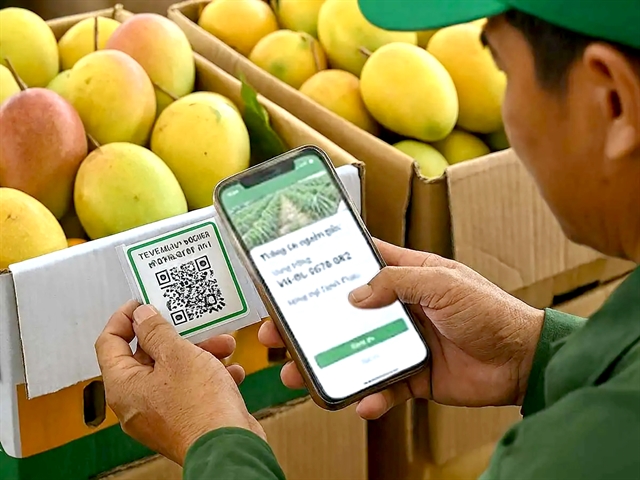
| A growing area code of Vietnamese mangos for export. Photo snivietnam.vn |
Alongside the management of growing area codes, the agricultural sector is also accelerating the development of a digital traceability system.
Nguyễn Văn Long, director general of the Department of Science and Technology, said the ministry's agricultural traceability system had initially been piloted for durian and was being further refined for expansion to other products.
As of May 25, the system had recorded 1,396 data entries covering 112 products, connecting nearly 18,000 production facilities across 14 provinces and cities, with participation from enterprises, farming households, growing areas and export shipments.
In practice, data-driven supply chain management has already delivered noticeable improvements. Some durian shipments were processed from growing areas to customs clearance in just six days, significantly reducing processing times compared with previous procedures. Approximately 23,000 traceability labels have been attached to products, with data updated in real time.
Nevertheless, implementation continues to face multiple challenges, including fragmented data systems, a lack of standardisation and limited technical infrastructure and investment resources.
Huỳnh Tấn Đạt, director general of the Department of Crop Production and Plant Protection, said the agency would continue refining standards to meet the requirements of different export markets while strengthening coordination with local authorities on the issuance of growing area codes and the monitoring of product quality.
According to Deputy Minister of Agriculture and Environment Võ Văn Hưng, traceability is intended not only to shorten processing times but, more importantly, to ensure quality control, product safety and transparency. As digital transformation accelerates, the agricultural sector must regard data as the foundation of modern governance.
Hưng emphasised that sustainable agricultural development should be built on three closely interconnected pillars: raw material area planning, management of growing area codes and traceability systems. These are essential components for restructuring production, increasing added value and improving the competitiveness of Vietnamese agricultural products. — VNS
Economy
 Economy
.jpg) Economy
Economy
 Economy
 Economy
 Economy
 Economy
 Economy
 Economy
 Economy
 Economy
 Economy
 Economy
 Economy
 Economy