.jpg) Economy
Economy


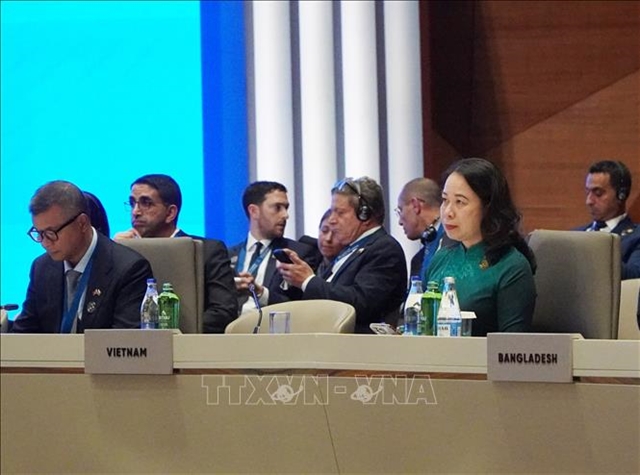
Vietnamese Vice President addresses 7th CICA Summit in Azerbaijan
1.
|
Võ Trí Thành*
After four decades of Đổi mới (Renewal) and international integration, the foreign-invested enterprise (FIE) sector has become a key driver of Việt Nam's economic growth.
To date, Việt Nam has more than 46,500 valid foreign direct investment (FDI) projects with total registered capital exceeding US$543 billion. Cumulative disbursed capital stands at roughly $357.6 billion. The FDI sector now contributes about 20 per cent of GDP, accounts for more than 70 per cent of export turnover and creates jobs for millions of workers.
Major technology corporations such as Samsung, Intel, LG, Canon, Foxconn and Lego have chosen Việt Nam as a key manufacturing base in global supply chains, helping turn a number of localities into new industrial hubs.
Yet alongside these achievements, notable shortcomings remain: low localisation rates, weak links between FIEs and domestic firms, technology transfer falling short of expectations and projects that are still confined largely to processing and assembly, with low added value.
Amid increasingly fierce international competition, the global minimum tax and the trend toward restructuring supply chains are reshaping investment flows worldwide.
Meanwhile, Việt Nam's digital and green transition and the growing need to strengthen the Vietnamese economy's self-reliance are shifting the mindset on attracting and using foreign capital, which has become an urgent imperative.
While the previous goal was mainly to attract investment, create jobs and boost exports that largely based on the country's comparative advantages, the focus has now changed to improving the quality of investment inflows. Foreign investment is treated as a driving force to renew the growth model, fortify economic self-reliance and enable deeper participation by local firms in global value chains.
This is not merely an adjustment of investment policy, but a transformation in development thinking.
The Politburo's Resolution 10-NQ/TW marks an important milestone, signalling a shift in Việt Nam's policy on developing the foreign-invested sector.
Party General Secretary and State President Tô Lâm highlighted this spirit, saying that the goal of attracting foreign investment today is to turn these resources into domestic economic capacity.
This new capacity is not measured in registered capital figures or export turnover, but in sustainable value accumulated from within, through advanced technology, stronger Vietnamese enterprises, a high-quality workforce, innovation capability and a higher position in global value chains.
Focus is thus no longer placed on attracting more projects, but on selecting projects with advanced technology, innovation and modern governance – ones capable of generating spillover effects and making a substantive contribution to raising the economy's productivity and competitiveness.
Moving from input-based incentives to results-based incentives also reflects this shift in thinking about foreign investment attraction.
Incentive policies are being reformed to connect with the fulfilment of commitments on technology transfer, research and development, workforce training, links with domestic enterprises, green transition and sustainable development.
Rather than allowing the gap between the FIE sector and domestic enterprises to persist as before, Resolution 10 calls for building a genuine industrial ecosystem that promotes technology transfer, enabling Vietnamese enterprises to strengthen their governance capacity, participate deeply in supply chains and gradually take charge of high value-added stages.
Only when technology is transferred, skills are accumulated and Vietnamese enterprises become capable of serving as trusted partners to multinational corporations will foreign investment truly become a driving force for enhancing the economy's competitiveness and self-reliance.
|
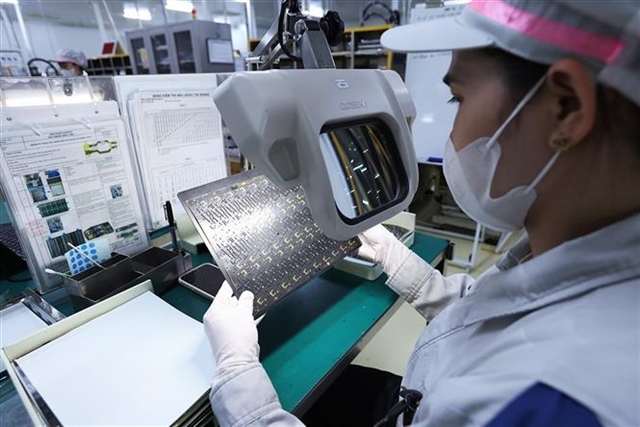
| Production at the 100 per cent Japanese-invested Mektec Manufacturing Vietnam Co. Ltd in the Thăng Long II Industrial Park in the northern province of Hưng Yên. — VNA/VNS Photo Vũ Sinh |
The resolution also takes a more comprehensive approach, covering both direct and indirect investment, capital markets and international financial institutions, and treating the foreign-invested economy as an organic component of the national economy that develops in harmony with the domestic sector to serve national goals.
This is a notable new feature of the resolution, placing direct investment, indirect investment, capital markets, international financial centres (IFC) and new development spaces (such as free-trade zones and special economic zones) within a unified whole, aimed at improving the efficiency of resource mobilisation and allocation.
As many multinational corporations restructure their supply chains, Việt Nam continues to be assessed as one of the most attractive destinations in Southeast Asia, thanks to its stable political environment, its network of new-generation free trade agreements and the accelerating pace of institutional reform.
However, this opportunity will only be realised if, at the same time, Việt Nam addresses persistent bottlenecks in logistics infrastructure, high-quality personnel, supporting industries and the innovation capacity of domestic enterprises.
Resolution 10 is not just a direction for developing the FIE sector; it also sets out requirements for a comprehensive renewal of the investment environment, improved national governance and enhanced economic competitiveness.
Specifically, Việt Nam must complete institutional reforms towards transparency, stability, consistency and alignment with international practice; invest heavily in strategic infrastructure (seaports, airports, expressways, clean energy and digital infrastructure); step up training of skilled workers; and renew investment promotion to be more selective, well-prepared and sustained in helping investors from the initial exploration stage through to production expansion.
As many countries compete fiercely to attract leading technology corporations, the quality of institutions and the effectiveness of governance will become a competitive advantage, at least, no less important than tax incentives or labour costs.
Resolution 10 is not simply an orientation for attracting foreign investments, but also reflects a shift in Việt Nam's economic development thinking.
While the previous priority was to expand the scale of investment, the focus has now shifted to improving the quality, effectiveness and spillover capacity of foreign capital flows across the entire economy.
This is the foundation on which foreign investment in the new era – through its spillover effects to Vietnamese sectors – can generate not only an increase in volume, but also high added value, driving the transformation of economic growth and elevating Việt Nam's position in global value chains.
* Võ Trí Thành is former vice president of the Central Institute for Economic Management and a member of the National Financial and Monetary Policy Advisory Council. With a doctorate in economics from Australian National University, he focuses on macroeconomic policy, trade liberalisation and institutional reform.
Economy
 Economy
 Economy
 Economy
 Economy
 Economy
 Economy
 Economy
 Economy
 Economy
 Economy
 Economy
 Economy
 Economy
 Economy