 Economy



HIIVE by fusion brings business and golf closer in Bình Dương
1.
|
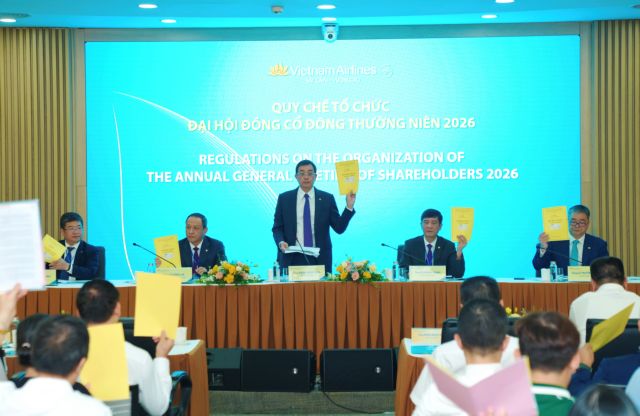
| Vietnam Airlines' leaders at the Annual General Meeting of Shareholders on Sunday. — Photo courtesy of the airline |
HÀ NỘI — National flag carrier Vietnam Airlines is aiming to remain profitable in 2026 despite mounting pressure from higher jet fuel prices, exchange rate fluctuations and rising operating costs, while pursuing an ambitious expansion and restructuring programme.
Speaking at the airline's Annual General Meeting of Shareholders on Sunday, President and CEO Lê Hồng Hà said 2026 marks the first year of Vietnam Airlines' long-term development strategy for 2026–35, which is being implemented against an increasingly uncertain global economic and geopolitical backdrop.
The airline has been particularly affected by sharp increases in aviation fuel prices driven by tensions in the Middle East. At one point, Jet A1 fuel exceeded US$200 per barrel, significantly increasing operating costs across the aviation industry.
Vietnam Airlines estimates the average Jet A1 price for 2026 at $128.54 per barrel, up nearly 48 per cent from 2025. Based solely on fuel price movements, excluding changes in exchange rates or passenger demand, the airline expects an additional VNĐ11.9 trillion ($455 million) in fuel costs compared with last year.
The carrier is also facing pressure from foreign exchange volatility, higher global maintenance and logistics costs, as well as increasing expenses related to environmental compliance and its green transition.
"Since April, our operations have been significantly affected by rising fuel prices resulting from the conflict in the Middle East, placing considerable pressure on our business performance," Hà said.
To mitigate these challenges, Vietnam Airlines has developed flexible operating scenarios, optimised its domestic and international route network, tightened cost controls and improved fleet utilisation.
Despite the headwinds, the airline remains committed to achieving its 2026 business targets while strengthening its competitiveness, supporting economic growth and promoting trade, tourism and international connectivity.
During the first half of the year, Vietnam Airlines launched or announced new international services to Amsterdam, Phuket and Colombo, while increasing frequencies on routes to Singapore, Manila, Moscow, Kaohsiung, Melbourne and Sydney to meet rising travel demand.
The carrier is also implementing a range of strategic initiatives to expand capacity and improve operational efficiency. These include a long-term investment plan for 50 new narrow-body aircraft, scheduled for delivery between 2030 and 2032, alongside the lease of 20 additional narrow-body aircraft for 2027–28.
Vietnam Airlines also plans to introduce its first dedicated cargo aircraft in the third quarter of 2026 and continue expanding technical infrastructure at key airports, including Long Thành International Airport.
Following the reopening of the Strait of Hormuz and a ceasefire agreement between the US and Iran in June, jet fuel prices have eased to around $112–115 per barrel, offering some relief for airlines.
Assuming fuel prices average around $120 per barrel in the second half of the year, Vietnam Airlines forecasts pre-tax profit of approximately VNĐ101 billion for the parent company and VNĐ510 billion on a consolidated basis.
"Although these figures are significantly lower than our first-quarter performance, they reflect our strong efforts to optimise costs and respond to an exceptionally challenging operating environment marked by rising input costs, supply chain disruptions, geopolitical uncertainty and intensifying market competition," Hà said.
To address aircraft shortages, the airline has adjusted flight frequencies to better match market demand while protecting its core domestic network. Vietnam Airlines Group, comprising Vietnam Airlines, Pacific Airlines and VASCO, will continue to focus on maintaining its market share on key trunk routes while increasing capacity on leisure destinations.
For 2026, the airline targets carrying 27.73 million passengers and 361,400 tonnes of cargo, representing year-on-year increases of 8.1 per cent and 6.2 per cent, respectively. Consolidated revenue is projected to reach VNĐ138.9 trillion, up more than 12 per cent from 2025.
Chairman Đặng Ngọc Hòa said the airline would continue restructuring its organisation, streamlining business processes and strengthening its workforce, including pilots, cabin crew and engineers, to support anticipated double-digit growth in the coming years.
Alongside fleet expansion through aircraft purchases, Vietnam Airlines will continue evaluating dry-lease and wet-lease options to ensure sufficient capacity during peak demand periods.
In line with Politburo Resolution 57-NQ/TW on science, technology, innovation and digital transformation, the carrier is accelerating its digital transformation strategy, investing in technology infrastructure and developing a digital airline model that meets international standards.
Vietnam Airlines is also advancing its environmental, social and governance (ESG) agenda through measures to reduce carbon emissions, improve fuel efficiency and explore the use of sustainable aviation fuel (SAF). At the same time, it is enhancing service quality, developing high-quality human resources and strengthening corporate governance as it works towards becoming a five-star international airline by 2030.
The airline reaffirmed its commitment to maintaining its role as Việt Nam's national flag carrier and leading air transport provider, contributing to the country's socio-economic development and strengthening its connectivity with regional and global markets. —VNS
Economy
 Economy
 Economy
 Economy
 Economy
 Economy
 Economy
 Economy
 Economy
 Economy
 Economy
 Economy
 Economy
 Economy
 Economy