 Economy

Việt Nam, EU and Belgium seek deeper, practical cooperation
1.
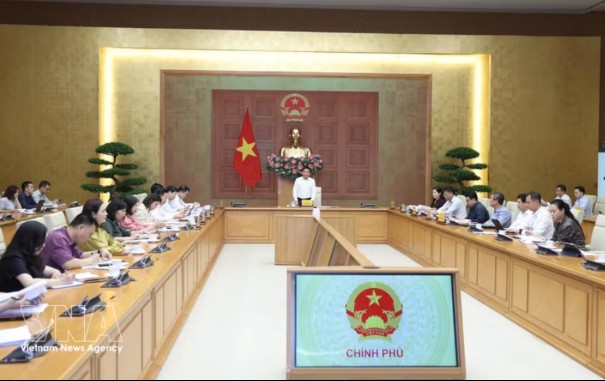 |
| Deputy Prime Minister Nguyễn Văn Thắng chairs a meeting of the Price Management Steering Committee in Hà Nội on June 26. — VNA/VNS Photo |
HÀ NỘI — Deputy Prime Minister Nguyễn Văn Thắng has asked for flexible price management scenarios and careful assessment of inflationary impacts to keep inflation under control while supporting economic growth.
Thắng was chairing a meeting of the Price Management Steering Committee in Hà Nội on June 26, which focused on reviewing price management in the first half of 2026 and discussing measures for the remainder of the year.
Three inflation scenarios updated
Delivering a report at the meeting, Deputy Minister of Finance Trần Quốc Phương said inflation remains under control, although pressure on the full-year target persists.
The consumer price index (CPI) rose between 0.84 per cent and 1.23 per cent month-on-month in February, March, and April, driven by seasonal factors and higher global prices for fuel, gas, and construction materials, before easing towards the end of the second quarter thanks to abundant food supplies.
He noted that domestic prices will face internal and external pressures in the second half of 2026. However, inflationary pressures are expected to be moderated by continued tax and fee reductions, flexible monetary policy, stable domestic food supplies, and the Government's commitment to maintaining macroeconomic stability and controlling inflation.
The Ministry of Finance has updated three inflation scenarios for 2026, projecting average inflation at around 4.5 per cent, 5 per cent, or 5.5 per cent. The State Bank of Vietnam forecasts average inflation of 4.8–5.5 per cent, while international organisations estimate it at 3.8–5.2 per cent.
Careful assessment of CPI impacts
Thắng said domestic supply and demand remained broadly balanced in the first half of the year, with adequate supplies of essential goods. However, the conflict in the Middle East has pushed up energy prices, transport costs, and input materials, while exchange rate pressures and stronger consumption and investment have added to inflationary risks.
He attributed the inflation control results to the Government's decisive leadership, close coordination between fiscal and monetary policies, measures to ensure adequate supplies and stabilise markets, fee reductions on fuel, and stronger action against price manipulation and speculation. As a result, widespread shortages and price surges have been avoided, helping maintain macroeconomic stability and support growth.
Although inflation remains within the annual target, Thắng stressed that limited policy room requires continued vigilance.
He instructed ministries and localities to strengthen forecasting by closely monitoring global economic developments, monetary policies of major central banks, energy and food prices, exchange rates, trade policies, geopolitical developments, and potential supply chain disruptions.
He also called for prudent fiscal management, strict control of recurrent spending, prioritisation of development investment and social welfare, and accelerated but well-paced disbursement of public investment to avoid year-end pressure on construction materials, labour costs, and prices.
Monetary policy should remain proactive and flexible, with close coordination with fiscal policy, while carefully managing core inflation, money supply, credit growth, exchange rates, and interest rates to curb imported inflation and stabilise market expectations.
Regarding the State-managed prices, particularly in health care and education, Thắng said authorities should carefully review planned price adjustments to determine which increases are essential and which can be postponed. Any adjustment should be thoroughly assessed for its impact on the CPI before submission to competent authorities.
He also underscored the importance of transparent communication on price management policies to help stabilise market sentiment, anchor inflation expectations, and deter speculative activities.
The Deputy PM urged ministries and agencies to promptly implement the 2023 Law on Price, the 2025 Law Amending a Number of Articles of the Law on Price, and review outdated legal documents to ensure a coherent legal framework.
In addition, he instructed authorities to develop an online price declaration system under Government Decree No. 85/2024/NĐ-CP by July 1, 2027, ensure that price declaration data are integrated into the national price database, and promptly issue lists of businesses subject to price declaration requirements under their management. — VNA/VNS
Economy
 Economy
 Economy
 Economy
 Economy
 Economy
 Economy
 Economy
 Economy
 Economy
 Economy
 Economy
 Economy
 Economy
 Economy