 Economy

Việt Nam, EU and Belgium seek deeper, practical cooperation
1.
|
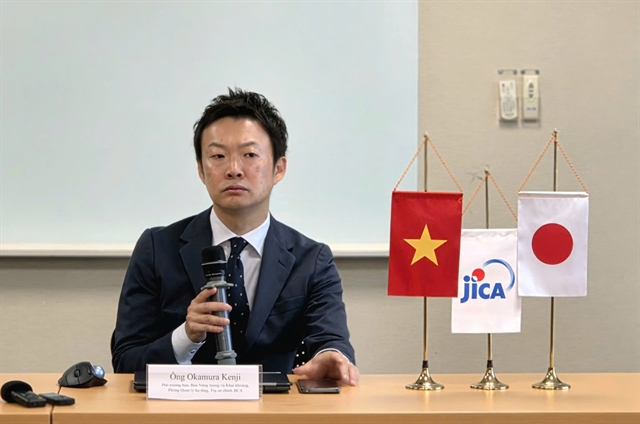
| Okamura Kenji, Deputy Director General of the Energy and Mining Group under JICA's Infrastructure Management Department, at the press briefing. — VNS Photo Ly Ly Cao |
HÀ NỘI — The Japan International Cooperation Agency (JICA) will work with Việt Nam to study the development of a strategic petroleum reserve system, aiming to strengthen the country's energy security and resilience against potential supply disruptions as geopolitical uncertainties continue to weigh on global energy markets.
Speaking at a press briefing on June 26 introducing a feasibility study on Việt Nam's petroleum stockpiling needs and oil supply chain, Okamura Kenji, Deputy Director General of the Energy and Mining Group under JICA's Infrastructure Management Department, said the initiative comes as Việt Nam's energy demand continues to rise alongside rapid economic growth and expanding refining capacity.
He noted that the disruption surrounding the Strait of Hormuz earlier this year had once again highlighted the importance of maintaining stable energy supplies for countries across ASEAN.
"Preparing for emergencies during normal times is becoming more important than ever," Okamura said.
JICA and Vietnamese experts will jointly assess the country's current energy security from multiple perspectives, including institutional arrangements, infrastructure and financial resources, with the aim of developing a roadmap for a resilient and sustainable oil stockpiling system.
According to Okamura, the project follows an agreement reached by the prime ministers of Việt Nam and Japan during their meeting in May. It also aligns with one of the four pillars of cooperation announced during the recent visit of the JICA President to Việt Nam, which focuses on supporting the growth of domestic enterprises and expanding their participation in global value chains.
Okamura added that energy security is a shared regional challenge rather than an issue any single country can address alone.
Both Japan and Việt Nam rely heavily on crude oil imports from the Middle East, meaning supply disruptions affecting ASEAN would have far-reaching consequences across the region, including for Japan's industries and price stability.
"Strengthening crude oil stockpiling capacity and supply chain resilience across ASEAN, including Việt Nam, will directly contribute to regional stability and, in turn, Japan's own stability," he said. "This is not one-way assistance but a joint effort to enhance the resilience of the entire region for our mutual benefit."
Japan's experience offers valuable lessons for the project. Following the oil shocks of the 1970s, the country established a strategic petroleum reserve system based on clearly defined roles for the government and private sector.
The JICA expert said he hopes to share more than five decades of experience in institutional design, operational mechanisms, crisis response frameworks and human resource development.
"Our strength lies not only in supporting physical infrastructure but also in providing comprehensive assistance covering institutional design, operational systems, crisis management frameworks and capacity building," Okamura said.
"JICA does not seek specific business opportunities. We want to accompany Việt Nam as a neutral partner to strengthen its own institutional and operational capabilities."
To ensure the initiative is implemented effectively, JICA also plans to cooperate with Japanese organisations, including the Japan Organisation for Metals and Energy Security (JOGMEC), alongside relevant Vietnamese ministries and agencies, including the Ministry of Industry and Trade, the Ministry of Finance and PetroVietnam.
Regarding challenges in building an oil reverse system, Okamura said Việt Nam's circumstances differ significantly from Japan's and require a tailored approach.
Before the Strait of Hormuz crisis, Japan maintained strategic oil reserves equivalent to around 250 days of consumption. Even after releasing oil from national reserves twice during the crisis, the country's stockpile still stood at around 200 days.
By comparison, Việt Nam's current stockpiling capacity remains relatively limited, he said, adding that determining an appropriate reserve level, designing a suitable stockpiling model and defining the responsibilities of the Government and private sector would depend on Việt Nam's legal and policy framework.
"The key issue is optimising institutional framework, infrastructure and financial resources for the oil stockpiling system," Okamura said.
Addressing concerns over investing in petroleum reserves while countries are accelerating the transition towards cleaner energy, Okamura said energy transition and oil supply security should be viewed as complementary rather than conflicting objectives.
He said carbon neutrality remains an inevitable global trend that Việt Nam should continue pursuing. However, ensuring a stable energy supply is essential for achieving a successful transition.
"Oil is not only used as fuel for automobiles but is also a vital raw material for producing a wide range of products that support economic activity," he told Việt Nam News.
Establishing a strategic petroleum reserve would provide a safety net against supply disruptions, helping create the stability needed for long-term investment in renewable energy, he added.
Looking ahead, JICA is considering a range of cooperation activities, including joint policy research, technical exchanges, study visits for Vietnamese experts to Japan and seminars involving specialists from both countries.
Depending on future needs, the agency may also consider Official Development Assistance (ODA) to support oil storage infrastructure such as strategic storage tanks. — BIZHUB/VNS
Economy
 Economy
 Economy
 Economy
 Economy
 Economy
 Economy
 Economy
 Economy
 Economy
 Economy
 Economy
 Economy
 Economy
 Economy