 Economy


HIIVE by fusion brings business and golf closer in Bình Dương
1.
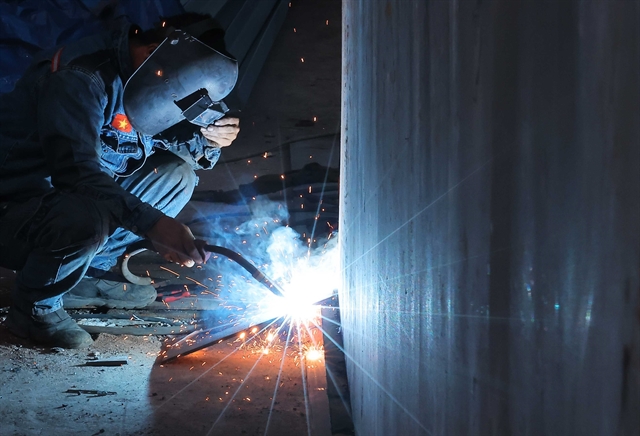 |
| Shipbuilding operations at Khiên Hà Shipyard in Hải Phòng. A new wave of global demand for greener vessels and mounting pressure to diversify supply chains is offering Việt Nam a rare opportunity to revive its shipbuilding industry. — VNA/VNS Photo Hoàng Hiếu |
HÀ NỘI — A decade after a painful restructuring that left much of its shipbuilding industry struggling to stay afloat, Việt Nam is finding itself back in the global spotlight.
As shipping companies race to replace ageing fleets with greener vessels and manufacturers seek alternatives to traditional supply chains, a rare window of opportunity is opening for the country to rebuild its position in one of the world's most strategic industries.
Việt Nam climbed to fourth place globally in commercial shipbuilding capacity in 2024, up three places from a decade earlier. While its share of global output remains modest at about 1 per cent, industry experts say the next five to seven years could determine whether the country emerges as a significant regional shipbuilding centre or remains a marginal player in a rapidly changing market.
"The current favourable cycle for the global shipbuilding industry could last until 2030-32," said Vũ Hữu Chiến, general director of Phà Rừng Shipbuilding Company.
"The opportunity is open but will not remain open indefinitely."
Global shipbuilding is entering a new growth phase driven by fleet renewal, decarbonisation requirements and the adoption of digital technologies.
Industry estimates show that orders placed between early 2024 and mid-2026 were equivalent to about 12 per cent of the world's commercial fleet with total contract value rising by around 20 per cent. Major shipyards in China, South Korea and Japan are reportedly booked through 2027 and 2028.
More than 60 per cent of new shipbuilding demand between 2024-33 is expected to come from replacing ageing vessels and complying with stricter environmental regulations, while demand is also increasing for ships powered by alternative fuels and vessels supporting offshore wind projects.
Global shift
According to the Vietnam Maritime and Waterways Administration (VMWA), countries around the world are accelerating the transition toward green shipping as they pursue net-zero emissions goals by 2050. Several nations have set targets to become green shipbuilding hubs by 2030 and aim to operate domestic fleets powered entirely by clean energy by mid-century.
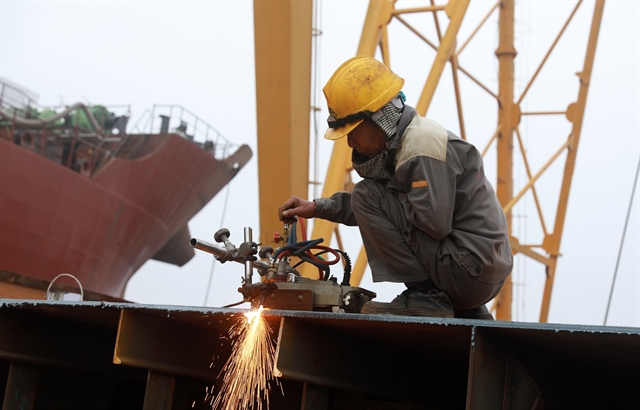 |
| Phú An Shipyard in Ninh Bình. The global shipbuilding market is projected to reach about US$195 billion by 2030, up from the current level of US$150-180 billion. — VNA/VNS Photo Quốc Khánh |
Nguyễn Tiến Đạt, deputy general director of the Shipbuilding Industry Corporation (SBIC), said the global shipbuilding market was projected to reach about US$195 billion by 2030, up from its current value of US$150-180 billion.
"The growing adoption of clean-fuel vessels, smart ships and floating infrastructure supporting the marine economy is creating substantial opportunities for Việt Nam's shipbuilding industry, provided there is a long-term and well-planned investment strategy," Đạt said.
The shipbuilding industry is also seeing growing demand at home as Việt Nam implements its maritime economic development strategy through 2045.
Lê Đỗ Mười, director of the VMWA, said the country's relatively old fleet would require extensive modernisation in the coming years.
"Shipbuilding needs to be restored, restructured and elevated into a major economic sector, focusing on the construction and repair of high-value vessels and specialised ships serving the marine economy, national defence and security," Mười said.
Việt Nam has established a roadmap for the green energy transition in the transport sector which encourages investment in vessels powered by clean fuels during 2022-30 and aims to convert the entire domestic fleet to green energy between 2031 and 2050.
It is estimated that demand for newbuilds and replacement vessels for the Vietnamese merchant fleet will reach about 4-5 million deadweight tonnes (DWT) between now and 2030.
Strategic industry
 |
| A worker uses a grinding machine to smooth welded joints at Bạch Đằng Shipyard in Hải Phòng. Shipbuilding should increasingly be viewed as a strategic industry rather than a traditional heavy manufacturing sector. — VNA/VNS Photo Lan Anh |
The industry's long-term prospects will increasingly depend on its ability to participate in the global transition toward low-carbon shipping.
Phạm Hoài Chung, deputy president of the Vietnam Shipbuilding Industry Association (VISIA), said shipbuilding should increasingly be viewed as a strategic industry rather than a traditional heavy manufacturing sector.
Citing estimates from the United Nations Conference on Trade and Development, Chung noted that 80-90 per cent of global trade by volume is transported by sea, while around 90 per cent of Việt Nam's international trade depends on maritime transport.
"Countries with strong shipping and shipbuilding capabilities enjoy significant advantages in trade, logistics, energy security and economic resilience," he said.
Chung warned that without long-term industrial policies and institutional reforms, Việt Nam could remain stuck at the lower end of the global value chain despite favourable market conditions.
He pointed out that Việt Nam possesses several advantages, including its location along one of the world's busiest maritime routes, a coastline stretching more than 3,260 kilometres, an exclusive economic zone of more than one million square kilometres and a robust port infrastructure system.
As Việt Nam pursues ambitious economic growth targets and seeks to lower logistics costs, shipbuilding could become a leading industry that supports the country's maritime economic development strategy and industrialisation goals, Chung said.
However, the industry continues to face significant challenges, including dependence on imported engines and equipment, limited access to long-term financing and shortages of highly skilled workers in areas such as artificial intelligence, automation and new energy technologies.
Chung said Việt Nam should avoid direct competition with China, South Korea and Japan in large, high-technology vessels and instead focus on market segments that better match its industrial capabilities.
He also identified ship repair, retrofitting and upgrading vessels to meet new emissions standards as promising growth areas. Demand for such services is expected to rise rapidly across the Asia-Pacific region as shipping companies seek to comply with increasingly stringent environmental regulations.
He argued that building a stronger local supply chain for materials, equipment and technical services would be critical if Việt Nam wants to improve competitiveness and capture a larger share of the global market.
Chung said government support through industrial policies, export financing, credit guarantees and technology development programmes would be needed to create a globally competitive shipbuilding industry.
Charting course
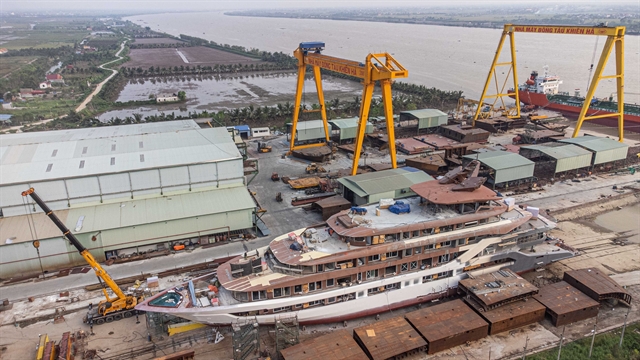 |
| Khiên Hà Shipyard in Hải Phòng. Experts have called on the Government to accelerate the development of a national shipbuilding strategy linked to fleet renewal plans, the green transition and global production shifts. — VNA/VNS Photo Hoàng Hiếu |
Stressing that the global shipbuilding industry is undergoing its most profound transformation in decades, experts say Việt Nam has significant opportunities to become an important shipbuilding centre in Southeast Asia while helping reduce logistics costs and support the maritime economy.
Phạm Quang Tuyến, director general of the Nam Triệu Shipbuilding Company, said that, with a well-planned strategy, the shipbuilding industry, led by companies emerging from the restructuring of SBIC, could fully capitalise on the global green transition and production shift.
“A new chapter for Việt Nam's shipbuilding industry could begin at the shipyards that once witnessed the rise and fall of Vinashin and SBIC," Tuyến said.
Experts also called on the government to accelerate the development of a national shipbuilding strategy linked to fleet renewal plans, the green transition and global production.
Nguyễn Văn Thành, vice chairman of the Central Theoretical Council, said the maritime economy was increasingly driven by technology-intensive sectors including artificial intelligence, automation, big data and smart monitoring systems.
"Maritime economic development can no longer rely solely on traditional infrastructure and industries. It increasingly depends on modern marine technology ecosystems, digital maritime data infrastructure and smart governance models," Thành said.
He added that developing shipbuilding capacity should be viewed as part of a broader strategy to strengthen Việt Nam's economic resilience, technological self-reliance and maritime competitiveness.
Việt Nam currently has 88 seagoing shipbuilding enterprises and 411 inland waterway vessel builders, including nearly 120 companies capable of building and repairing vessels with deadweight tonnage (DWT) exceeding 1,000 tonnes.
For an industry that has spent more than a decade rebuilding after a period of turbulence, the global shift towards greener shipping and diversified supply chains presents a rare second chance. Whether Việt Nam can transform that opportunity into a lasting position in the international shipbuilding market will depend on the decisions it makes today. —— VNS
Economy
 Economy
 Economy
 Economy
 Economy
 Economy
 Economy
 Economy
 Economy
 Economy
 Economy
 Economy
 Economy
 Economy
 Economy