 Economy


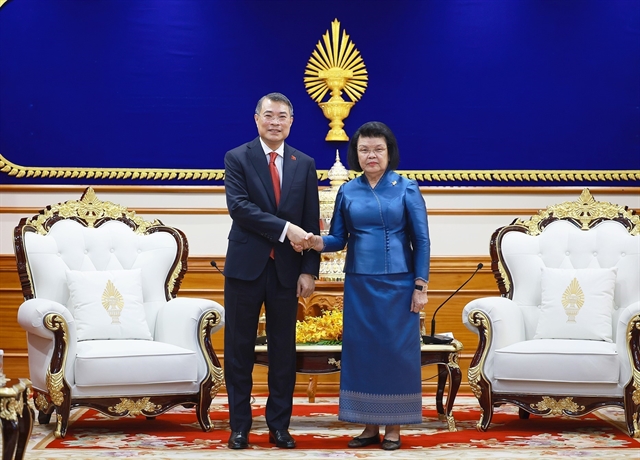
Vietnamese Prime Minister meets Cambodian National Assembly President
1.
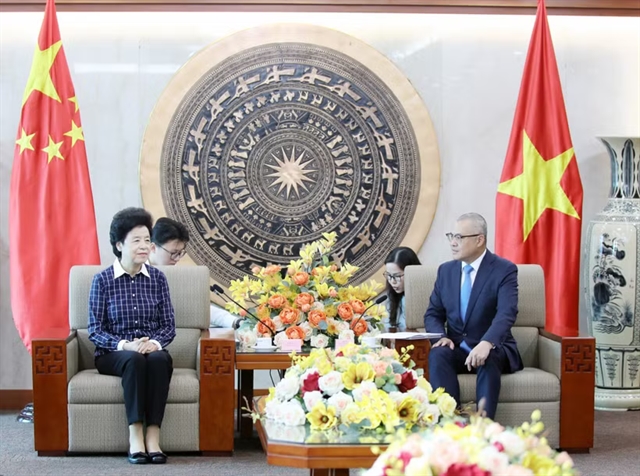
|
| Vice Chairperson of the National Committee of the Chinese People's Political Consultative Conference (CPPCC) Xian Hui (left) meets with Secretary of Phú Thọ provincial Party Commitee Phạm Đại Dương on comprehensive cooperation. — VNA/VNS Photo |
PHÚ THỌ — A high-level delegation of the National Committee of the Chinese People's Political Consultative Conference (CPPCC), led by its Vice Chairperson Xian Hui, visited the production facility of BYD Vietnam Co., Ltd. at Phú Hà Industrial Park and held a working session with leaders of Phú Thọ Province on Tuesday.
Addressing the meeting, Xian said the visit aimed to implement and concretise the important common perceptions reached by General Secretary of the Communist Party of Việt Nam Central Committee and State President Tô Lâm and General Secretary of the Communist Party of China and President of China Xi Jinping, thereby contributing to national development and socialist construction in each country.
Commending Phú Thọ’s recent socio-economic achievements, she expressed her impression of the province’s dynamic growth and confidence that it would continue to effectively tap its potential and advantages in the coming years.
She also briefed participants on China’s development, noting that the country is formulating its 15th Five-Year Plan following the successful implementation of the 14th plan, which laid a solid foundation for socio-economic progress and sustainable growth.
For his part, Secretary of the Phú Thọ Province Party Committee Phạm Đại Dương said the visit took place amid the positive development of the Việt Nam–China Comprehensive Strategic Cooperative Partnership, marked by increasing exchanges and practical cooperation between the two Parties, States and peoples.
He described the visit as an important opportunity to strengthen connectivity and expand cooperation between Phú Thọ and Chinese localities and enterprises.
Introducing the province’s strengths, Dương said the new Phú Thọ Province was formed through the merger of the former provinces of Phú Thọ, Vĩnh Phúc and Hòa Bình. With an area of more than 9,361 sq.km, a population exceeding four million, and an economic scale of over VNĐ412 trillion (US$15.6 billion), it is among Việt Nam’s largest local economies.
Located on the Kunming–Lào Cai–Hà Nội–Hải Phòng economic corridor and benefiting from a well-connected transport network linking it with Hanoi and northern provinces, Phú Thọ offers favourable conditions for industrial development, logistics, trade and foreign investment attraction.
The province is also home to the Hùng Kings Temple historical relic site and five UNESCO-recognised intangible cultural heritage elements, providing significant potential for tourism and cultural cooperation.
According to the provincial leader, Chinese investors have registered 180 projects in Phú Thọ with a total capital of $3.57 billion, creating jobs for more than 41,000 workers. Projects in electronics, textiles and garments, manufacturing and environmental treatment have contributed positively to local economic growth and budget revenues.
The province will continue improving its investment climate, upgrading industrial park and logistics infrastructure, and promptly addressing difficulties faced by businesses, while stepping up investment and trade promotion activities and expanding exports to China, he said.
Duong expressed his hope that the CPPCC National Committee would continue promoting exchanges between localities of the two countries and facilitate connections between Chinese businesses and investors and Phú Thọ. He also called for stronger cooperation in industry, trade, tourism, education, youth exchanges and cultural preservation.
Earlier, the Chinese delegation toured BYD Việt Nam’s production lines and learned about the company’s operations and development strategy.
Xian praised the company’s business performance and Phú Thọ’s efforts to improve the investment environment. She expressed her hope for strengthened cooperation between Chinese and Vietnamese enterprises in high technology, green manufacturing and sustainable development, highlighting the importance of balancing economic growth with environmental protection and efficient resource use. — VNA/VNS
Economy
 Economy
 Economy
 Economy
 Economy
 Economy
 Economy
 Economy
 Economy
 Economy
 Economy
 Economy
 Economy
 Economy
 Economy