 Economy

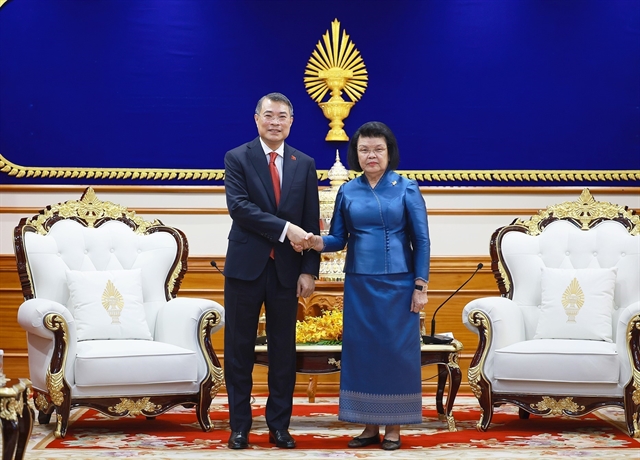
Vietnamese Prime Minister meets Cambodian National Assembly President
1.
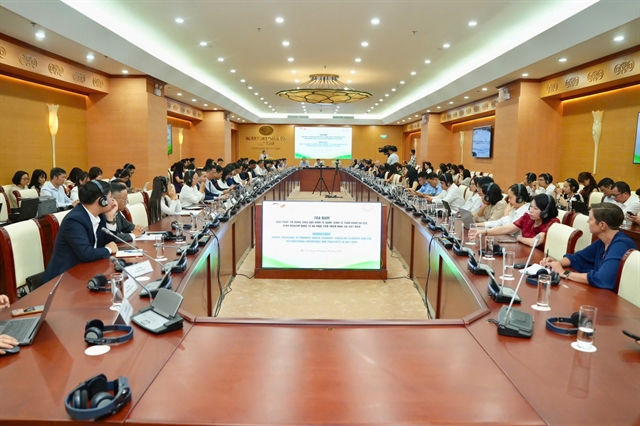 |
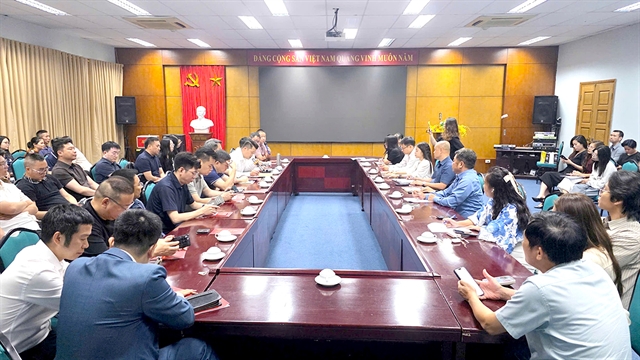
| Participants at a workshop on credit solutions for a green and circular economy. — VNS Photo |
HÀ NỘI — Transitioning to a green growth model, along with economic development, environmental protection and efficient resource use, will help Việt Nam move toward a sustainable, inclusive and prosperous future, Deputy Governor of the State Bank of Vietnam (SBV) Nguyễn Ngọc Cảnh said at a workshop on Tuesday.
The deputy governor was speaking at the event, titled ‘Credit solutions to promote the green and circular economy and ESG: international experience and practices in Việt Nam,’ held by the SBV and GIZ as part of the German government-supported Macroeconomic Reforms/Green Growth Programme.
According to Cảnh, aside from the State budget and international finance, the development of green credit is identified as a key solution to meet the capital needs for the economy's green transformation, contributing to the effective mobilisation and allocation of capital for sustainable growth.
“The banking sector has actively and proactively implemented comprehensive solutions to promote green growth and sustainable development," Cảnh said.
"The SBV has thus developed guidelines and set clear objectives for credit institutions in implementing green credit granting, green banking and environmental and social risk management in the development strategies of the banking sector, in line with national green growth goals and Việt Nam's commitments at international forums.”
In addition, the SBV has issued guiding documents on green credit activities and implemented various preferential credit mechanisms and policies to encourage organic agriculture and circular economy-related agricultural production.
Other moves from the SBV include issuing guidance documents on building a social and environmental risk management system in credit granting activities, and enhancing the ESG implementation capacity of credit institutions.
Cảnh reported that 82 credit institutions have thus far generated outstanding green loans of VNĐ828 trillion (US$31.4 billion). The average growth rate of these loans reached over 20 per cent per year during the 2017-2025 period.
Loans assessed for environmental and social risks have thus far reached over VNĐ5.1 quadrillion, rising by nearly 25 times compared to the end of 2017, and accounting for 27.7 per cent of the total outstanding loans of the entire economy.
Speaking at the event, GIZ Country Director in Việt Nam Dr Michaela Baur emphasised that cooperation between Việt Nam and Germany in green finance is more than a development partnership; it is a strategic, reciprocal investment in green growth and competitiveness, she said.
Việt Nam benefits from attracting investment, boosting growth and reducing carbon emissions, while Germany gains increased market access, partner connections and more resilient supply chains.
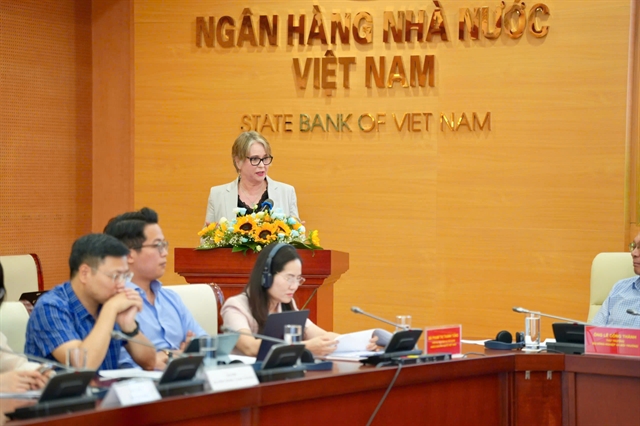 |
| Dr Michaela Baur, GIZ Country Director in Việt Nam, speaking at the event. —VNS Photo |
She noted: “The transition towards a greener and more circular economy cannot be achieved by governments or banks alone. It requires strong cooperation between the public sector, the financial sector and the real economy.
"Banks need clear frameworks and incentives. Businesses need access to finance and practical guidance. Policymakers need feedback from the market. And development partners can contribute international experience and facilitate partnerships."
Under the Macroeconomic Reforms/Green Growth Programme, GIZ, in cooperation with the Ministry of Agriculture and Environment and relevant agencies, is working to finalise a classification for green and circular projects and an ESG implementation framework with accompanying incentives. It is also taking steps to strengthen banks’ capacities in governance, data, due diligence and sustainable finance products.
The joint engagement of KfW and DZ Bank alongside GIZ demonstrates an integrated approach to cooperation between Việt Nam and Germany. Technical collaboration on policy and capacity building goes hand in hand with financial cooperation and private-sector engagement. This coordination will better channel resources to green and circular projects and to ESG implementation in Việt Nam, from policymaking to concrete investment portfolios.
At the workshop, representatives from the Ministry of Agriculture and Environment provided guidance on identifying green and circular projects and applying ESG standards.
International experts from Germany’s DZ Bank and KfW shared global practices on ESG frameworks and bank-level ESG implementation, as well as on financing circular economy projects.
In addition, inputs from Ernst & Young, credit institutions and enterprises helped assess the banking sector’s lending efforts in support of the green transition of businesses and the broader economy, while also identifying bottlenecks that need to be addressed to enhance effectiveness going forward.
Participants also discussed the implementation and outcomes of the banking sector’s credit solutions to promote the green economy, circular economy and ESG standards, as well as the current conditions and challenges faced by credit institutions and Vietnamese enterprises in the new context.
Guidance on identifying green and circular projects and applying ESG standards was also discussed, as well as international experiences in financing circular economy projects, implementing ESG in banks and policy recommendations for Việt Nam.
Policy coherence paired with practical solutions will enable credit institutions to expand lending to green and circular economy projects and to businesses applying ESG standards, participants said. — BIZHUB/VNS
Economy
 Economy
 Economy
 Economy
 Economy
 Economy
 Economy
 Economy
 Economy
 Economy
 Economy
 Economy
 Economy
 Economy
 Economy