 Economy



European higher education week opens new opportunities
1.
|
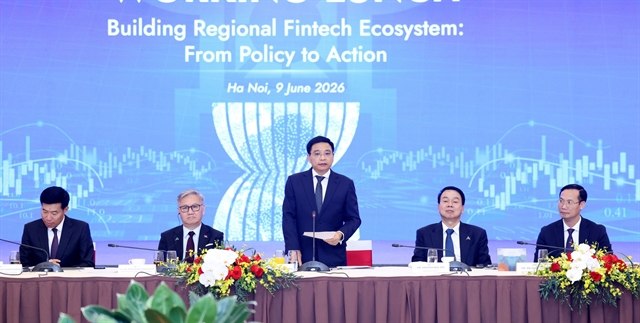
| Deputy Prime Minister Nguyễn Văn Thắng speaks at the forum. — Photo baochinhphu.vn |
HÀ NỘI — ASEAN must move beyond connecting markets and start building an integrated financial technology ecosystem if it wants to emerge as a major digital finance hub in the Asia-Pacific region, Deputy Prime Minister Nguyễn Văn Thắng said on Tuesday.
Speaking at a discussion on regional fintech development during the ASEAN Future Forum 2026, Thắng called for stronger cooperation among governments, regulators, businesses and investors to create a more connected, secure and inclusive digital financial landscape across Southeast Asia.
He said fintech had evolved far beyond digital payments and banking services, becoming strategic infrastructure that supports economic growth, cross-border connectivity and trust in the region's digital economy.
“To become a digital financial centre of the Asia-Pacific and the world, ASEAN must not only connect markets but also connect fintech ecosystems,” Thắng said.
Thắng said data, digital connectivity and smart financial networks were becoming as important as traditional infrastructure (roads, airports, seaports) in driving ASEAN's competitiveness, while fintech was helping broaden access to economic opportunities across the region.
The Deputy Prime Minister urged ASEAN countries to jointly build an 'open, secure, transparent, inclusive and sustainable fintech ecosystem'.
“Open to connect. Secure to grow. Transparent to build trust. Inclusive so that no one is left behind. And sustainable so that it can remain resilient and go further,” he said.
The discussion highlighted growing consensus that fintech will play a central role in deepening regional integration, particularly as ASEAN accelerates digital transformation and cross-border economic activity.

|
| Representatives of leading regional and global corporations take part in the discussion. — Photo baochinhphu.vn |
Participants pointed to artificial intelligence, digital identity systems, data infrastructure and cross-border payment networks as key building blocks for the next phase of regional financial integration.
According to Deputy Governor of the State Bank of Vietnam Phạm Tiến Dũng, Việt Nam has established core digital financial infrastructure, including electronic payment switching systems, national credit information platforms and digital identity and authentication systems.
As a result, nearly 89 per cent of adults now hold bank accounts, while more than 90 per cent of banking transactions are conducted through digital channels. QR-code payments have recorded annual growth of over 100 per cent in both volume and value between 2021 and 2025.
Marc Woo, managing director of Google Vietnam, said AI was creating new opportunities across the financial sector and should be supported by region-wide standards and governance frameworks.
He called on ASEAN to develop common AI governance principles, harmonise data and cybersecurity standards, strengthen cross-border payment connectivity and expand regulatory sandbox mechanisms to support innovation.
Woo said Việt Nam was well-positioned to become a testing ground for data-driven fintech solutions and could play a larger role in developing innovative financial services for regional and global markets.
Former Indonesian Minister of Tourism and Creative Economy Mari Pangestu said ASEAN had made significant progress in digital payments, particularly in cross-border transactions that are reshaping consumer behaviour across the region.
However, she noted that major gaps remain in digital finance development among ASEAN members, underscoring the need for a multilateral approach rather than isolated bilateral arrangements.
She said the region should focus on creating an interoperable and secure payment network that can support broader financial integration.
Thắng warned that ASEAN would struggle to build a strong fintech ecosystem if countries remained divided by fragmented data systems, incompatible standards and governance gaps.
To address these challenges, he outlined four priorities: improving cross-border payment infrastructure and common standards; creating balanced regulatory frameworks that support innovation while managing risks; expanding public-private partnerships; and ensuring that fintech development remains centred on people and practical outcomes.
He also proposed studying the feasibility of an ASEAN-wide fintech sandbox to allow cross-border financial technology solutions to be tested in a controlled environment.
“The success of a fintech ecosystem will not be measured by the number of applications we create or the number of technology unicorns we produce,” he said.
“It will be measured by whether people and businesses across ASEAN can access and benefit from these services fairly, and whether our digital society becomes safer and more transparent.”
Thắng said ASEAN had a unique opportunity to strengthen its position as an increasingly important fintech centre in both regional and global markets, adding that Việt Nam remained committed to working with ASEAN members and international partners to advance a more open, connected and human-centred digital financial ecosystem. — VNS
Economy
 Economy
 Economy
 Economy
 Economy
 Economy
 Economy
 Economy
 Economy
 Economy
 Economy
 Economy
 Economy
 Economy
 Economy