 Economy


Vietnamese Prime Minister meets Cambodian National Assembly President
1.
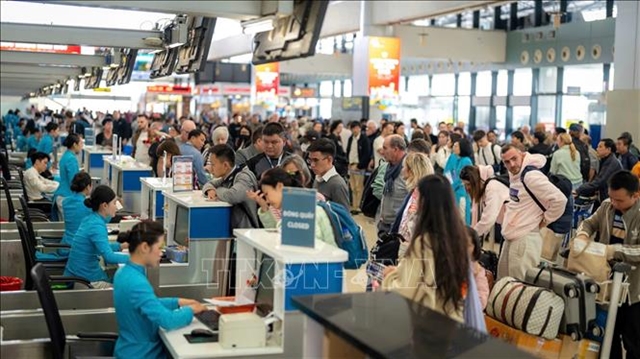 |
| Check-in area of Vietnam Airlines at Terminal 1, Nội Bài International Airport. — VNA/VNS Photo |
HÀ NỘI — As the summer travel season approaches, Việt Nam’s aviation industry is grappling with subdued consumer demand, rising operational costs and growing geopolitical uncertainty that continue to weigh on ticket prices and travel choices.
Meanwhile, tensions in the Middle East have heightened concerns over fuel supply stability, adding further pressure to airlines already facing cost increases.
Combined with increasingly selective consumer spending, the sector is seeking new ways to stimulate demand and support tourism growth.
A Vietnam News Agency survey conducted during the recent Reunification Day and Labour Day holiday period found that many travellers chose road transport over air travel due to high ticket prices.
Airlines are currently facing significant operational cost pressures stemming from fuel prices, exchange rate fluctuations, aircraft and spare parts shortages and broader geopolitical uncertainties, said Uông Việt Dũng, director general of the Civil Aviation Authority of Vietnam (CAAV).
These factors directly affect airfares, demand stimulation efforts and the competitiveness of aviation businesses, he said.
Although global oil prices have recently shown signs of easing, the downward trend may not be sustainable as supply disruptions remain a risk due to the conflict in the Middle East, he added.
Fuel costs currently account for between 35 and 40 per cent of airlines’ total operating expenses. As a result, many carriers have been forced to adjust flight frequencies, cut routes or maintain relatively high ticket prices, he said.
Rising service costs have also affected tourism and travel operators, while consumers have become more cautious with their spending, he said.
Đinh Văn Tuấn, deputy general director of Vietnam Airlines, said the national carrier has reintroduced cost-cutting measures similar to those adopted during the COVID-19 pandemic.
These include significant reductions in management payroll expenses, postponement of non-essential investment projects and the implementation of unpaid leave policies for some employees, he said.
On the operational side, Vietnam Airlines has negotiated with air traffic management authorities to introduce more direct flight routes, helping reduce flight times and fuel consumption, Tuấn said.
The carrier has also adopted flexible refuelling strategies, taking fuel in neighbouring countries where prices are lower, while increasing engine maintenance and washing to improve fuel efficiency, he added.
“The application of artificial intelligence to flight operations systems to identify the most efficient routes is also a key solution at this stage,” the Vietnam Airlines representative said.
Similarly, Vietravel Airlines is pursuing a cautious but flexible approach. Dương Hoàng Phúc, commercial director of Vietravel Airlines, said the carrier is focusing on optimising its route network to maximise fleet utilisation while diversifying revenue streams through ancillary services rather than relying solely on fare competition.
From an economic perspective, expert Võ Trí Thành noted that aviation and tourism are among the sectors most vulnerable to shocks such as pandemics and geopolitical tensions.
He stressed the need to strengthen resilience at both policy and enterprise levels while enhancing connectivity between aviation and tourism to improve the industry’s overall resilience.
According to Thành, demand-stimulation policies, consumer support measures, visa facilitation and stronger ecosystem linkages are particularly important under current conditions.
Beyond immediate challenges, Việt Nam must also prepare long-term foundations for the aviation and tourism sectors, including investment, energy security, infrastructure development and maintenance ecosystems, he said.
Sharing the same view, Nguyễn Quý Phương, a representative from the Viet Nam National Authority of Tourism, said stronger coordination between aviation and tourism is not only essential for reviving the domestic market but also strategically important for developing the service economy and enhancing national competitiveness.
“We need more substantive cooperation among airlines, local authorities and tourism businesses to develop integrated promotional packages combining air tickets, accommodation, sightseeing and entertainment services,” he said.
He also recommended diversifying tourism products, strengthening regional linkages, improving multimodal transport connectivity and accelerating digital transformation to enhance destination competitiveness.
The CAAV has proposed that the Government consider extending fuel tax support measures, introducing mechanisms for fuel surcharges and providing preferential credit packages for airlines and aviation fuel suppliers.
Bùi Minh Đăng, head of CAAV’s Air Transport Division, said transparent fuel surcharge mechanisms are also being considered as a short-term solution to help the industry cope with fluctuations in global oil prices.
In the longer term, accelerating major airport infrastructure projects is a critical step towards reducing logistics costs and enhancing competitiveness across the aviation sector, he said. — VNS
Economy
 Economy
 Economy
 Economy
 Economy
 Economy
 Economy
 Economy
 Economy
 Economy
 Economy
 Economy
 Economy
 Economy
 Economy