 Economy



LANDMARK Launches ‘Destination CENTRAL’: A District-Wide Invitation to Explore the Dynamism, Luxury, and Soul of Central
1.

|
| Automatic check-in kiosks at Nội Bài International Airport. The Ministry of Finance has proposed travel bans on taxpayers who own a tax debt of VNĐ1 million or higher and are no longer living or operating at their registered addresses. — VNA/VNS Photo Quốc Khánh |
HÀ NỘI — As a proposal to impose travel bans on taxpayers with debts from VNĐ1 million (US$38) has triggered debate, the Department of Taxation on May 22 defended the measure as a necessary step to prevent tax evasion and tackle cases of businesses operating from false or unregistered addresses.
The proposal was raised under a recent draft decree guiding the Law on Tax Administration 108/2025/QH15 and would apply to business individuals, household business owners, legal representatives and beneficial owners of enterprises who own a tax debt of VNĐ1 million or higher and are no longer operating at their registered addresses.
Speaking at the press briefing, Deputy Director of the Department of Taxation Mai Sơn said the temporary exit suspension measure had already been stipulated under the Law on Tax Administration 2019, which took effect in July 2020, and was later amended under Law 56/2024/QH15.
Based on those laws, the Government issued Decree 49/2025/NĐ-CP in February this year, specifying thresholds for applying travel bans to different groups of taxpayers.
The first includes business individuals and household business owners subject to tax enforcement measures who have owed at least VNĐ50 million ($1,900) in overdue taxes for more than 120 days.
Legal representatives of enterprises and cooperatives with overdue tax debts of at least VNĐ500 million that have been owed for more than 120 days are among the second group.
The third group covers business individuals, household business owners and legal representatives of enterprises or cooperatives who are no longer operating at their registered addresses but still owe overdue taxes and have failed to settle their obligations within 30 days after receiving notification from tax authorities.
Finally, the fourth group includes Vietnamese citizens emigrating abroad, overseas Vietnamese and foreigners leaving Việt Nam without fulfilling overdue tax obligations.
However, the existing rules do not specify any minimum debt threshold for taxpayers who abandon their registered business addresses. As a result, even debts of only a few thousand Vietnamese đồng could technically lead to temporary travel suspension.
Not a tightening move
|
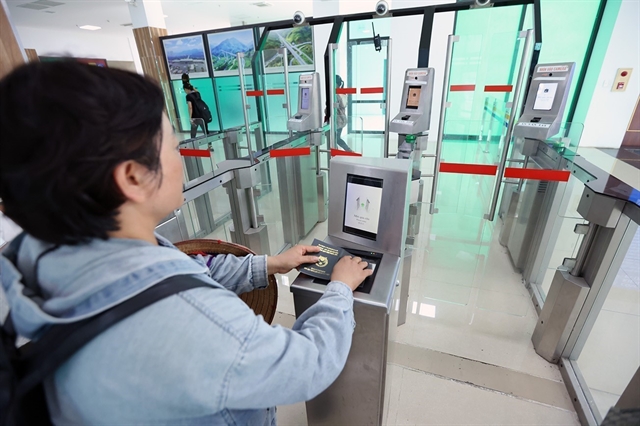
| Passengers complete departure procedures through the electronic border control system at Lào Cai International Border Gate in Lào Cai. — VNA/VNS Photo Vũ Sinh |
The Department of Taxation said the proposed VNĐ1 million threshold would narrow the scope of those subject to the measure by excluding taxpayers with very small debts arising from technical or administrative issues.
According to the department, statistics show that more than 50 per cent of taxpayers classified as “not operating at registered addresses” currently owe less than VNĐ1 million, while those debts account for only about 0.2 per cent of total tax arrears.
Without a minimum threshold, temporary exit suspension could affect a large number of taxpayers over very small debts, while the effectiveness of debt recovery would remain limited, the tax department said.
Tax officials stressed that temporary travel bans would not be imposed immediately once a tax debt arises.
Under the draft decree, the measure could only be considered after taxpayers are officially classified as no longer operating at their registered addresses, receive formal notification from tax authorities and still fail to fulfil tax obligations within 30 days after the notice.
The 30-day period is reasonable, allowing taxpayers to verify information, settle payments or contact tax authorities to resolve issues, according to the Tax Department.
Nguyễn Đức Huy, deputy head of the department’s Tax Operations Division, said tax authorities had implemented multiple measures to support taxpayers before applying enforcement actions, including public information campaigns, open letters, tax obligation notifications via the eTax Mobile application and electronic data connections with immigration authorities.
On May 12, the Department of Taxation and the Immigration Department signed a coordination agreement allowing electronic transmission of notices on temporary travel suspension and cancellation of such measures.
Under the system, information is automatically transferred to immigration authorities immediately after tax authorities issue electronic notices, helping shorten processing times and protect taxpayers’ rights once obligations are fulfilled.
The Department of Taxation pointed out that many countries worldwide also impose travel restrictions on taxpayers with outstanding debts.
China applies thresholds of 200,000 yuan ($29,000) for organisations and 30,000 yuan ($4,400) for individuals, while no threshold is imposed on businesses that abandon their registered addresses. Indonesia applies travel restrictions to companies with tax debts of at least 100 million rupiah ($5,600) or those suspected of abandoning registered addresses or concealing assets.
In the US, taxpayers with debts exceeding $50,000 may face passport denial or revocation. Malaysia applies a threshold of around 10,000 ringgit ($2,500), while Taiwan applies a threshold of NT$2 million ($63,500).
The Department of Taxation said it would continue coordinating with the Immigration Department to upgrade information technology systems so that temporary travel bans could be lifted in real time immediately after taxpayers fulfil their obligations to the State budget.
Recently, the proposal has sparked debate, as some argue that the VNĐ1 million threshold remains too low and could affect taxpayers facing temporary financial difficulties, lack of information or system-related errors.
Some experts proposed more flexible solutions, including electronic kiosks at border gates and airports that would allow taxpayers to make online payments before departure and immediately obtain confirmation documents.
Others suggested that travel suspension measures should focus on larger and longer overdue debts or taxpayers showing repeated violations or avoidance of obligations.
Some have even warned that temporary exit bans directly affect citizens’ freedom of movement, commercial activities, overseas study, medical treatment and family visits, and therefore should only be applied to clearly defined cases.
The Tax Department, in response, stressed that the measure would be a relaxation rather than a tightening of current rules, because existing regulations contain no minimum debt threshold for taxpayers who abandon registered business addresses.
Statistics show that notices of temporary exit suspension have so far been issued to around 105,000 legal representatives of enterprises and household business owners with combined tax debts of nearly VNĐ61 trillion.
Among those cases, about 65,000 involved taxpayers no longer operate at registered addresses, with total debts exceeding VNĐ6.9 trillion.
More than VNĐ4 trillion in tax arrears have been recovered from over 13,000 taxpayers, while about 7,100 taxpayers who had abandoned registered addresses later contacted tax authorities, paid nearly VNĐ100 billion in taxes and subsequently had travel bans lifted. — VNS
Economy
 Economy
 Economy
 Economy
 Economy
 Economy
 Economy
 Economy
 Economy
 Economy
 Economy
 Economy
 Economy
 Economy
 Economy