 Economy



HCM City tops national Chinese chess championship in Bắc Ninh
1.
|
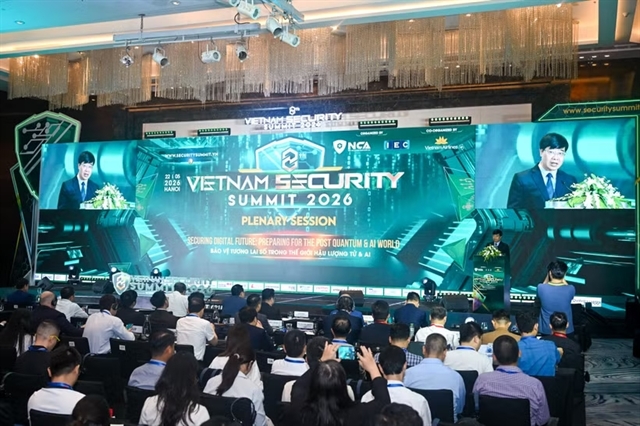
| A view of the summit. — VNS Photo |
HÀ NỘI — Việt Nam must proactively strengthen its cyber security capabilities for the next phase of digital development rather than only reacting to immediate threats, experts said on Friday, warning that rapid advances in quantum technology could soon undermine traditional security systems.
Addressing the Vietnam Security Summit 2026 in Hà Nội, Colonel Nguyễn Hồng Quân, deputy director of the Department of Cyber Security and High-tech Crime Prevention under the Ministry of Public Security, said data, artificial intelligence (AI) and digital technologies had gradually become the foundation of the modern economy and society.
“Cyberspace has become a particularly important strategic space, directly linked to national sovereignty, national security, economic security and the legitimate rights and interests of organisations and individuals," Quân said.
“We all see that along with the national digital transformation process, data is becoming a new strategic resource.
”Not only the data of agencies, organisations and businesses, but also the personal data of Vietnamese citizens are now present in the digital environment on an increasingly large scale.”
However, he warned that the rapid pace of development had also increased risks to cyber security and data protection.
“Notably, the rapid development of quantum technology in the near future is also posing new challenges to traditional security systems. Many current encryption formulas are at risk of no longer being secure against the processing power of quantum computing," he said.
“This shows that the current requirement is not only to respond to immediate threats but also to proactively prepare the capacity to protect cybersecurity for the next phase.”
Experts at the forum said inadequate protection of data and information systems could leave countries, businesses and individuals vulnerable to cyber attacks, threatening economic security, social order, public safety and trust in the digital environment.

|
| Visitors at a booth of the International Technology Expo held on the sidelines of the summit. — VNS Photo |
Quân said global cyber security threats were expected to remain increasingly complex in the coming period, with risks of attacks targeting critical information systems, financial infrastructure, energy, telecommunications, personal data and business data continuing to rise.
He said agencies, organisations and businesses needed to strengthen awareness of cyber security, proactively invest in technology, human resources and risk management capabilities and improve coordination with relevant authorities to help prevent, detect and address threats at an early stage and from a distance.
He also stressed the need to accelerate the development of a proactive, synchronised and sustainable national cyber security ecosystem, with stronger cooperation among State management agencies, technology companies, research organisations and the cyber security expert community.
Major General Nguyễn Tùng Hưng, deputy commander of the Cyberspace Operations Command under the Ministry of National Defence, said cyber security should be implemented through a comprehensive, proactive and long-term strategy.
“The first thing that needs to change is from a reactive mindset to a proactive, preventative one.
“In cybersecurity, prevention is always more effective than mitigation of the consequences. Businesses need to consider cybersecurity as an integral part of the design process, not something to be added after an incident occurs," Hưng said.
“Simultaneously, a closely collaborative ecosystem between businesses and the government needs to be built to promote early warning sharing, information sharing about threats, coordinated incident response and regular operational drills.”
Hưng said a country could not guarantee its digital sovereignty if it relied solely on foreign technology.
He said it was therefore necessary to gradually develop domestic platforms, promote Make-in-Vietnam security products, build domestic data centres and strengthen self-reliance in technology and digital infrastructure.
He added that businesses also needed to foster a cyber security culture within their organisations, as many successful cyber attacks stemmed from personal data breaches and weak internal control procedures.
At the summit, Philip Dimitriu, senior director of Southeast Asia, Pacific and Japan at Sophos, spoke about taking control of every threat and highlighted the challenge of improving control, monitoring and response capabilities against increasingly complex threats during the digital transformation process.
Lee Sang Yoon, head of the Global Business Team at Piolink Inc, presented on AI in the cloud and the evolving frontlines of cyber offence and defence.
The Vietnam Security Summit 2026, organised by the National Cybersecurity Association and IEC Group, brought together more than 1,500 policymakers, cyber security leaders and technology innovators from across the sector.
The summit featured a plenary session titled 'Securing the Digital Future in the Post-Quantum & AI World' and three thematic workshops exploring emerging risks, critical strategic gaps and new opportunities shaping the cyber security landscape in the AI era.
An international technology expo was also held alongside the summit, showcasing next-generation security solutions and technologies, including AI-driven cyber security, data security, identity and access management, application security, data loss prevention and cloud security. — BIZHUB/VNS
Economy
 Economy
 Economy
 Economy
 Economy
 Economy
 Economy
 Economy
 Economy
 Economy
 Economy
.jfif) Economy
Economy
 Economy
 Economy
 Economy