 Economy


Việt Nam-Cambodia trade gathers pace towards $20 billion target
1.
|
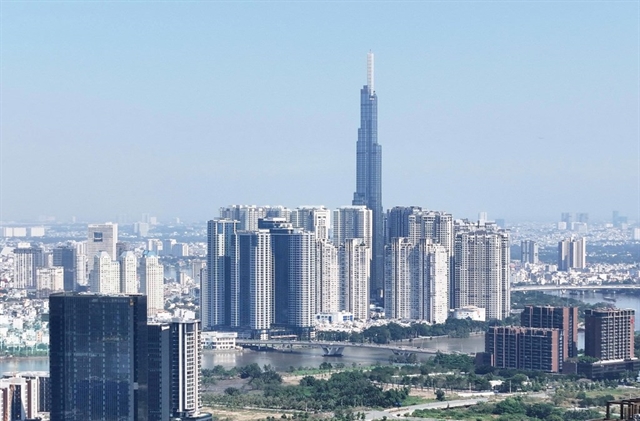
| High-rise buildings in HCM City. — VNA/VNS Photos Hồng Đạt |
HCM CITY — Integrating high-rise developments with transit-oriented development and climate resilience is a crucial planning strategy to optimise land use and strengthen the long-term competitiveness of Việt Nam’s major cities, a forum has heard in HCM City.
The Tall Building Forum, organised by the EuroCham Construction Subcommittee and the Council on Vertical Urbanism, brought together international planners, architects, and policymakers to discuss the challenges of rapid urbanisation in Asian metropolitan areas, particularly Hà Nội and HCM City.
Experts highlighted the recent merger of the Ministries of Transport and Construction as a significant milestone.
Bringing transport and construction planning under a unified management framework allows policymakers to better synchronise metro networks, public spaces, and population density within a cohesive long-term national strategy.
Rather than administrative and horizontal expansion, which places immense pressure on existing infrastructure, the forum advocated compact, multi-functional urban clusters centred around public transport hubs.
Dennis Ho, APAC strategic development director at Skidmore, Owings & Merrill - a global practice of architects, designers, engineers, and planners - said urban planning must prioritise human needs.
Drawing on the success of the One Bangkok mega-project, he pointed out that a city’s success depends largely on the quality of ground-level spaces.
In the coming decades, the focus should shift to the ‘buffer spaces’ between buildings, where community life is fostered, he said.
“The benchmark for future cities will be defined by pedestrian zones, green corridors, and connectivity woven between high-rises. Residents do not want to live in isolated, air-conditioned boxes.”
On sustainability, he urged developers to shift their focus from short-term construction costs to whole-life asset management, noting that investment in premium materials and integrated designs today secures a building’s performance for decades.
Shonn Mills, chairman of the Council on Vertical Urbanism, pointed out that data collected over the past 15 years shows integrated mixed-use structures combining living and working spaces have become the dominant global trend.
"High-rise developments are no longer isolated blocks, but vital components of vibrant, compact cities."
But panellists warned that planners must preserve human and cultural elements as cities grow vertically.
HCM City’s extremely high population density — currently among the world’s top 20 — presents a major infrastructure challenge, but also an opportunity if it can harness vibrant street life, community interaction, and diverse commercial activities, they said.
|
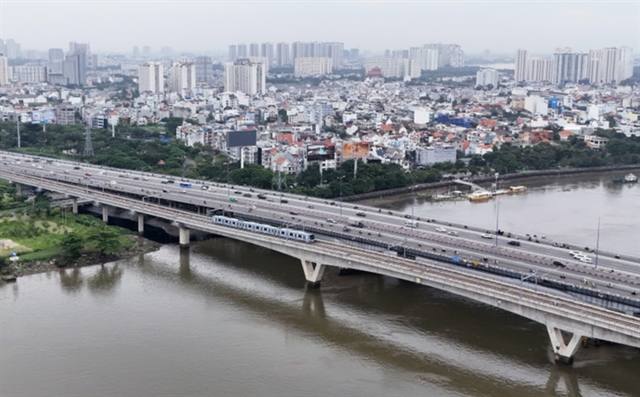
| A view of the metro line No.1 that connects major urban and high-rise developments in HCM City |
Marc Salemink, CEO and senior architect at UNStudio, shared insights from a company project in Frankfurt, Germany, where contemporary architecture was harmoniously integrated into a historic structure.
Technology and design could actively support heritage preservation while creating semi-public spaces that encourage social connections, he said.
Addressing climate challenges, Tony Chan, Southeast Asia planning lead at ARUP, said the extreme weather events seen across central Việt Nam in 2025 proved climate resilience must be deeply embedded in urban master plans.
Cities need to look beyond individual project boundaries and adopt a broader regional mindset, he said.
“The true value of a building should be judged by its operational stability during natural disasters and its ability to provide public utility space for the surrounding community.”
Recent National Assembly resolutions granting specific pilot mechanisms and policies for HCM City have opened up new solutions by encouraging high-performance investment projects, streamlining administrative procedures, and freeing up infrastructure capital, he added.
As HCM City finalises its new general master plan, Việt Nam’s future urban landscape is expected to strike a delicate balance between growth and sustainability, construction density, and quality of living space.
Speaking from a regulatory perspective, Lê Minh Long, deputy director general of the Ministry of Construction’s department of science, technology and environment, said the ministry aims to bridge the gap between policy and implementation.
“Its goal is to gradually turn green, energy-saving, and environmentally friendly standards into core requirements in construction regulations.”
This aligns with Việt Nam’s international commitments to sustainable development, he said.
Urban planning and development management must stay “one step ahead” to ensure complete synchronisation between high-rise expansion and technical and social infrastructure, he said.
Adapting advanced models such as compact and eco-cities must be tailored to Vietnamese conditions to maximise land-use efficiency and improve urban living standards, he added. — VNS
Economy
 Economy
 Economy
 Economy
 Economy
 Economy
 Economy
 Economy
 Economy
 Economy
 Economy
 Economy
 Economy
 Economy
 Economy