 Economy


Market falls due to loss on energy, large-cap stocks
1.
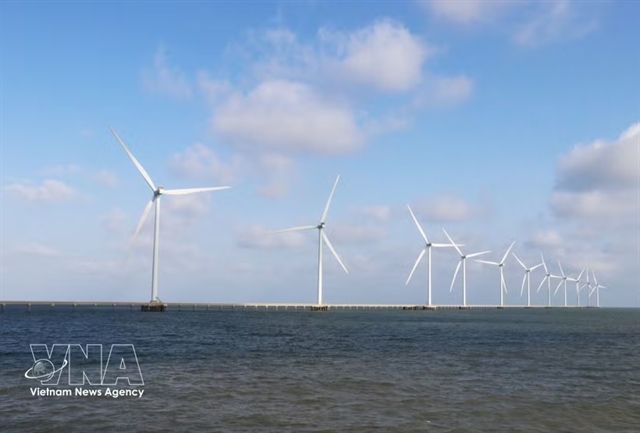 |
| Duyên Hải Wind Power Plant in Trường Long Hòa Ward, Vĩnh Long Province. — VNA/VNS Photo |
HÀ NỘI — As Việt Nam targets double-digit GDP growth in the 2026-30 period, the energy sector is facing a dual challenge of ensuring energy security while fulfilling the country’s commitment to achieving net-zero emissions by 2050.
Politburo Resolution No. 70-NQ/TW dated August 20, 2025 on national energy security through 2030, with a vision to 2045, identifies energy security as a critical foundation for national development and an integral part of national security. The resolution stresses that energy development must be prioritised to support sustained economic growth of more than 10 per cent in the coming years.
Chairman of the Vietnam National Industry-Energy Group (Petrovietnam) Lê Ngọc Sơn said Việt Nam’s energy demand will continue rising sharply, creating enormous pressure on power generation investment. To sustain GDP growth of around 10 per cent, electricity demand is expected to increase by 12-15 per cent annually, requiring an additional 7,000-8,000 MW of new capacity each year.
Dr. Nguyễn Đình Hòa from the Institute of Vietnam and World Economy said total energy consumption would need to increase by at least 8 per cent to sustain double-digit economic growth. However, higher energy consumption would also raise the risk of greenhouse gas emissions.
To ensure energy development stays ahead of economic demand while reducing emissions, Petrovietnam is focusing investment on LNG-to-power complexes. The Nhơn Trạch 3 and 4 projects, Việt Nam’s first imported LNG-fired power plants, have already come into operation, marking an important step in the country’s energy transition.
According to Sơn, LNG power centres should be developed at a scale of 3,000-5,000 MW instead of isolated projects of around 1,500 MW. Such a model could reduce LNG port and storage infrastructure costs by 20-30 per cent and lower plant construction costs by about 10 per cent through standardised designs.
LNG facilities could also utilise cold energy generated during regasification to support data centres and improve investment efficiency.
Petrovietnam is also promoting large-scale eco-industrial and energy hubs by leveraging its integrated energy value chain. The group has proposed an eco-industrial energy centre in Vũng Áng township in the central province of Hà Tĩnh, focusing on three pillars: LNG-based energy, industry, and logistics services.
In Cần Thơ City, Petrovietnam has proposed another eco-industrial energy hub in Ô Môn ward.
Nguyễn Văn Tư, deputy director of the Vietnam Petroleum Institute, described the model as a strategic solution supporting energy security, food security, and the net-zero target while contributing to the development of Cần Thơ and the Mekong Delta.
Alongside these initiatives, Petrovietnam is accelerating research into offshore wind power, an area where Việt Nam’s potential is estimated at 600-1,000 GW, far exceeding the country’s current total installed power capacity of about 85 GW.
Experts also called for stronger policy support for offshore wind surveys and mandatory regulations on energy efficiency.
Dr. Hoàng Xuân Quốc from the Vietnam Petroleum Association proposed treating offshore wind as a national resource, allowing State agencies to conduct preliminary surveys before auctioning project sites to investors.
Meanwhile, Hòa stressed that compulsory energy-saving measures would be essential for Vietnam to honour its climate commitments while sustaining economic expansion. — VNA/BIZHUB
Economy
 Economy
 Economy
 Economy
 Economy
 Economy
 Economy
 Economy
 Economy
 Economy
 Economy
 Economy
 Economy
 Economy
 Economy