 Economy


Sơn La launches $24 million industrial cluster project
1.
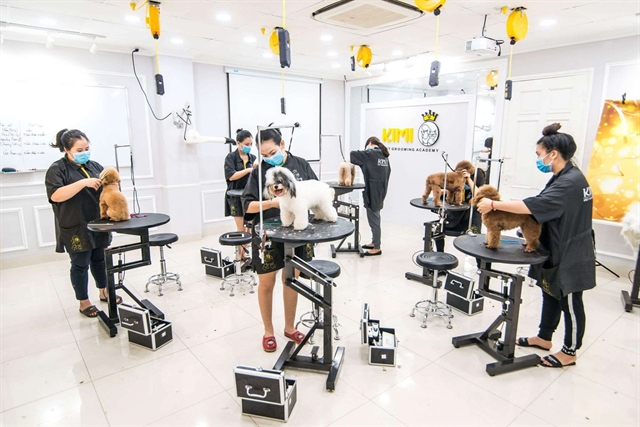 |
| Pets are groomed at a shop in Hà Nội. — Photo toplisthanoi.com |
HÀ NỘI — Việt Nam’s pet industry is expanding at double-digit rates, but domestic companies may be missing out on higher-value segments as demand accelerates across food, health care, grooming and boarding services, analysts said, pointing to a rapidly evolving market driven by social change and income growth.
A rapidly expanding high-value market
Market research estimates that Việt Nam’s pet market is growing at a compound annual rate of 10–11 per cent. Pet food alone is projected by Euromonitor International to rise from about US$156 million in 2025 to nearly $170 million this year.
Việt Nam’s attractiveness is not in its current scale but in the rapid formation of a new consumption market, Nguyễn Bá Vinh, a representative of the organising committee of Petfair Vietnam 2026, said.
The demand is expanding faster than in traditional consumer sectors, driven less by income growth and more by social change, including urbanisation, smaller households and the rising number of young people living alone, Vinh told saigontimes.vn.
Industry surveys suggest about 45 per cent of pet owners now view pets as family members, according to TGM Research Vietnam.
Marketers said this shift is reshaping spending behaviour, with owners increasingly purchasing premium food, nutritional supplements, vaccinations, grooming services, pet hotels and personalised products.
Pet humanisation has become a key demand driver, said Vũ Ngọc Anh Thuyên, marketing director at TGM Research Vietnam.
As a result, the sector is transitioning from product sales to a broader service ecosystem covering health care, hospitality and lifestyle services for pets, Thuyên told saigontimes.vn.
Thu Thủy, who lives in HCM City, said her family spent more than VNĐ30 million ($1,200) on nearly a month of treatment for their cat, underscoring rising willingness to pay for pet healthcare.
Domestic firms lag behind
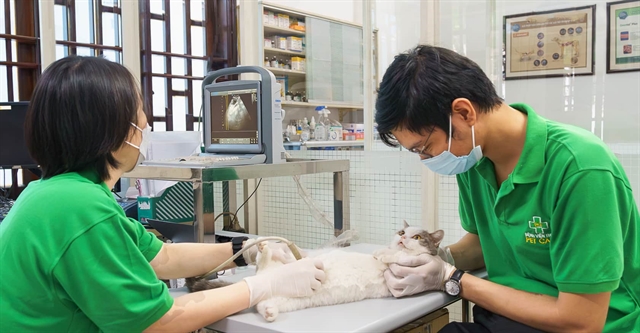 |
| The PETCARE Veterinary Hospital in HCM CIty. — Photo petcare.vn |
To tap into the fast-growing market, many businesses now operate integrated models combining retail and recurring care services such as grooming, hygiene treatment, vaccinations and boarding.
However, domestic firms have failed to capture a proportionate share of higher-value services despite rising demand.
For example, in high-margin segments such as premium pet food, nutritional supplements, specialised veterinary medicines, modern retail chains and advanced veterinary services, foreign companies continue to dominate the market.
Major brands operating in Việt Nam include Mars Petcare, Nestlé Purina, Royal Canin and Hill’s Pet Nutrition alongside suppliers from Thailand, Japan, the US and South Korea.
By contrast, most domestic firms remain concentrated in lower-value activities such as import and distribution, basic processing, sourcing raw materials and small-scale service provision.
Though Việt Nam has a natural advantage in agricultural products and seafood by-products that could serve as inputs for pet food production, the country largely exports low-cost raw materials while importing higher-value finished products for domestic consumption and resale, industry participants said.
According to Võ Hồng Đức, founder of The Pet Vietnam, which produces fresh pâté for dogs and cats, local companies struggle to compete on scale with international players, which benefit from deeper research into pet preferences, care habits and owner purchasing behaviour.
He said market understanding alone is not enough, adding that investment in research and development, quality control, logistics and branding is needed to secure long-term positioning.
Diệp Ngọc Trúc, a representative of the Vietnam Small Animal Veterinary Association, said standardisation pressure extends beyond products to services, requiring continuous training and clearer professional standards.
She added that as consumers become willing to pay more, expectations for safety and transparency are also rising.
Without upgrading capabilities, Vietnamese firms risk expanding sales in a fast-growing market while remaining excluded from the most profitable segments, she told the online newspaper. — VNS
Economy
 Economy
 Economy
 Economy
 Economy
 Economy
 Economy
 Economy
 Economy
 Economy
 Economy
 Economy
 Economy
 Economy
 Economy