 Economy



HCM City tops national Chinese chess championship in Bắc Ninh
1.
|
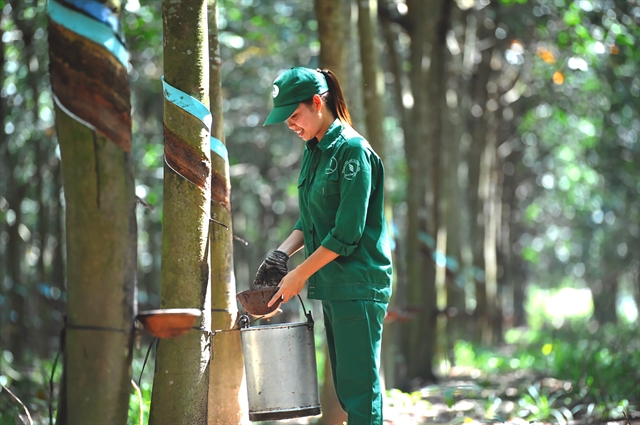
| A worker collects natural rubber latex at a plantation. — Photo vrg.vn |
HÀ NỘI — Rubber stocks are attracting renewed investor attention as the sector benefits from a combination of rising natural rubber prices and growing expectations surrounding industrial park development on large land banks owned by rubber companies.
These dual growth drivers have helped several rubber-related shares outperform the broader market in recent months, with investors increasingly viewing the sector as a long-term beneficiary of both commodity recovery and industrial real estate expansion.
Rising oil prices are emerging as a major support factor for natural rubber prices, as higher production costs for synthetic rubber are driving stronger substitution demand toward natural rubber.
Since early May, natural rubber prices have climbed to their highest levels in nearly nine years, fluctuating around US$2,200-2,300 per tonne. The rally is creating favourable conditions for major rubber-exporting countries in Asia, including Việt Nam.
During the first four months of 2026, the country's natural rubber exports continued to expand while selling prices improved significantly. Higher selling prices and stronger demand have quickly translated into improved business performance for many companies in the sector.
According to Vietcombank Securities (VCBS), global rubber prices recovered rapidly in the first quarter of 2026 and traded at around $2,000 per tonne, close to the peak established in early 2025.
VCBS said the rebound has been supported by higher oil prices and concerns over supply shortages during the low-yield harvesting season.
Business activities among natural rubber companies have also shown strong improvement.
At Tan Bien Rubber JSC (TABIRUCO), first-quarter 2026 revenue rose 135 per cent year-on-year to more than VNĐ523 billion, while its profit after tax surged 209 per cent to over VNĐ228 billion.
Meanwhile, Vietnam Rubber Group, which currently owns approximately 377,797ha of rubber plantations, posted a 56 per cent gain in first-quarter revenue. Profit climbed 89 per cent.
The growth was driven mainly by stronger international rubber demand, particularly from China's automotive and tyre manufacturing industries — the world's largest rubber-consuming market.
Phuoc Hoa Rubber JSC also reported strong first-quarter growth, with revenue increasing 50.3 per cent year-on-year.
The favourable trend in rubber prices and improving earnings expectations have rapidly attracted investor interest in rubber stocks on the Vietnamese stock market.
Recently, shares of several rubber companies, including TABIRUCO (RTB), Phuoc Hoa Rubber (PHR) and HORUCO (HRC), have recorded strong gains. Notably, HRC shares hit the daily ceiling limit for four consecutive sessions from May 7 to 12.
Investors said rubber stocks are entering a more favourable phase, as they are benefiting simultaneously from the commodity price upcycle and expectations of stronger core business performance.
|
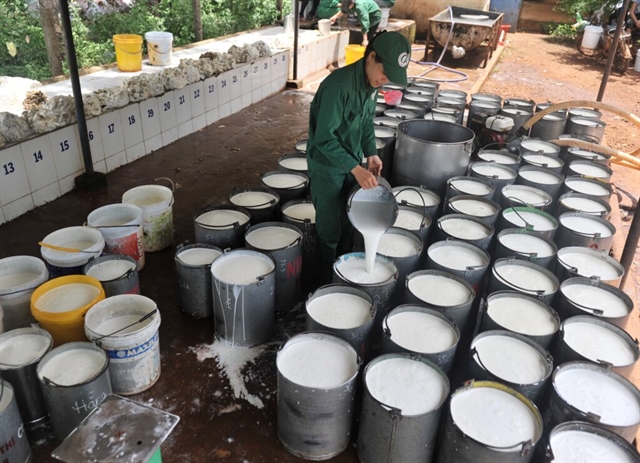
| A worker collecting rubber latex. — Photo vrg.vn |
The land bank story
This represents a notable difference compared with previous years, when many companies in the sector were valued mainly based on their land bank potential.
Phuoc Hoa Rubber continues to draw significant market attention as one of Việt Nam's largest natural rubber producers, with extensive land holdings concentrated in HCM City and the former Bình Dương province.
The company plans to convert more than 3,000ha of rubber land into industrial park projects while expanding into supporting sectors, such as residential development, renewable energy and high-tech agriculture.
Meanwhile, analysts at An Binh Securities (ABS) said Tay Ninh Rubber JSC has positive consumption prospects thanks to the recovery of the automotive and tyre manufacturing industries in major markets, such as China and India.
ABS added that the expansion of the country's electric vehicle ecosystem, particularly the cooperation between Vingroup and Vinachem to develop material supply chains for VinFast, could indirectly boost long-term domestic rubber demand through increased local tyre production.
Favourable soil conditions and lower labour costs in Cambodia have also helped maintain relatively strong profit margins for the company’s operations there.
Besides benefiting from rising natural rubber prices, many listed rubber companies are also attracting investors through what analysts describe as a dual-growth model — combining growth potential in core operations with opportunities for extraordinary profits from industrial land conversion.
According to VCBS forecasts, Phuoc Hoa Rubber could record around VNĐ700 billion in profit from compensation related to rubber land conversion in 2026 alone.
During the 2026–2028 period, the pace of land conversion is expected to accelerate as legal procedures and infrastructure development gradually progress.
The Bắc Tân Uyên Industrial Park project is expected to generate approximately VNĐ2–3 trillion in land compensation income for Phuoc Hoa Rubber during this period.
In addition to compensation revenue, the company is also expected to benefit from industrial park leasing activities through related projects, such as VSIP III and the second-phase expansion of Nam Tân Uyên Industrial Park.
VCBS expects leasing demand at these projects to improve significantly through 2028, as industrial land demand recovers while industrial park supply in Bình Dương remains relatively limited. — BIZHUB/VNS
Economy
 Economy
 Economy
 Economy
 Economy
 Economy
 Economy
.jfif) Economy
Economy
 Economy
 Economy
 Economy
.jfif) Economy
Economy
 Economy
 Economy
 Economy