 Economy


Power transmission to be separated from EVN to develop a competitive electricity market
1.
|
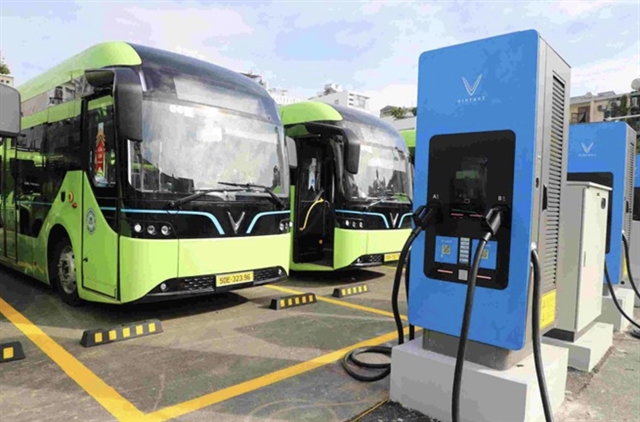
| HCM City accelerates the development of charging stations, serving the goal of 100% electric bus by 2030. — Photo: laodong.vn |
HCM CITY — As Việt Nam pushes towards its net-zero emissions target by 2050, the transition to electric vehicles is accelerating in major cities, but inadequate charging infrastructure remains a major obstacle.
In major cities such as Hà Nội and HCM City, where private vehicle ownership and travel demand continue to rise rapidly, the development of low-emission transport is no longer merely an environmental issue. It is also closely linked to urban planning, energy security and the competitiveness of the domestic automobile industry.
In recent years, the use of electric vehicles in HCM City has increased sharply as residents become more concerned about environmental protection and fluctuating fuel prices. However, charging infrastructure in many apartment buildings remains largely unprepared for the transition.
Many apartment residents have struggled to charge electric vehicles as parking basements often lack suitable sockets or charging stations.
“I want to switch to an electric motorbike because it is economical and environmentally friendly, but there are very few charging stations near where I live. Every time I need to charge, I have to travel more than 5km to a shopping centre,” Đức Ân, a 30-year-old resident in Bình Tân Ward, HCM City, told Việt Nam News.
According to Đào Công Quyết, head of the Communications Subcommittee under the Vietnam Automobile Manufacturers Association, Việt Nam’s automobile market still has significant room for growth thanks to its large population and rising average income levels.
The country’s automobile market reached around 604,000 vehicles in 2025, up 22 per cent compared to 2024. Passenger cars increased by 21 per cent, while commercial vehicles rose by 26 per cent.
The shift towards electrified vehicles is viewed as a strategic opportunity, though it also presents considerable challenges. Electrified vehicles currently include not only battery-electric cars, but also hybrid vehicles, plug-in hybrids and hydrogen fuel-cell vehicles.
Phạm Duy Hoàng, a transport expert from the United Nations Development Programme, said the biggest bottleneck at present remains charging infrastructure.
By the end of 2025, Việt Nam had around 300,000 battery-electric cars in circulation, including private vehicles and electric taxis, alongside approximately 45,000 charging pillars and 70,000 charging ports nationwide.
HCM City alone had around 34,500 electric cars and more than 300,000 electric motorbikes. The city currently operates 1,052 EV charging stations, equivalent to 2,127 charging pillars, in addition to 300 fast-charging stations for electric motorbikes and 1,132 battery-swapping points.
Despite this, the ratio of EVs to charging pillars in HCM City remains around 18 vehicles per charger, lower than the recommended benchmark of one charging pillar for every 10 EVs.
Infrastructure distribution is also uneven. Around 74.76 per cent of charging pillars are concentrated in urban areas, while rural regions continue to face shortages.
Experts said this reflects the reality that while charging stations are increasingly visible at shopping centres, parking lots and major streets, access remains limited in suburban residential areas, industrial parks, outlying districts and along transport corridors.
Without a more synchronised expansion of charging networks, concerns over driving range and charging times are likely to remain major barriers preventing consumers from switching to EVs.
According to an assessment conducted by the UNDP in HCM City, most private EV users charge vehicles between 8am and 8pm, coinciding with peak electricity demand hours.
In addition, around 90 per cent of drivers prefer fast chargers with capacities ranging from 60kW to 180kW.
Experts said the findings show that public charging infrastructure needs not only to expand in scale, but also to become smarter, with fast and ultra-fast charging stations placed in suitable locations, incentives encouraging off-peak charging and integration with smart-grid systems to ease pressure on the electricity network.
Quyết said Việt Nam should establish a nationwide master plan for charging infrastructure, initially focusing on major cities and expressways.
The planning process should include land allocation and electricity supply arrangements for charging stations. The association has also proposed incentives such as reductions in land rental fees, preferential electricity prices and import tax incentives for machinery, equipment and components used in charging infrastructure projects.
Regarding station placement, Hoàng stressed that charging facilities should be located in areas closely linked to actual travel demand, including residential areas, public parking lots, shopping centres, office buildings, major transport routes, expressway rest stops and public spaces.
The Ministry of Construction recently assigned specialised agencies to draft a national project on developing EV charging infrastructure.
The project is being prepared by the ministry’s Department of Science, Technology, Environment and Building Materials in coordination with the Academy of Construction Strategy and Training.
The move aims to implement the Prime Minister’s Directive No. 9/2026 on energy conservation, energy transition and the promotion of electric transport.
Under the plan, the charging network will be developed in a synchronised and practical manner, closely linked to transport, urban and residential infrastructure planning.
The proposal aims to establish a foundation for a nationwide charging network serving electric vehicles and other green-energy transport modes in the coming years. The project is expected to be submitted to the Ministry of Construction within 2026.
In addition to expanding charging infrastructure, the proposal will also specify responsibilities for ministries, agencies and local authorities in developing facilities supporting electric transport. — VNS
Economy
 Economy
 Economy
 Economy
 Economy
 Economy
 Economy
.jfif) Economy
Economy
 Economy
 Economy
 Economy
 Economy
 Economy
 Economy
 Economy