 Society

Việt Nam intensifies efforts to combat illegal fishing
1.
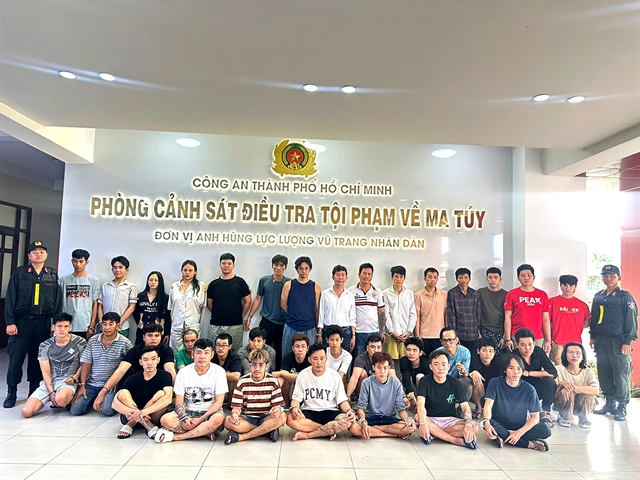 |
| More than 70 people linked to drug-related offences are arrested in a crackdown by HCM City police on Wednesday. — VNA/VNS Photo |
HÀ NỘI — A series of drug-related arrests involving entertainers has reignited concerns over the spread of synthetic narcotics, as health experts warn that increasingly sophisticated drugs are silently causing severe neurological damage while remaining difficult to detect.
Police in HCM City said on Wednesday they had arrested singer Long Nhật, whose real name is Đinh Long Nhật, 59, and actor Sơn Ngọc Minh, 36, along with several others for investigation over alleged drug offences.
Investigators said Nhật admitted using methamphetamine, commonly known as crystal meth, since the Lunar New Year holiday earlier this year. He allegedly used the drug with other people, with the narcotics reportedly supplied by a driver.
The case came just days after another incident involving entertainers drew public attention.
On May 10, police in the Cát Hải special zone of Hải Phòng City detained six people at a beach area on Cát Bà Island after receiving reports from residents about suspected drug use.
Rapid tests showed all six had used narcotics, including methamphetamine, ketamine and MDMA. Among those identified were singer Miu Lê, whose real name is Lê Ánh Nhật, and several others from Hà Nội, Bắc Ninh and HCM City.
The incidents have highlighted growing concern over methamphetamine, regarded by specialists as one of the world’s most dangerous synthetic drugs.
Dr Trần Thị Hồng Thu, former deputy director of Mai Hương Psychiatric Hospital, said methamphetamine is widely known among users by slang terms including 'ice' or 'crystal'.
The drug commonly appears in crystal form resembling coarse salt or flavouring powder, but can also be found as tablets or coloured powders.
Users often experience intense alertness, euphoria and bursts of energy, leading many young people to believe they are more productive or in control, Thu said.
“In reality, the drug forces the brain to release dopamine abnormally, pushing the nervous system beyond its limits,” she told the Voice of Vietnam.
Long-term use can lead to memory loss, chronic insomnia, paranoia, hallucinations and prolonged psychosis even after users stop taking the drug, according to doctors.
Health experts also warn of serious physical effects including malnutrition, tooth decay, dry mouth and premature ageing caused by prolonged blood vessel constriction.
Dr Nguyễn Trung Nguyên, director of the Poison Control Centre at Bạch Mai Hospital, said synthetic drugs are now appearing in increasingly varied forms, ranging from crystals and tablets to liquids, sweets and electronic cigarettes.
“Most users today are no longer taking just one substance, but combining several types at the same time,” he said. “That greatly increases the risk of acute poisoning, neurological injury and severe psychiatric disorders.”
Nguyên said Việt Nam has the technical capacity to identify drugs through advanced laboratory methods, such as gas and liquid chromatography.
Specialised laboratories can also detect evidence of drug use months or even years after consumption through biological samples, he said.
But despite advances in testing technology, authorities face major obstacles in anti-drug efforts because many laboratories lack access to certified drug reference standards required for accurate analysis.
Current regulations make it difficult for licensed laboratories to obtain the necessary chemicals for testing, creating what experts describe as a dangerous contradiction.
“Drugs can enter Việt Nam relatively easily, while testing for treatment and prevention remains restricted,” Nguyên said.
Experts warn that the gap leaves many cases of drug use undetected and hampers efforts to curb the spread of synthetic narcotics among young people and within the entertainment industry. — VNS
Society
 Society
 Society
 Society
 Society
 Society
 Society
 Society
 Society
 Society
 Society
 Society
 Society
 Society
 Society