 Society

Singapore DPM calls for stronger ASEAN through Singapore-China cooperation
1.
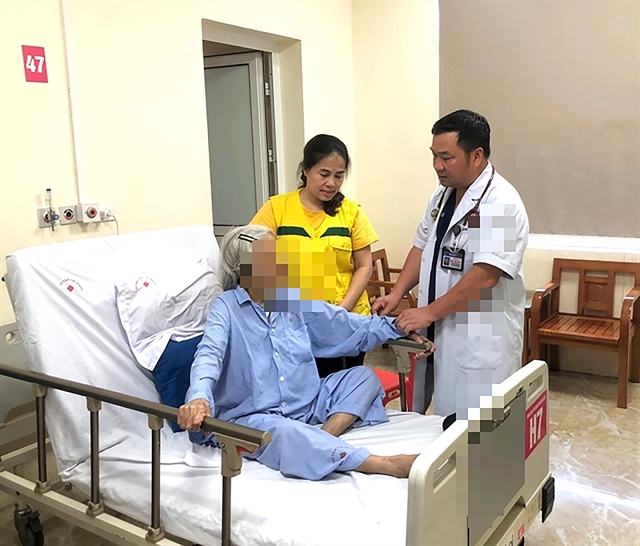 |
| Phan Thảo Nguyên, Deputy Director in charge of professional affairs at E Hospital cum Head of Adult Cardiology Department, examines a 91-year-old patient at the hospital in Hà Nội. — Photo suckhoedoisong.vn |
HÀ NỘI — Transcatheter aortic valve implantation (TAVI) is offering a new lease of life to patients suffering from aortic valve stenosis, particularly the elderly.
At the age of 91, Trần Thị Vượng from Thanh Xuân Ward in Hà Nội had already survived multiple brushes with death caused by cardiovascular disease.
Eight years ago, she underwent emergency intervention for a right-sided myocardial infarction. A year later, doctors treated another heart attack affecting the left side.
During follow-up examinations, physicians discovered that she had aortic valve stenosis, a cardiovascular condition that progresses silently but poses a particularly serious threat to elderly patients.
In the early stages, the disease often causes few noticeable symptoms. Over time, however, the aortic valve opening gradually narrows.
During the past two to three years, she was repeatedly hospitalised due to severe shortness of breath.
Her most recent admission came when the disease had progressed to a critical stage.
She was entirely dependent on oxygen support, suffering from acute pulmonary oedema and heart failure.
Her urine output had fallen to around one litre over 24 hours while kidney function had deteriorated to stage 2B renal failure.
She required simultaneous treatment with diuretics and cardiac support medication. Diagnosed with severe aortic stenosis, the patient urgently needed intervention to survive.
Yet according to doctors, open-heart surgery was considered almost impossible given her age and multiple underlying conditions.
Phan Thảo Nguyên, Deputy Director in charge of professional affairs at E Hospital and Head of the Adult Cardiology Department, told Sức khỏe & Đời sống (Health and Life) newspaper that a major operation involving opening the chest, cutting through the sternum and using cardiopulmonary bypass would pose an enormous challenge for an elderly patient with multiple comorbidities.
Faced with this exceptionally difficult case, doctors first performed balloon dilatation of the aortic valve twice in an effort to relieve the severe narrowing and stabilise haemodynamics.
Once the patient’s heart failure had gradually improved and she no longer depended on oxygen support, the medical team decided to proceed with TAVI.
“After five days of intensive treatment, we decided to carry out transcatheter aortic valve implantation,” Nguyên said.
From the outside, TAVI appears to be a relatively straightforward procedure lasting just over an hour without the need to open the chest.
Behind the scenes, however, lies a highly complex process often compared to precision navigation inside one of the body’s most delicate and high-risk structures.
The greatest challenge in the 91-year-old patient’s case was the extensive calcification affecting both the heart valves and the aorta.
The femoral artery, the standard route used to deliver the replacement valve to the heart, was extremely narrow and heavily calcified, significantly increasing the risk of complications during intervention.
Doctors from anaesthesiology, interventional cardiology and diagnostic imaging held extensive multidisciplinary consultations to calculate every possible scenario.
If access through the femoral artery proved impossible, the backup plan was to use the subclavian artery.
Unlike conventional open-heart surgery, TAVI replaces the diseased aortic valve using a catheter-based technique.
The new biological valve is compressed onto a small catheter system, inserted through a femoral artery measuring just 5–6 mm in diameter and guided to the narrowed aortic valve.
Once positioned correctly, the new valve is expanded to replace the damaged one without stopping the heart or using an external circulation system.
Yet, the complexity of the procedure extends far beyond simply delivering the valve into the heart.
Before intervention, surgeons must use advanced computed tomography imaging systems to analyse the heart’s structure in extraordinary detail, including valve ring dimensions, areas of calcification, the height of coronary artery openings and vascular diameters, all measure with accuracy down to 0.1 mm.
According to Nguyên, the replacement valve must fit the patient’s cardiac structure with near-perfect precision. Even the slightest deviation could lead to severe complications.
The procedure lasted around 90 minutes. Just four hours later, the patient was extubated.
In the days that followed, she recovered far more quickly than expected.
The 91-year-old woman can now feed herself, sit upright and walk again.
Nguyễn Thị Quế, the patient’s daughter-in-law, said the family barely dared to hope when bringing her to the hospital in such a critical condition.
At home, her mother-in-law struggled to breathe, suffered chest tightness and depended constantly on oxygen support. She could hardly eat anything. Just one day after the intervention, when her mother-in-law was transferred to the treatment ward, she was already much more alert.
“We never imagined her recovery would progress so quickly,” Quế said.
New hope for valve-replacement patients
Another notable case involved 74-year-old Nguyễn Đức Thủy, a man from the north-eastern province of Quảng Ninh, who had undergone biological valve replacement 11 years earlier.
According to Nguyên, biological heart valves generally last between 10 and 15 years before degenerating.
This time, Thủy was admitted to hospital with chest pain, shortness of breath, fatigue and difficulty walking steadily.
Examinations revealed a 60–70 per cent narrowing in the left anterior descending coronary artery while the previously implanted biological valve had significantly deteriorated.
What made the case particularly remarkable was the use of the valve-in-valve technique, implanting a new valve directly inside the old, degenerated biological valve without the need for repeat open-heart surgery.
Nguyên said surgeons faced enormous challenges in ensuring the new valve would function stably within the existing structure.
The patient’s family said his health was already extremely fragile due to advanced age and previous surgery, compounded by diabetes, hypertension, lung disease, kidney disease and varicose veins.
“Our entire family was deeply worried and uncertain whether he would survive. But after doctors explained the intervention method, we placed our full trust in them,” a relative said, adding that just 24 hours after the procedure, the patient had stabilised, was eating normally again and no longer suffered dizziness or chest pain.
A pinnacle of interventional cardiology
According to cardiovascular experts, aortic valve stenosis is a common condition among elderly people.
Statistics show an incidence rate of approximately five to six cases per 1,000 people, meaning that among every one million people, around 5,000 to 6,000 may develop the disease.
Alarmingly, the condition often progresses silently over many years.
International scientific guidelines indicate that aortic stenosis typically advances over five-year stages.
After initial diagnosis at a mild stage, the disease may progress to moderate stenosis within five years before reaching severe stenosis another five years later.
Once severe stenosis is accompanied by symptoms such as breathlessness, chest pain, fainting or dizziness, the risk of death rises dramatically, often within just two to three years.
Previously, open-heart surgery for aortic valve replacement was the only treatment option.
However, for elderly patients with multiple underlying illnesses, surgical risks remain extremely high.
TAVI has therefore emerged as the optimal solution.
The major advantages of TAVI include its minimally invasive nature, the absence of sternotomy and no requirement for cardiopulmonary bypass, allowing patients to recover much more rapidly.
Many patients regain consciousness within hours and are able to walk again within 24 hours of intervention.
Nguyên said that around eight medical facilities in Việt Nam currently perform TAVI routinely.
Successful interventions in patients over 90 years old, however, remain exceptionally rare.
The 91-year-old woman mentioned above is among only a handful of patients over 90 in Việt Nam.
Previously, E Hospital also successfully performed TAVI on a 92-year-old patient.
He also warned that symptoms such as sudden fainting, dizziness, chest pain, shortness of breath during exertion or unusual fatigue should never be ignored as they may indicate aortic valve stenosis or other serious cardiovascular diseases. — VNS
Society
 Society
 Society
 Society
 Society
 Society
 Society
 Society
 Society
 Society
 Society
 Society
 Society
 Society
 Society