 Economy


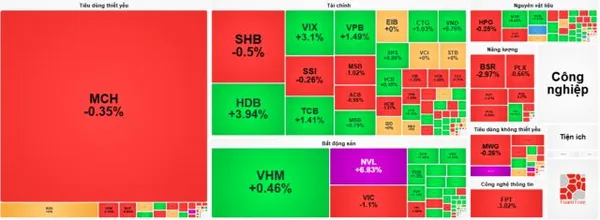
VN-Index ends lower despite liquidity hit over $1 billion
1.
|
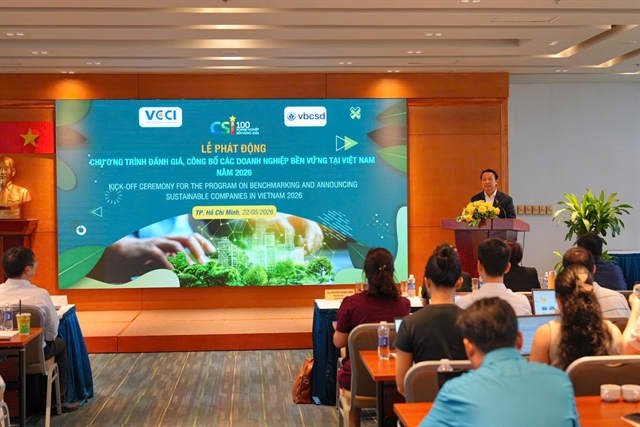
| Nguyễn Quang Vinh, Vice Chairman of VCCI and Chairman of VBCSD, speaks at the launching ceremony in HCM City. — Photo courtesy of VBCSD |
HÀ NỘI — The Vietnam Business Council for Sustainable Development (VBCSD) under the Vietnam Chamber of Commerce and Industry officially launched the 2026 Corporate Sustainability Index (CSI 2026) programme on Friday, aiming to strengthen business competitiveness and promote sustainable development in Việt Nam.
The programme continues to receive support from the Party Central Committee's Policy and Strategy Commission, the Ministry of Agriculture and Environment, the Ministry of Home Affairs, the Ministry of Finance and the Vietnam General Confederation of Labour, all of which are members of the CSI steering committee.
At the centre of the programme is the Corporate Sustainability Index (CSI), a tool used to assess and rank participating businesses based on their sustainability performance. This year, the programme will recognise 100 sustainable enterprises, including the Top 10 companies in manufacturing and the Top 10 in trade and services.
Nguyễn Quang Vinh, Vice Chairman of VCCI and Chairman of VBCSD, said the programme’s 11-year journey demonstrates VCCI’s long-term commitment to promoting sustainable growth models in Việt Nam.
According to Vinh, the CSI 2026 framework continues to follow the principles of simplicity, practicality and accessibility, while remaining adaptable to Việt Nam’s business environment.
“The CSI has become a Vietnamese-made sustainable corporate governance index that aligns with international practices while remaining suitable for domestic conditions,” he said.
The programme secretariat noted that CSI 2026 encourages businesses to move beyond a compliance mindset and focus on creating long-term value. Rather than viewing sustainability as a cost burden, companies are encouraged to see it as investment in resilience and competitiveness.
The 2026 framework has also been updated to better reflect legal changes and global sustainability trends, including standards developed by the International Sustainability Standards Board (ISSB), the Task Force on Climate-related Financial Disclosures (TCFD) and the United Nations Guiding Principles on Business and Human Rights (UNGPs).
A notable addition this year is a section on implementing sustainability commitments for medium- and large-sized enterprises, requiring businesses to demonstrate concrete actions and measurable outcomes instead of simply setting targets.
One of the programme’s highlights is its inclusive approach, with separate frameworks designed for businesses of different sizes.
The version for medium- and large-sized enterprises includes 166 indicators divided into eight sections, including 97 compliance indicators and 69 advanced indicators focused on sustainability initiatives.
Meanwhile, the version for micro-, small- and medium-sized enterprises (MSMEs) has been streamlined to 105 indicators, with compliance-related indicators accounting for 82 per cent of the framework. The approach aims to reduce administrative burdens and encourage smaller firms to begin their sustainability journey through practical steps.
To ensure transparency and fairness, the evaluation process will include multiple rounds of assessment, verification by relevant authorities and final approval by the steering committee.
Phạm Thiện, Deputy General-Director of DKSH Vietnam, said sustainable development has become a strategic factor in ensuring long-term business continuity.
“The CSI is an effective governance tool that helps us turn commitments on the environment, supply chains and people into transparent and measurable actions,” he said.
Over the past 10 editions, more than 4,500 businesses have directly participated in the programme, while over 10,000 enterprises have used the CSI as a self-assessment tool.
Online applications for CSI 2026 will be accepted free of charge until August 8 via the VBCSD official website. — VNS
Economy
 Economy
 Economy
 Economy
 Economy
 Economy
 Economy
 Economy
 Economy
 Economy
 Economy
 Economy
 Economy
 Economy
 Economy