 Economy



Vietnamese Prime Minister meets Cambodian National Assembly President
1.
|
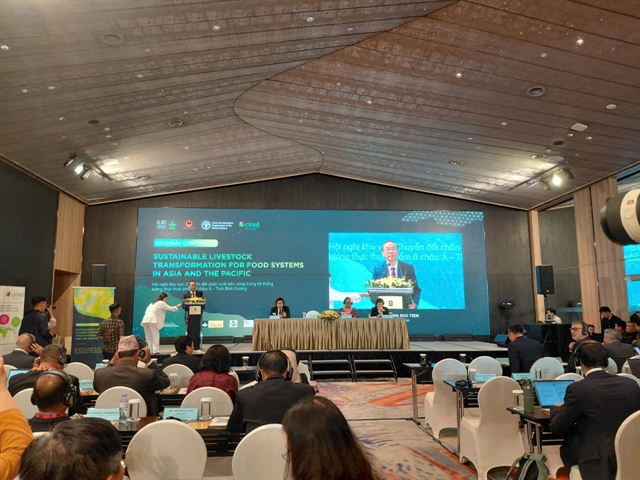
| Delegates attended the regional conference on Sustainable Livestock Transformation in Food Systems in Asia and the Pacific, being held in the capital city from March 24-26.— Photo courtesy of the event's organisers |
HÀ NỘI — Efforts to green the livestock sector are becoming essential for countries seeking to stay competitive and integrate into global supply chains, delegates heard at a regional conference in Việt Nam on Tuesday.
The message was highlighted at the Sustainable Livestock Transformation in Food Systems in Asia and the Pacific conference, held in the capital from March 24-26, which brought together more than 150 participants including policymakers, scientists, business representatives and international organisations.
Delegates discussed ways to promote sustainable livestock development as demand rises for safe and nutritious animal-based foods, while the sector faces mounting challenges from climate change, disease outbreaks, environmental degradation and rising consumer expectations.
The meeting comes at a pivotal time for the region, home to nearly 60 per cent of the world’s population and about 44 per cent of global livestock. Growing populations, urbanisation and rising incomes are driving increased demand for meat, milk and other animal products. At the same time, livestock systems contribute to greenhouse gas emissions and remain vulnerable to climate-related impacts, zoonotic diseases and cross-border animal health threats.
Across Asia, the livestock sector supports the livelihoods of hundreds of millions of smallholder farmers and contributes between 18 per cent and 30 per cent of agricultural GDP in many countries. However, it also accounts for a significant share of global livestock-related emissions and faces persistent risks from transboundary animal diseases.
Opening the conference, Deputy Minister of Agriculture and Environment Phùng Đức Tiến said the global food system faced a historic turning point as it must provide food and nutrition for nearly 10 billion people by 2050.
“Livestock farming is not only a vital source of protein but also the livelihood of hundreds of millions of farmers,” he said. “However, this industry is both a perpetrator and a victim of climate change. Without shifting our production models towards transparency and sustainability, we will exclude ourselves from the global supply chain.”
A three-pillar strategy

|
| Việt Nam’s livestock sector accounts for about 27 per cent of agricultural output. —VNA/VNS Photo |
Tiến said Việt Nam was promoting a three-pillar strategy to transform its livestock sector, centred on technology, biosecurity and climate-focused practices.
“Science, innovation and digital transformation must be the main drivers,” he said, pointing to the use of high-yield breeds, biotechnology and data-based farm management to improve productivity and competitiveness.
He added that livestock development must be linked to stronger biosecurity and the One Health approach, including modern veterinary systems, disease surveillance, antibiotic controls and food safety measures to protect both human and animal health.
A third pillar focuses on integrating livestock into climate solutions through greener production models, circular economy practices and improved waste management, such as converting waste into bioenergy and organic fertilisers.
According to Tiến, Việt Nam’s livestock sector accounts for about 27 per cent of agricultural output, with more than 31 million pigs and over 585 million poultry, producing around 8.7 million tonnes of meat annually, helping meet domestic demand and support the tourism sector.
The country has shifted in recent years from small-scale farming to larger, more technology-driven production linked to value chains, though it continues to face challenges including high input costs, reliance on imported feed, disease risks and environmental pressures.
Advances in breeding, feed technology and vaccine development had helped improve productivity and disease control, Tiến said, highlighting the development of a vaccine against African swine fever as a significant milestone.
In his speech, Alue Dohong, Assistant Director-General and FAO Regional Representative for Asia and the Pacific, emphasised the need to transform livestock systems to contribute to healthier and more sustainable food systems.
“Livestock systems play a key role in ensuring access to nutritious and affordable diets in Asia and the Pacific. Transforming the sector is essential to strengthening food security while safeguarding the environment and public health,” he said.
The solutions already exist, according to researchers. Climate-smart livestock practices, One Health, better feed management and stronger food safety standards can significantly reduce environmental impacts while improving productivity.
However, scaling these solutions remains a major challenge, often due to fragmented policies, limited coordination between countries and gaps between scientific research, investment and implementation.
Francois Roger, Regional Director for Continental Southeast Asia at CIRAD, stressed the value of scientific cooperation to solve complex challenges.
“For millions of farmers in the region, livestock is a cornerstone of livelihoods. Research partnerships help develop solutions suited to diverse farming systems while ensuring that the transformation of the livestock sector contributes to inclusive and sustainable development,” he said. — VNS
Economy
 Economy
 Economy
 Economy
 Economy
 Economy
 Economy
 Economy
 Economy
 Economy
 Economy
 Economy
 Economy
 Economy
 Economy