 Economy



Bramah takes three awards as Hanoi Buffaloes dominate VBA Awards
1.
 |
| Vũ Thị Chân Phương, chairwoman of the State Securities Commission (SSC), delivers a speech at the conference on implementing tasks for stock market development in 2026 on March 20. — Photo courtesy of SSC |
HÀ NỘI — Việt Nam's stock market is entering a new phase of development following its upgrade to emerging-market status, with regulators emphasising the need for deeper reforms to ensure sustainable growth.
Vũ Thị Chân Phương, chairwoman of the State Securities Commission (SSC), has outlined two central solutions aimed at strengthening the market's long-term foundation.
Speaking on the future direction of the market, she stressed that the stock market has maintained stability and continued to affirm its role as a key channel for medium- and long-term capital for the economy, despite global uncertainties and domestic challenges.
Framing 2026 as the start of a new phase for capital markets, Phương said the SSC’s agenda responds to the country's ambitious macroeconomic objective of average GDP growth above 10 per cent per year for the coming period.
With that target, she argued, improving the market's capacity to channel medium- and long-term capital efficiently is a key imperative.
The SSC's programme centres on two complementary pillars: strengthening supply, both the quantity and quality of investable securities, and enhancing demand by cultivating a more stable, diversified investor base.
On the supply side, the regulator intends to upgrade market infrastructure across equities, bonds and derivatives.
For the equity market, the SSC is pushing to streamline the initial public offering process and its link to listing procedures, with a target to cut the time to list to under 30 days.
Measures to increase high-quality listings include facilitating public offerings and listings by foreign-invested enterprises (FDI), accelerating state-owned enterprise (SOE) equitisation and divestment where state ownership remains high, and establishing dedicated trading boards with tailored standards to support startups and innovative small- and medium-sized enterprises.
Corporate governance and disclosure reform are central to this push. The SSC will press for higher governance standards in line with international practice and wider adoption of bilingual disclosure to ease foreign investor access to timely, comparable information - an initiative already partially implemented among roughly 100 VN100 constituents.
In the bond market, the SSC is prioritising trust-building and legal certainty. Plans include completing a more robust regulatory framework, diversifying offerings, notably green and sustainability-linked bonds, and strengthening national credit-rating mechanics, valuation services and collateral management standards.
These steps aim to broaden investor choice and deepen liquidity in fixed income as a stable source of medium- and long-term financing.
Derivatives development will also accelerate. The SSC intends to roll out new products, such as index and government bond futures, study index options and expand the range of financial instruments to include covered warrants, fund certificates and green finance instruments.
Such expansion is designed both to provide investors with risk-management tools and to improve market completeness.
On the demand side, the SSC's strategy focuses on building a more institutionalised professional investor community while raising the quality of retail participation. Institutional investors are seen as the linchpin for market stability.
To attract and grow institutional demand, the SSC will diversify fund structures, enhance index systems, and incentivise the participation of pension funds and insurance companies.
For foreign investors, regulators plan administrative reforms to simplify account opening and trading, refine trading mechanisms and incrementally widen foreign ownership limits in non-sensitive sectors.
The SSC also committed to operational upgrades to support foreign participation, including the launch of a central counterparty (CCP) model aligned with international practice, targeted for early 2027, which should reduce counterparty risk and strengthen settlement resilience.
Modernising market infrastructure is already underway: a first-phase IT upgrade has been completed to enhance connectivity between foreign investors and securities firms, and work continues to automate linkages to reduce the risks in manual trading processes.
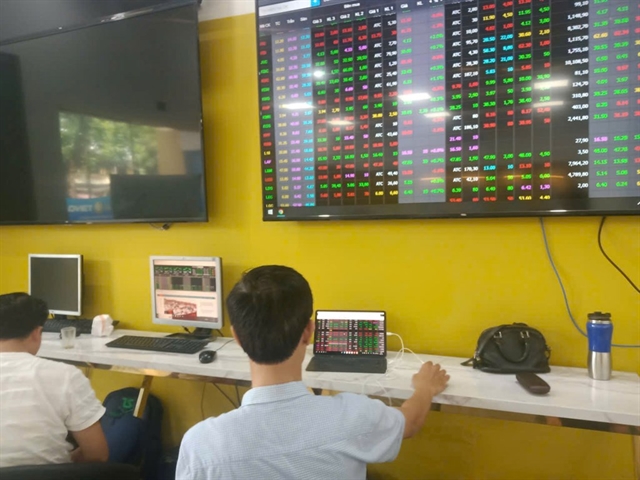 |
| Investors observe the market's movements at a trading office of a securities firm in Hà Nội. — VNA/VNS Photo |
Recognising that currency and interest-rate exposures remain a deterrent for foreign capital, the SSC flagged plans to develop hedging instruments for FX and foreign-currency interest-rate risks. Currently, such tools are mostly available to FDI investors.
Expanding access would make Việt Nam's markets more attractive to a broader set of global investors. The regulator also pledged to maintain ongoing dialogues with investors and international financial institutions to identify and resolve barriers to market entry.
For the retail investor segment, which still dominates Vietnamese market participation, the SSC emphasised elevating investor quality through education, enhanced public communication, higher standards and greater accountability for advisory services, and reinforced ethical norms across the broker-dealer community.
Improving the professionalism of market intermediaries and raising the bar for investor protection are seen as essential to sustaining trust as the market grows.
Complementing the supply-and-demand measures, the market watchdog announced stepped-up oversight and enforcement.
The commission is developing a comprehensive surveillance system that will incorporate artificial intelligence to detect anomalies and enhance monitoring efficiency.
This surveillance upgrade forms part of broader efforts to modernise IT infrastructure, accelerate digital transformation and upgrade trading systems, all intended to underpin a fair, transparent and resilient market.
Chairwoman Phương said that regulatory policy alone cannot guarantee sustainable market development. She added that the SSC expects market participants, including securities firms, asset managers, and other intermediaries, to engage proactively and responsibly to increase professionalism and support companies' access to capital.
With government leadership, a clear roadmap and active market participants, the SSC believes Việt Nam’s stock market can better fulfil its role as a primary channel for the country's medium- and long-term financing needs.
The SSC's twin-track approach, boosting quality supply and institutionalising robust demand, sets a concrete agenda as Việt Nam seeks to align capital-market development with its broader economic objectives through 2030. — BIZHUB/VNS
Economy
 Economy
 Economy
 Economy
 Economy
 Economy
 Economy
 Economy
 Economy
 Economy
 Economy
 Economy
 Economy
 Economy
 Economy